

When Narendra Modi became Prime Minister of India in 2014, he arrived with tremendous ambitions of reform. His promises included creating a unified national tax on goods and services (achieved!), deregulating agricultural markets (failed!), and building a lot of infrastructure (in progress!). For a full report card, see here.
But none said more about the state of India’s economy in 2014 than his promise that every household would have a toilet within four years. (He declared success after five.) Everyone knows India is the world’s most populous country; fewer realize it has roughly the same GDP per capita as Haiti, a failed state whose capital has been taken over by gangs.
THE SITUATION
India is a democracy of 1+ billion people, 22 recognized languages, and six major religions. Pushing through reforms like Modi’s is extraordinarily hard. And while farmers (led by Punjabi Sikhs) stymied his agricultural reforms, and while Modi now faces the kind of “Gen-Z” protests that inflation has sparked around the world, it is worth stepping back to appreciate what India has achieved under him.
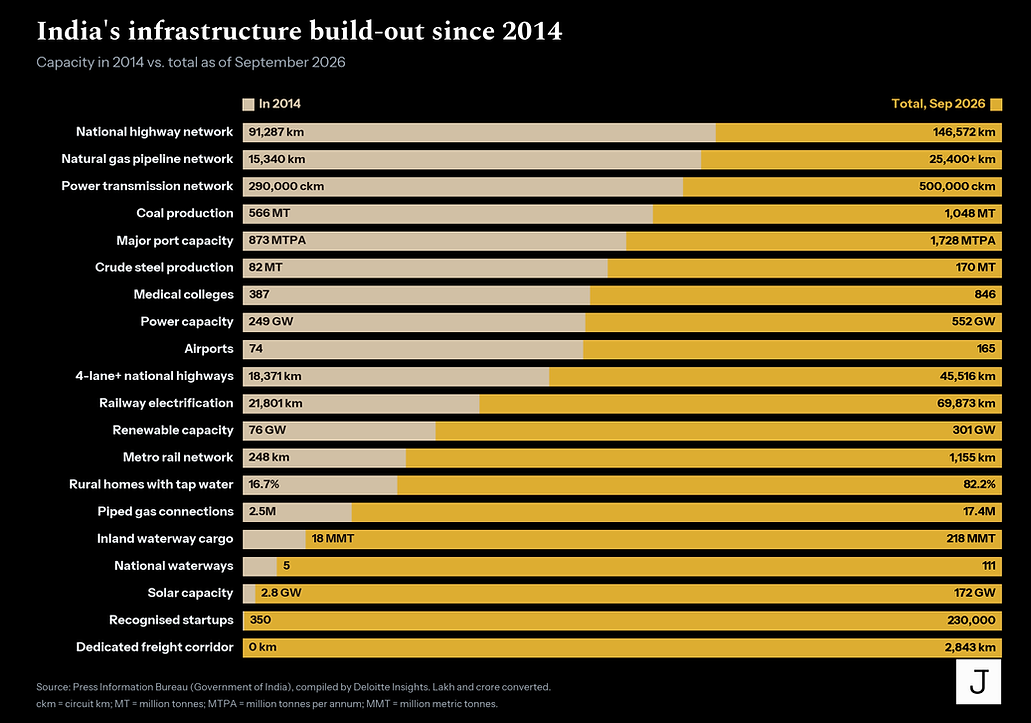
A few notable statistics: Since 2014, public capital expenditure has increased ~6X; national highway length is up over 60%; the number of airports has more than doubled; and major ports’ cargo-handling capacity has almost doubled while vessel turnaround time has halved.
Waiting on Private Capital
A key goal of standardizing governance and increasing public capex was to attract foreign and private investment. That investment has yet to materialize. According to a Deloitte study, “The share of private investments fell after fiscal 2018 to 2019 and is currently hovering around 10%.” The same study suggests the tide may soon turn. Growth in private consumption, stretched capacity utilization, better access to credit, and all-time highs in capital-goods production and imports might all augur a new private investment boom—“might” being the operative word. For now, private capital is taking a “wait-and-see” approach to India.
That makes sense. India has potential, but the macro context hasn’t favored it. Had globalization continued—had China climbed global value chains and the low end of its export complex sought cheaper labor elsewhere—India would have been well-placed to be the next Asian growth miracle. But globalization was receding even before the pandemic, and India itself was reluctant to commit to free trade agreements in the 2010s, never coming to terms with Europe and withdrawing from the massive Regional Comprehensive Economic Partnership.
Then came the pandemic, and Modi responded with “self-reliant India” (Atmanirbhar Bharat Abhiyan), in effect doubling down on protectionism. Next came the Russia-Ukraine war and the US-Iran war, both of which made it costlier for India—which imports almost half its energy and almost 90% of its oil—to keep the lights on.
And as if that weren’t enough, a super El Niño has given India a very weak monsoon, with its foreign minister recently warning that “there is going to be a major food crisis” in the coming months.
The Bromance Sours
On top of all this, the Trump administration, which in its first term was as gung-ho about the Modi-Trump bromance as any of Trump’s foreign relationships, turned its back on India in the second, forging deeper ties with Pakistan and even talking up the pressure it put on both countries to end their brief 2025 war. Those comments landed badly in Delhi, as did the fact that the US imposed some of its highest tariffs on any major partner, plus extra duties tied to India’s purchases of Russian oil. India has clung to non-alignment since independence, and after decades of US courtship it seemed to be softening (however slightly) only for that trust to be broken over the last ~18 months.
And yet India appears to be overhauling its trade policy. After more than a decade of on-and-off talks, India and the EU agreed to a free trade deal earlier this year. It still needs European Parliament approval, but both sides seem optimistic it will take effect by mid-2027. US and Indian officials are also suggesting their own deal is close, if not imminent, and Washington has already lowered tariffs on India and dropped the Russia-related duties as a show of goodwill.
India and Canada, whose relations blew up under Trudeau over the killing of a pro-Khalistan activist, are also negotiating a Comprehensive Economic Partnership Agreement, aiming for a deal by year-end. Recent free trade deals with New Zealand and the UK are in force. Meanwhile, China this year overtook the US as India’s largest trading partner, and Xi Jinping’s visit to Delhi for the September BRICS summit seemed to go well. That’s real non-alignment without the protectionist roadblocks.
No other country, and certainly no other democracy, offers India’s demographic advantages, especially if India opens its markets to trading partners. The headwinds are real, and Indian markets have been ugly in recent weeks: The Nifty 50 is down ~14% this year, on pace for its sharpest decline in 18 years. But markets don’t tell the whole story about an economy’s long-term trajectory. India’s real GDP grew 7.8% in the April–June quarter, and both government and IMF projections suggest strong growth will continue.
India’s politics will always be messy, and plenty of infrastructure and policy reform remains to be done, but don’t be surprised if India emerges stronger from its current predicament.
MAP/CHART OF THE WEEK
BLIND SPOT
On October 29, The New York Times reported that US intelligence sources believed Nvidia (NVDA) CEO Jensen Huang was the target of a Chinese spy plot. A Chinese citizen named Alice Huang (no relation), who worked for a Singapore-based data center company called Megaspeed, had developed a “close relationship” with him. She was suspected of feeding information to Chinese intelligence and of helping China evade limits on its access to Nvidia’s advanced AI chips.
An Nvidia spokesperson played down the report, saying, “Jensen’s interactions with Ms. Huang are not unusual or unexpected. Meetings with customers are part of a CEO’s job.” On November 6, The New York Times reported that a “memo” had circulated among top Trump officials claiming that Alice Huang was a spy for China’s Ministry of State Security. The Financial Times went further that same day, reporting that Jensen Huang had an extramarital affair with her. So much for nothing “unusual or unexpected.”
A Bar in Taipei
Megaspeed is a Singapore company spun off from a Chinese gaming firm called 7Road in March 2023, just five months after then-President Joe Biden imposed sweeping export controls on high-performance computing chips (like Nvidia’s) bound for China. It rents out computing power built on Nvidia chips to enterprise clients, and it began buying billions of dollars’ worth of Nvidia chips weeks after Jensen Huang was photographed next to Alice Huang at a bar in Taipei in June 2024.
In September 2024, Commerce Department officials visited a Megaspeed data center in Malaysia and found copious Nvidia gear still in boxes, raising concerns that the chips were ultimately bound for a different destination (i.e., China). The investigation deepened and US intelligence zeroed in on Alice Huang—all while Jensen Huang successfully lobbied President Trump to waive restrictions and licensing requirements on US chip exports to Southeast Asia. This year, Commerce referred the case to the Justice Department.
Who Benefits?
We aren’t interested in the sordid details of yet another powerful man’s affair. What matters is who is leaking this information? If China really had leverage over Jensen Huang via a honeypot operation, it would have been worth more as blackmail than as an embarrassment. Jensen Huang has made plenty of enemies, most notably Dario Amodei at Anthropic, who has advocated strict US export controls on chips like Nvidia’s. (Huang argues such controls only push China to build its own, and that the US is better served by dominating global markets.) But it is unlikely anyone at Anthropic had this level of detail on Megaspeed or Alice Huang.
Could it be a leak from the Trump administration itself? President Trump has been superficially tough on China, but he has been clear that those are tactics to get a deal. Consider his talk of a “G2” world, his enthusiastic recent hosting of Xi Jinping in Washington, or his willingness to allow exports of US tech. But most of the national security officials around him are China hawks. They don’t want a deal and want to use Trump’s affection for harsh tactics to create facts on the ground. One of Trump’s gripes against former Chief of Staff Susie Wiles was her inability to stop White House leaks, which makes the timing even more curious.
The upshot: The most powerful and vocal advocate of looser export controls on US tech to China has just seen his reputation destroyed by an affair with an alleged Chinese spy. Whoever leaked the information wanted Jensen Huang’s reputation destroyed, and therefore likely also wants tougher US restrictions on tech exports to China. That could be security hawks within the administration; other US AI companies at risk of losing to Chinese rivals; even China itself, which might want an external push to double down on domestic capabilities rather than depend on Nvidia.
Watch where US policy goes from here—and how much the leak shapes it.


Comments
Log in or sign up to join the conversation.