

Having spent last two months largely in the range of 1.29 to 1.34, the calls for a major bout recovery in ,versus other currencies, Cable are slowly gaining traction .
Moreover, the UK economic data for the month of July (except PMIs) showed no signs of post-Brexit gloom and doom. As far as the PMIs are concerned, the July weakness proved to be short lived as both manufacturing and services PMI for August posted the biggest rebound on record.
Consequently, a significant minority believes the currency could revisit 1.39-1.40 over the medium-term. Of course, those forecasts do not include the possibility of a Fed rate hike. Nevertheless, it is worth noting that markets are slowly turning at least mildly bullish on Pound. There are experts (minority) who also believe the Bank of England (BOE) may have to reverse the policy moves it initiated after Brexit vote.
Those arguments appear logical in a sense that ‘world has not really come to an end’ after Brexit. Furthermore, the UK trade numbers for July released on Friday which showed narrowing of trade deficit adds credence to the view the Pound may have bottomed out, especially against currencies except for US dollar.
‘J curve’ theory
As per ‘J curve’ theory, country’s trade deficit initially widens following a major bout of currency devaluation before narrowing in the subsequent months/period.
Why so?
It is largely an ‘expectations play’. Following a sharp slide in currency, foreign buyers in the hope that currency could slide even further, delay their purchases. On the other hand, domestic importers, fearing further slide in the currency, prepone purchases. The net effect is a stronger rise in imports leading to widening of the trade deficit.
Once the dust settles and the currency turns range bound (and expectation of further slide in currency evaporate), foreign buyers resume imports, thus leading to higher exports for home country.
If the home country exports (foreign demand) do not spike despite range bound exchange rate following a bout of devaluation, it is a signal that the home country currency is seen sliding/likely to fall further!. This is because exporters/importers almost always have a clearer picture of the economy/macros than the analysts; hence their decision to delay imports (foreign buyers) is a potent signal that the home country currency has not really bottomed out.
UK trade deficit narrowed
The Office for National Statistics released on Friday showed UK’s deficit in goods trade narrowed to £11.8 billion ($15.7 billion) in July from a revised £12.9 billion in June.
The UK’s imports shrank by £0.3 billion to £36.6 billion, while exports grew by 0.8 billion to £24.8 billion, the data showed. Including services, the nation’s overall deficit with the rest of the world narrowed to £4.5 billion in July from £5.6 billion in June.
In the case of UK, slide in Pound immediately resulted in narrowing of trade deficit due to a boost in export, which could be an indication that foreign importers do not see British Pound remaining weak or extending the post-Brexit slide. Furthermore, British importers are not worried about a further slide in Pound as well; else they would have responded by boosting purchases.
GBP/USD – Sharp slide on Brexit
Daily chart
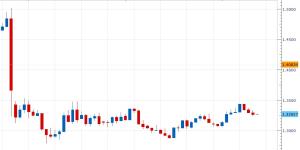
Brexit day high stands at 1.5019, while the post-Brexit low stands at 1.2789. A week ahead of the referendum, the pair was trading around 1.43. A drop from 1.43 to 1.2789 amounts to 10.60% drop in Sterling.
The pair hit a low of 1.2789 on July 6 and since then has been largely stuck in the range of 1.29-1.34.
As per J-curve theory, the sharp devaluation should have resulted in the widening of the UK trade deficit.
The narrowing of the trade deficit could be a sign the British Pound is either likely to stay range bound or recover, especially against currencies other than US dollar.
Conclusion
-
Immediate narrowing of trade deficit (due to rising in exports & drops in imports) following a bout of devaluation in Pound (contradicting J-curve theory) suggests Brexit sell-off in Pound is over.
-
The currency could recover further against majors except for US dollar.
-
Spike in Fed rate hike bets could drive the GBP/USD pair to fresh post-Brexit low; however, British Pound could outperform other majors during broad based USD rally.

Comments
Log in or sign up to join the conversation.