

“Cleveland Federal Reserve President Loretta Mester on Monday said that the recent flattening of the yield curve isn’t a sign that the US economy is weakening. Her comment follows a similar observation by Fed Chairman Jerome Powell, who suggested last week that low inflation in recent years has reduced the value of monitoring recession risk based on differences between long and short Treasury yields.” (James Picerno, The Capital Spectator, March 27, 2018)
“The Treasury yield curve inverted before the recessions of 2000, 1991, and 1981. The yield curve also predicted the 2008 financial crisis two years earlier. The first inversion occurred on December 22, 2005. The Fed, worried about an asset bubble in the housing market, had been raising the fed funds rate since June 2004. By December, it was 4.25 percent.” (Kimberly Amadeo, How An Inverted Yield Curve Predicts a Recession, February 28, 2018.)
Investors typically expect a higher return on long-term financial instruments than on shorter-term investments. As a result, under normal circumstances, the U.S. Treasury yield curve slopes upward.
A flat yield curve occurs when there is little difference between short-term and long-term rates for bonds of the same credit quality. This type of yield curve is often seen during transitions between normal and inverted curves.
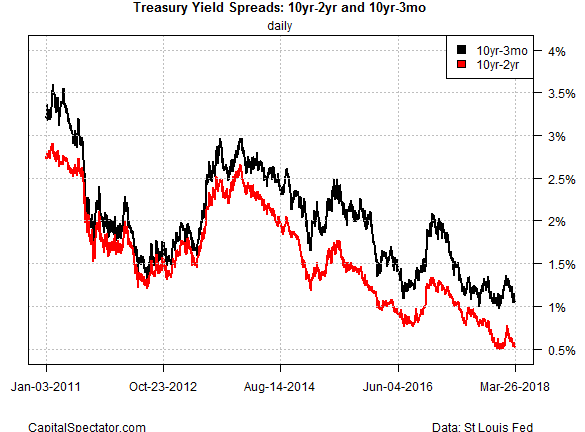
Recently (Mar. 27), the yield difference between the two U.S. Treasury maturities fell to 52 basis points, close to the lowest level since the recession ended in mid-2009. In January, the 10-year/2-year spread dipped to 50 basis points, a post-recession low.
In other words, there is little question that the yield curve has been flattening. In the current circumstances, some market participants are worried that the yield curve will potentially invert. Obviously, the Fed will continue to raise short-term rates this year and next. The yield curve is destined to flatten as short-term interest rates increase more than long rates.
The $64-dollar question is whether the flattening of the yield curve is signaling that a recession coming. Although the linkage between a fully inverted yield curve and recessions has been historically tight, a flattening yield curve does not mean a recession is imminent. Indeed, if the yield curve is flattening because the economy is improving, then this could be positive for financial markets.
The steepness of the U.S. yield curve is typically measured by the 10-year Treasury rate minus the two or three-year Treasury rate. If one examines the following chart we can see clearly that the yield curve has flattened during every economic expansion phase, signaling recession only when the curve inverted. In fact, the yield curve typically steepens during a recession.
The driving force for the flattening yield curve is virtually always the American central bank. At present, the Federal Reserve is inducing the flattening of the yield curve by raising its policy rate (the federal funds rate).
In other words, the flattening process is policy driven and independent of the actual marketplace. If the Fed stops raising interest rates, then the yield curve will likely stop flattening. Thus, the fate of economic expansion is in the hands of the Fed. As soon the Fed puts its foot on the brake of the tightening cycle, the yield curve will cease to flatten.
Inverted yield curves are rather unusual. An inverted yield curve means that investors have little confidence in the economy. The rule of thumb is that an inverted yield curve (short rates above long rates) indicates a recession in about a year, and yield curve inversions have preceded each of the last seven American recessions.
From this writer’s perspective, there is little question that a flattening of the yield curve should be expected. It is, of course, possible for the yield curve to fully invert. But I find it hard to square the chances of a new recession given the fact that the Trump Administration is set to run a more than $2 trillion in the near term. The extent of fiscal boost is almost unprecedented, particularly since it is imposed on a nearly fully employed economy.
Finally, using an economic forecasting model which is based on the slope of the yield curve, the ClevelandFed predicts that U.S. real GDP will slow, but that there is no recession in sight.
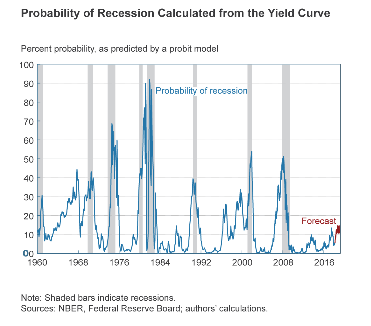
Their model predicts that the economy will only grow at about a 1.5% over the next year. Moreover, according to the model, the estimated probability of recession is very low at 11.1%. In other words, according to the Cleveland Fed, the flat yield curve is quite optimistic about the recovery continuing, even though economic growth will slow down.
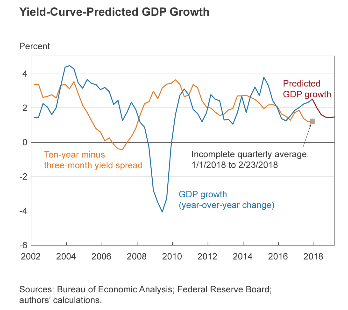
Cleveland Federal Reserve Bank, February 2018


Comments
Log in or sign up to join the conversation.