

Do term spread inversions help predict Australian recessions? Not really, even using alternative recession chronologies.
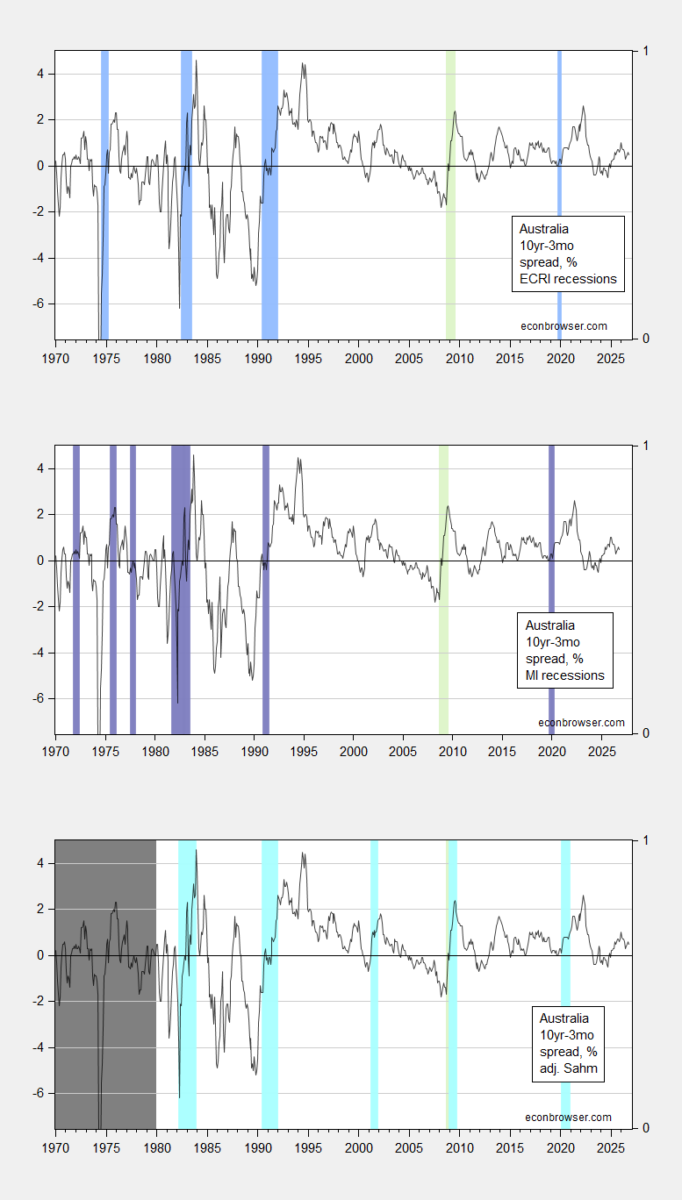
Figure 1: Top panel, Australia10 year-3 month term spread, %, and ECRI defined peak-to-trough recession dates shaded light blue, Middle panel, Light green denotes trough to peak unemployment rate defined dates. Melbourne Institute defined recession dates shaded light violet, Bottom panel, modified Sahm rule peak to trough (+0.75 ppt threshold). Unemployment rate available only starting 1978M02, so no Sahm rule based recession dates before 1979M02; end date is assumed equal to ECRI’s. Source: ECRI, Melbourne Institute, author’s calculations.
While ECRI and the Melbourne Institute largely agree on the mid-1980’s and 1990-91 recessions, and agree on the no-2009 recession call, they do disagree on the 1970’s recessions.
Interestingly, the Sahm rule (with a 75 bps threshold instead of 50 bps, as suggested by the RBA), would posit a recession in 2001 and 2009. However, total employment as well as GDP do not decline on a sustained basis.
None of these recession are predicted with an pseudo-R2 greater than 0.14 over 1986-26m (the coefficient on the spread is opposite of expected). Restricting the sample to the pre-pandemic period raises the pseudo-R2 to up to 50% for ECRI or Melbourne Institute chronologies; but the spread still retains the “wrong” sign.
Note that the lack of predictive power for recessions is different from lack of predictive power for, say, GDP growth (e.g., Poke, Wells, 2009).



Comments
Log in or sign up to join the conversation.