


Denison Mines has had, by most measures, a good year of operational news: construction underway on its flagship Phoenix in-situ recovery uranium project, a feasibility study advancing on a second deposit, exploration drilling turning up new targets, and a uranium market that's held firm on the back of AI-driven power demand. None of it has shown up in the stock. Denison shares have slid from above $4 earlier this year to around $2.71 today, down roughly 39% from the 52-week high, and still drifting lower even after a string of headlines that, on paper, should have helped. This piece looks at why a uranium developer can have a run of genuinely good news and still see its stock go nowhere but down.
What Is Denison Mines?
Denison Mines Corp. (NYSE: DNN, TSX: DML) is a Canadian uranium exploration and development company focused on the Athabasca Basin in northern Saskatchewan, one of the highest-grade uranium regions in the world. Denison doesn't currently produce or sell uranium from its own mines; it's best understood as a pre-production developer whose value sits almost entirely in the ground and in how close its projects are to actually generating revenue. That gives it large potential upside if Phoenix delivers on schedule, but no revenue from its own mines until it does.
Its flagship asset is Phoenix, part of the Wheeler River project, which is being built as an in-situ recovery (ISR) uranium mine - a lower-cost extraction method that pumps a solution underground to dissolve and recover uranium, rather than conventional shaft or open-pit mining. Phoenix is currently under construction, targeting first production in mid-2028. The same Wheeler River project also hosts a second deposit, Gryphon, which is advancing through feasibility study work as a likely conventional underground mine to follow Phoenix. Beyond Wheeler River, Denison holds additional exploration ground and joint-venture interests across the Athabasca Basin, including its partnership with Cosa Resources.
In short, Denison is a pre-production uranium company with a licensed flagship mine under construction and a well-funded balance sheet to build it, but it is not yet profitable and has no revenue from its own mines.
Price Performance: A Stock Going Nowhere
The chart tells a simple story of a stock that can't hold a bid. Denison was trading above $3.70 as recently as late August, and touched its 52-week high of $4.43 earlier in the year. From there it's been a fairly steady grind lower - not a single sharp drop tied to one piece of bad news, but a slow bleed that's continued through a period when the company was actually delivering on its construction and exploration milestones.
To understand how far DNN has moved, here's its stock price at the key reference points over the past year.
Reference Point | Price | vs. Latest Close |
52-week high | $4.43 | -39% |
Late August 2026 | ~$3.70 | -27% |
Latest close (Oct 6, 2026) | ~$2.71 | — |
52-week low | $2.20 | +23% |
[Chart: Denison Mines Corp. (NYSE: DNN) stock chart, via TradingView.
What makes the slide notable is what it isn’t tracking. Uranium developers like Denison are, in theory, a leveraged bet on the spot uranium price — when the commodity rises, mining and development stocks are supposed to rise faster. For a pre-production developer, that link is much looser than the theory suggests, which is the core puzzle this piece is trying to untangle.
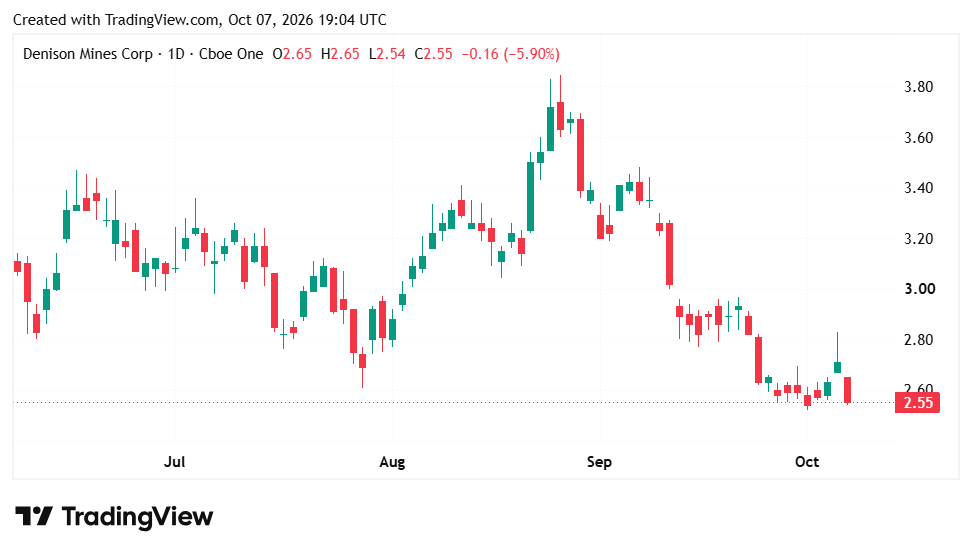
DNN stock chart by TradingView
October 7 update: Denison has bounced for three straight sessions, from $2.54 on October 1 to a $2.71 close on October 6 — up 3.0% on the day on the NYSE American, while the Toronto-listed shares (DML) were reported up 5.9%. We found no Denison-specific news behind the move; it came as uranium equities rallied across the sector, with the uranium spot price itself roughly flat near $89.70/lb. The bounce is small against the slide: the shares are still about 39% below the 52-week high and roughly 19% below where they traded in early September ($3.35 on September 8).
What the Fundamentals Say
Denison is still a pre-production developer, so its income statement looks nothing like an operating miner's, and that's expected at this stage. The TTM net loss below is inflated by non-cash items tied to the Phoenix build and isn't a clean read on ongoing cash burn, but it does underline how far Denison is from earnings. All figures are reported in Canadian dollars, Denison's home currency.
Metric | Trailing Twelve Months |
Revenue (TTM) | CA$4.09M |
Net loss (TTM) | CA$-275.57M |
EPS (TTM) | CA$-0.31 |
FY2025 net loss | CA$217.3M |
Price-to-book | ~11.8x |
What's striking here is the valuation. A ~11.8x price-to-book multiple on a company still posting nine-figure annual losses is a valuation that's pricing in a lot of future success at Phoenix and Wheeler River, not current earnings power, because there essentially aren't any yet. That's normal for a development-stage uranium company, but it also means the stock is more sensitive to sentiment and financing risk than to any near-term income statement.
On the balance sheet, Denison's most recent quarterly filing shows cash and cash equivalents of roughly CA$465M, built up in large part from a US$345M convertible senior notes offering priced in August 2025 at a 4.25% coupon, maturing September 15, 2031. That's a large cushion for a company at this stage, funding both Phoenix construction and ongoing exploration without an immediate need to raise more capital.
In short, the fundamentals describe a company that is funded but not yet earning: about CA$4 million in revenue against a CA$275.6 million trailing loss, a large cash balance to build Phoenix, and the convertible debt that helped pay for it. The numbers say little about today's earnings and a great deal about whether Phoenix is delivered on time, which is what the valuation is really betting on.
What's Happened Recently
This is the part that makes the stock's decline hard to square: the last several months have brought a genuine string of operational progress, not setbacks.
Phoenix construction is underway and on schedule. Site construction at the Phoenix in-situ recovery (ISR) uranium project began in March 2026, targeting first production in mid-2028. As of late July 2026, the company reported more than 20% of site civil work complete, an early but tangible sign the project is moving on its stated timeline rather than slipping, which is historically where mining developers run into trouble.
Denison booked its first uranium sale of the year. In its Q2 2026 results, the company reported the sale of 750,000 pounds of U3O8 at an average realized price of 122.16/lb(US89.17/lb), generating 91.6million(US66.9 million) in gross proceeds. It's worth being precise about what this is: Phoenix isn't producing yet, so this sale reflects uranium moved under existing supply arrangements and inventory rather than new mine output. It's still a meaningful data point - Denison also has 600,000 pounds committed for delivery through Q2 2027, including a fixed-price tranche - but it isn't evidence of Phoenix ramping up.
Wheeler River's second deposit has strong economics, but isn't moving yet. The Gryphon deposit at the Wheeler River project, Denison's other major asset alongside Phoenix, remains at the pre-feasibility study (PFS) level. A 2023 update to that PFS showed a base-case pre-tax NPV of $1.43 billion and a 41.4% pre-tax IRR, but Denison has not made a decision to advance Gryphon to the next stage; it's being held as a likely future use of cash flow from Phoenix rather than an active near-term project. That's worth flagging honestly, since it's a smaller and slower-moving part of the bull case than the "second deposit advancing" framing sometimes implies.
Exploration continues through the Cosa Resources joint venture. Summer drilling has continued through September 2026 across the Darby and Murphy Lake North properties under Denison's joint venture with Cosa Resources, additional upside optionality beyond the two flagship deposits, though nothing at this stage that would move the valuation on its own. (Cosa's separate Aurora project, also in the Athabasca Basin, was optioned to Traction Uranium and isn't part of the active Denison-linked drilling this year.)
The Case For Patience
None of this is the profile of a company in trouble. Construction milestones are being hit, a second deposit carries strong PFS-level economics even if it isn't being actively advanced yet, exploration is adding optionality, and the balance sheet is well funded through the current build.
If the stock is being punished despite this, it raises the question of whether the market is pricing in something else entirely, commodity sentiment, sector rotation, or general risk appetite for pre-revenue miners, rather than anything specific to Denison's execution.
The Disconnect: Uranium Prices vs. Denison's Stock
Here's the part of the story that doesn't add up on the surface. Uranium spot prices have held up reasonably well, around $89.70/lb as of October 5, 2026, roughly flat over the past month and supported by AI data-center power demand and continued supply constraints across the sector. That's the commodity backdrop uranium developers are supposed to be leveraged to. Over the same window that uranium has been roughly flat, Denison's stock has fallen roughly 20%, even after this week's bounce.
A few explanations are plausible, and they're not mutually exclusive. Development-stage miners often trade less on the spot commodity and more on financing risk, dilution expectations, and general risk-off sentiment toward small-cap resource names, categories that can move against a stock even while its underlying commodity is fine. Broader commodity-market jitters may be bleeding in here too: even with high oil prices pressuring input and energy costs across the resource sector, capital hasn't been rewarding commodity developers broadly, uranium included.
It's also possible the market has simply re-rated how much construction and financing risk is left between now and Phoenix's mid-2028 target, given how far out that date still is.
So what does this mean for DNN? Right now, Denison is better described as a risky, long-dated bet than an easy opportunity. The upside is real if Phoenix delivers on schedule in 2028, but the shares are priced on future production, the project still has years of construction and financing risk ahead, and there are no earnings to cushion a disappointment. For investors with a long horizon and a high tolerance for volatility, the current weakness may look like a discount. For anyone expecting a quick payoff, it's a stock that has already shown it can fall while the news stays good.
The mistake inexperienced investors often make is treating DNN as a simple play on the uranium price. Denison doesn't mine or sell uranium from its own projects yet, so today's numbers depend far more on construction progress than on where spot uranium trades. That's why the commodity can hold steady while the stock slides. What matters for DNN is Phoenix development on budget and on schedule, financing updates, and any new uranium sales or contracts. Once Phoenix is producing, the spot price will matter a great deal. Until then, those milestones are the signals to follow.
AllinAllSpace View
The operational story at Denison is genuinely good: Phoenix is under construction and on schedule, Wheeler River's Gryphon deposit carries strong PFS-level economics as a future second phase, exploration continues to add optionality, and the balance sheet is well capitalized through the current build phase. That's not spin — it's what the last several months of disclosures actually show.
But a good operational story isn't the same as a good stock right now. Denison is a pre-revenue developer, so the shares are priced on what Phoenix might deliver in 2028, not on anything the company earns today. That's why a ~39% decline from the 52-week high can happen while uranium spot prices hold firm: the stock is trading on financing risk, timeline risk and sentiment toward pre-revenue miners, not on the commodity. Whether the current weakness is temporary or a more considered re-rating isn't something the fundamentals alone can answer.
What would change the picture is company-specific proof that de-risks the story: a construction update showing Phoenix still on budget and on schedule, Q3 results in early November that confirm the cash runway, new uranium sales or contracts, or a decision to advance Gryphon. A sector-wide move in uranium can lift the shares for a few days, as this week's bounce showed, but it doesn't change the underlying picture. For now, DNN is a long-dated, high-risk bet on Phoenix delivering, and the milestones are what to watch, more than the spot price.
Originally published on September 20, 2026. Updated on October 7, 2026 to reflect the latest market data and developments.



Comments
Log in or sign up to join the conversation.