

With the Iran war escalating, the conflict is again getting harder to ignore, which strengthens the case for maintaining a globally diversified portfolio. The reasoning isn’t based on assuming that a broad approach to asset allocation will outperform other strategies or deliver superior risk management. Although one or both outcomes are possible, the stronger case for leaning into global diversification is that it rests on the idea that markets can, and often will, deliver surprising results.
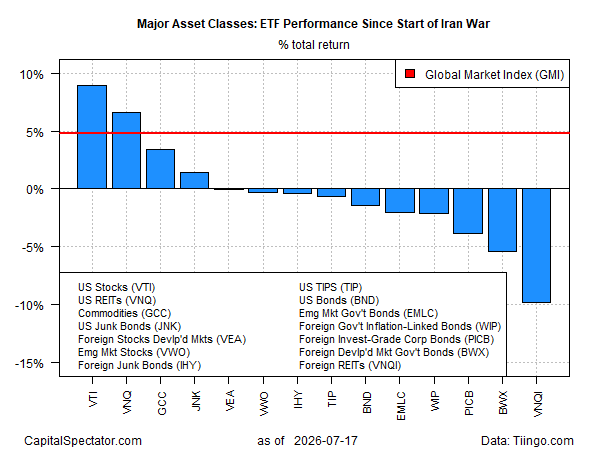
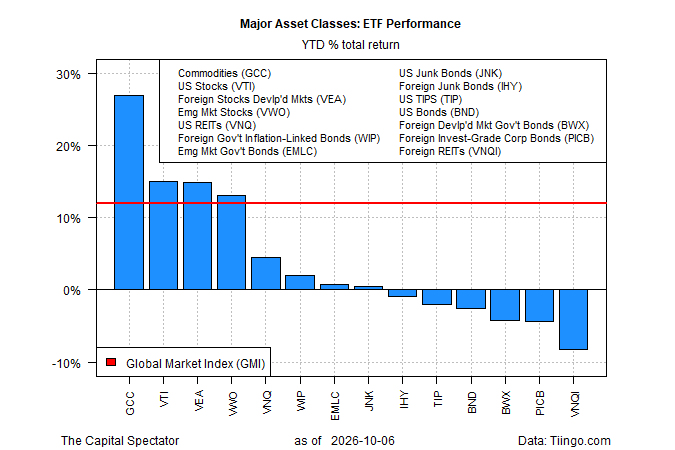
Consider asset-class performances since the bombing of Iran began on Feb. 28. My initial assumptions after learning of the attack turned out to be quite different from how markets reacted through Friday’s close (July 17), based on a set of ETFs. U.S. stocks (VTI) and real estate investment trusts (VNQ) have rallied, outperforming the rest of the field. Bonds — including the U.S. investment‑grade benchmark (BND) — have lost ground. Foreign real estate shares (VNQI) have been hammered, posting the steepest losses among the major asset classes.
To say that I didn’t expect these results is an understatement. Perhaps I’m in a minority of clueless market observers, but I suspect there are many more card‑carrying members of this club than it appears.
The question is how to read the latest headlines in terms of adjusting asset allocation. Is the case for hedging with a particular tilt timely? The news flow certainly inspires acting to some degree.
The U.S. and Iran traded fresh strikes on Monday — American attacks on Iranian sites followed by Iranian hits on Bahrain and Kuwait — underscoring how the collapse of last month’s interim deal has pushed both sides step by step toward a wider war and stalled shipping through the Strait of Hormuz.
Energy prices are rising again, and the specter of elevated inflation and potential Federal Reserve rate hikes is once more a risk factor on the march. Although there are reports that the U.S. and Iran are willing to restart peace talks, there’s also growing concern that the conflict will intensify before a new phase of relative calm returns.
“This is the wake‑up moment for both sides,” said Ellie Geranmayeh, an authority on Iran at the European Council on Foreign Relations. “They either take the diplomatic off‑ramp now or risk allowing the war to spiral beyond managed escalation.”
Attempting to predict how the war evolves at this point — and how asset classes will react over the coming weeks and months — is difficult bordering on impossible. That, at least, is my main takeaway as I review performances to date since the start of the conflict.
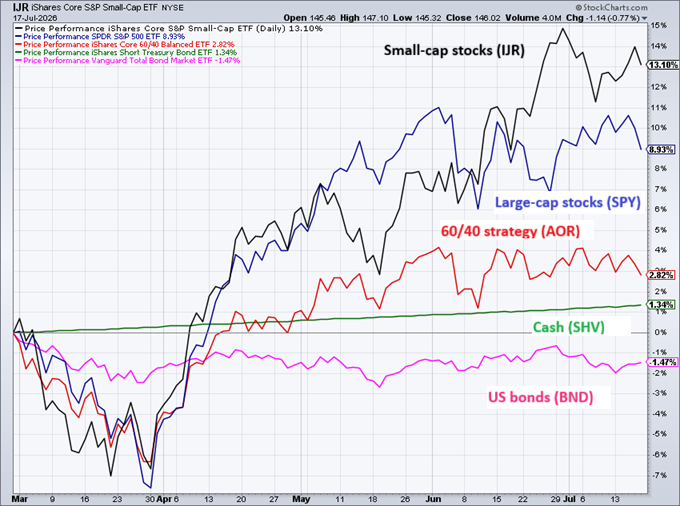
Consider, for instance, the chart below, which shows that small‑cap stocks (IJR) have outperformed during the war. Meanwhile, cash (SHV) is ahead of bonds (BND), while a relatively middling but respectable rally has been logged by a 60% stocks/40% bonds portfolio strategy (AOR).
For investors who, on Feb. 28, expected these results, congratulations — you’re a member of what is probably an elite club of seers. But even if you anticipated how the past five months have unfolded, you still have your work cut out for you for the remainder of the year.
Granted, for analysts with sophisticated models that have proven to be resilient during various macro shocks and periods of elevated geopolitical risk, there could be a case for relatively aggressive portfolio tilts via focused hedging actions. But there’s also a case for considering forecast‑free asset allocation that limits tilting and takes a broader perspective.
The market isn’t perfectly efficient, nor is passive asset allocation a shortcut to investment success. But it’s a good place to start when refining a portfolio to match the specifics of investors’ assumptions and financial objectives.
Predicting how markets will fare in the short term remains as challenging as ever, but history provides valuable lessons. Perhaps the most important is that a passive asset‑allocation strategy will likely continue to deliver average to above‑average results through time, especially after adjusting for trading costs, taxes, and other frictions. That’s one of the few forecasts likely to stand tall once we review the results after the Iran conflict truly ends at some unknown point in the future.
Comments
Log in or sign up to join the conversation.