

What happens when you run massive budget deficits year after year and make no effort to rein in borrowing and spending?
People stop lending you money.
We’re starting to see the impacts of the United States’ fiscal malfeasance in a struggling bond market.
The federal government ran the third-largest budget deficit in history in fiscal 2026, despite rising tax receipts. The Trump administration blew through a record $7.4 trillion. To put that into context, that's roughly $20.3 billion per day.
No wonder people are becoming wary of loaning Uncle Sam more money.
Meanwhile, yields on the long end of the curve have hit levels not seen since the early 00s. The 30-year Treasury recently eclipsed 5.7 percent, and while the yield has eased modestly, it remains at multi-decade highs.
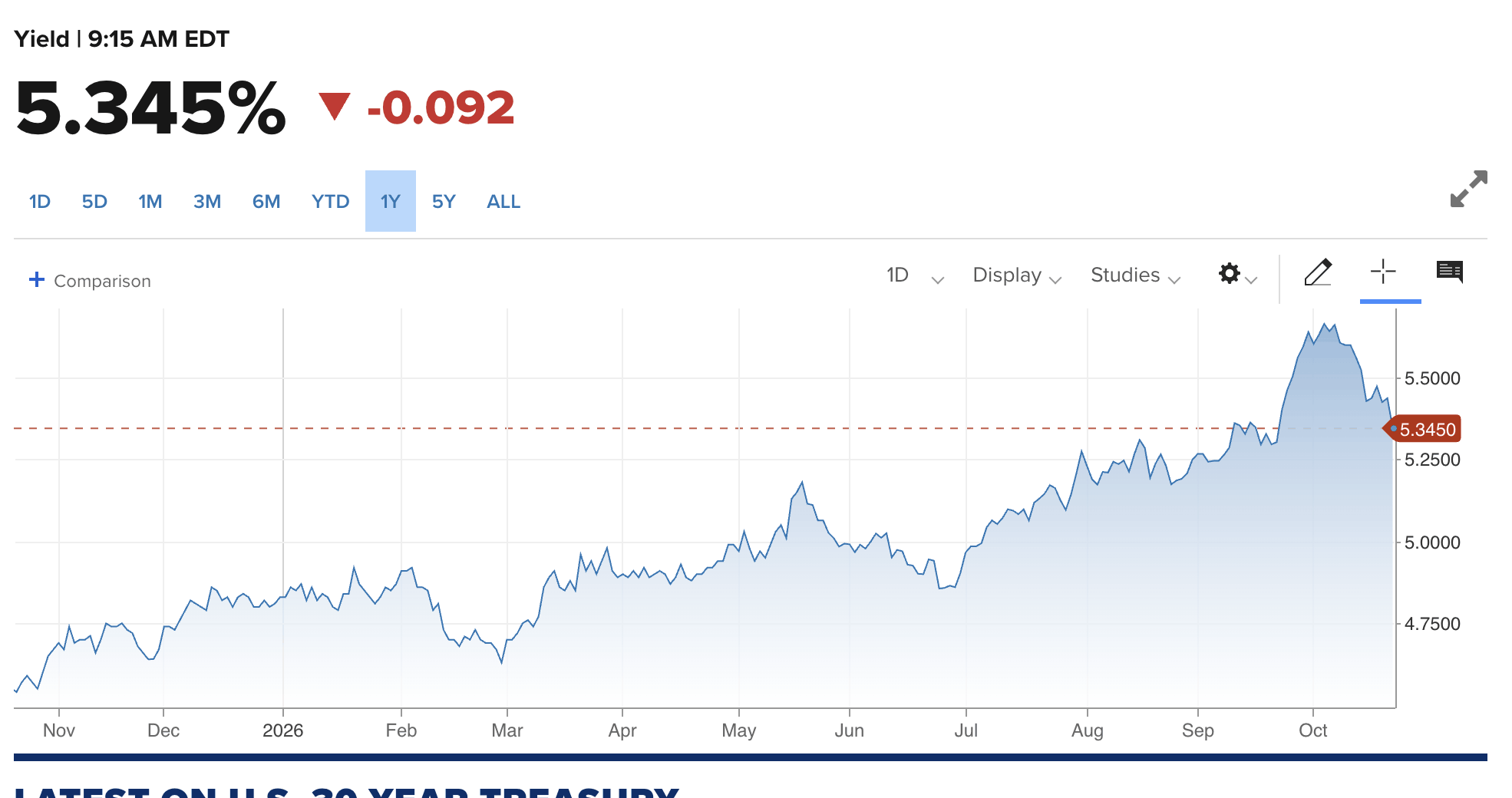
This signals sagging demand for Treasuries.
Yields inversely correlate with bond prices. As bonds become less expensive with softening demand, interest rates simultaneously rise.
Falling Treasury demand is also showing up at government auctions.
On Wednesday (Oct. 21), the U.S. Treasury ran a 20-year bond auction. Morningstar said it showed “softer than expected demand.”
The Treasury sold $13 billion in bonds with a high yield of 5.469 percent. That was the highest yield in a 20-year Treasury auction since 1986, the year the Treasury stopped issuing the 20-year bond. It resumed selling 20-year Treasuries in 2020.
Bad News for Uncle Sam
By the way, this is a big problem for the federal government. Selling bonds at higher yields means Uncle Sam will be on the hook for higher interest payments in the years to come. Interest expense is already overwhelming the government budget. The Treasury forked out $1.36 trillion in fiscal 2026. That was an 11.5 percent increase over the previous year.
Much of the debt currently on the books was financed at very low rates before the Federal Reserve started its hiking cycle. Every month, some of that super-low-yielding paper matures and must be replaced with bonds with much higher rates.
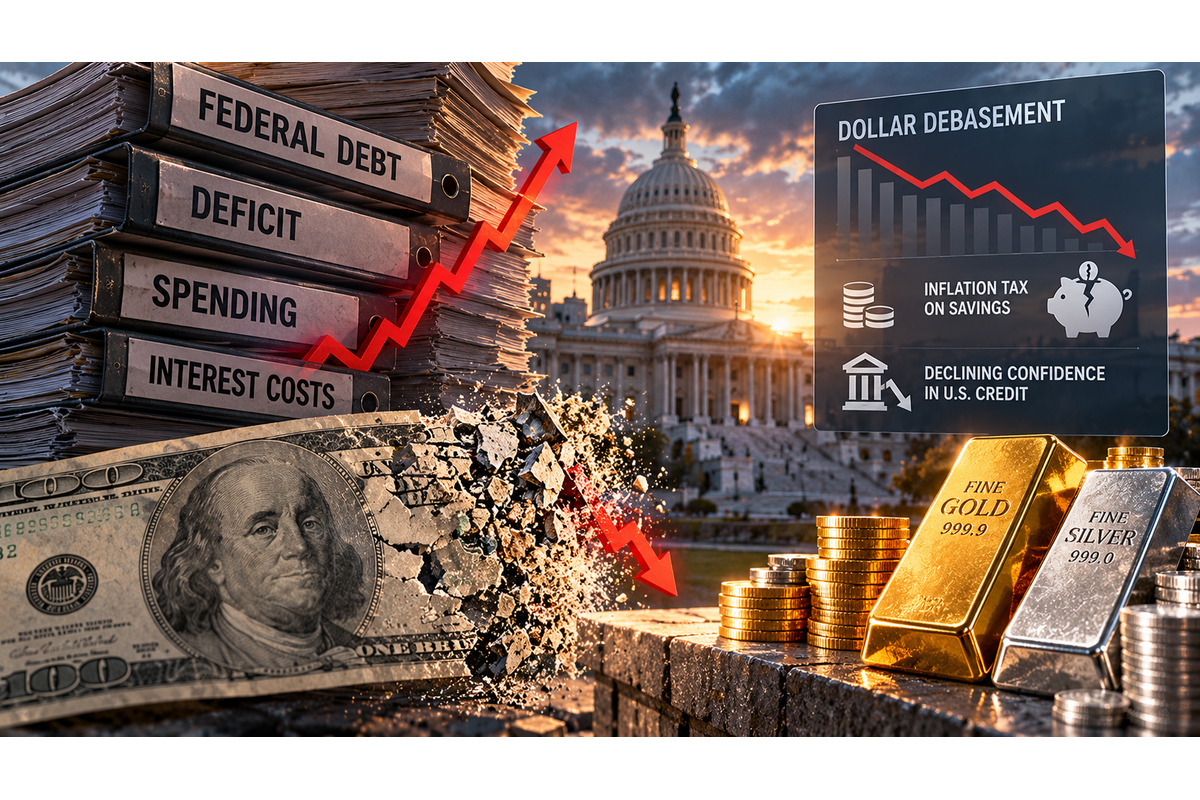
The soft bond market reflects a broader trend dubbed the “debasement trade.” This strategy emphasizes holding tangible assets such as gold, silver, and other commodities to protect against declining fiat currencies due to monetary debasement.
Monetary debasement and rising debt are directly connected.
When the federal government borrows excessively, the Federal Reserve eventually steps in with quantitative easing (QE). In these operations, the central bank buys Treasuries using money created out of thin air and holds them on its balance sheet. This effectively takes the bonds out of circulation, thereby lowering supply, boosting prices, and lowering yields. In effect, QE creates artificial demand for Treasuries, enabling the government to borrow more and lower rates.
However, this debt monetization is inflationary. It erodes your purchasing power.
Should I Sell My Gold and Silver?
Rising yields have created significant headwinds for precious metals. That’s because conventional wisdom holds that higher interest rates make non-yielding assets like gold and silver less attractive. We’ve seen this pressure in the precious metals markets for several months.
However, it’s important to consider why yields are rising. If it’s due to inflation, you might consider keeping your inflation hedge.
It’s also important to remember that while nominal rates might be rising quickly, real interest rates rise much more slowly in a high-inflation environment.
The real interest rate is simply the stated rate adjusted for price inflation.
To calculate the real interest rate, subtract the CPI from the stated interest rate. For instance, if a bond yields 5 percent but the CPI is 4 percent, the real interest rate on the bond is only 1 percent.
Sagard Wealth Management CIO Stephen Harvey called the current economic environment “pro-growth and pro-inflation” and emphasized that fiscal policy now matters more than monetary policy.
In other words, investors are paying less attention to what the Fed and other central banks may do with interest rates and more attention to the rampant borrowing and spending by the world’s governments.
Global Chief Investment Strategist at State Street Investment Management Jenn Bender told Reuters that "real assets, tangible assets valued for their intrinsic physical qualities," have gained appeal since the post-COVID inflation shock. She emphasized that the case continues to strengthen as "the bond outlook clouds and soaring equity markets appear vulnerable."
"The worry is that there is some downside risk in equities. Fixed income is not the place that people want to move their equity allocations over to. Basically, real assets is kind of where you end up."


Comments
Log in or sign up to join the conversation.