

The main decision is whether outside DevOps support will fix the delivery process or make it harder to manage. The question matters because teams now use AI, cloud services, containers, and internal platforms in the same delivery flow. The DORA 2025 research drew on nearly 5,000 tech workers and more than 100 hours of qualitative research. It found that AI tends to magnify what already works and what already fails.
That finding gives buyers a useful test. Managed DevOps should improve the system around the tools, including ownership and testing. It should also make daily delivery easier to see and measure.
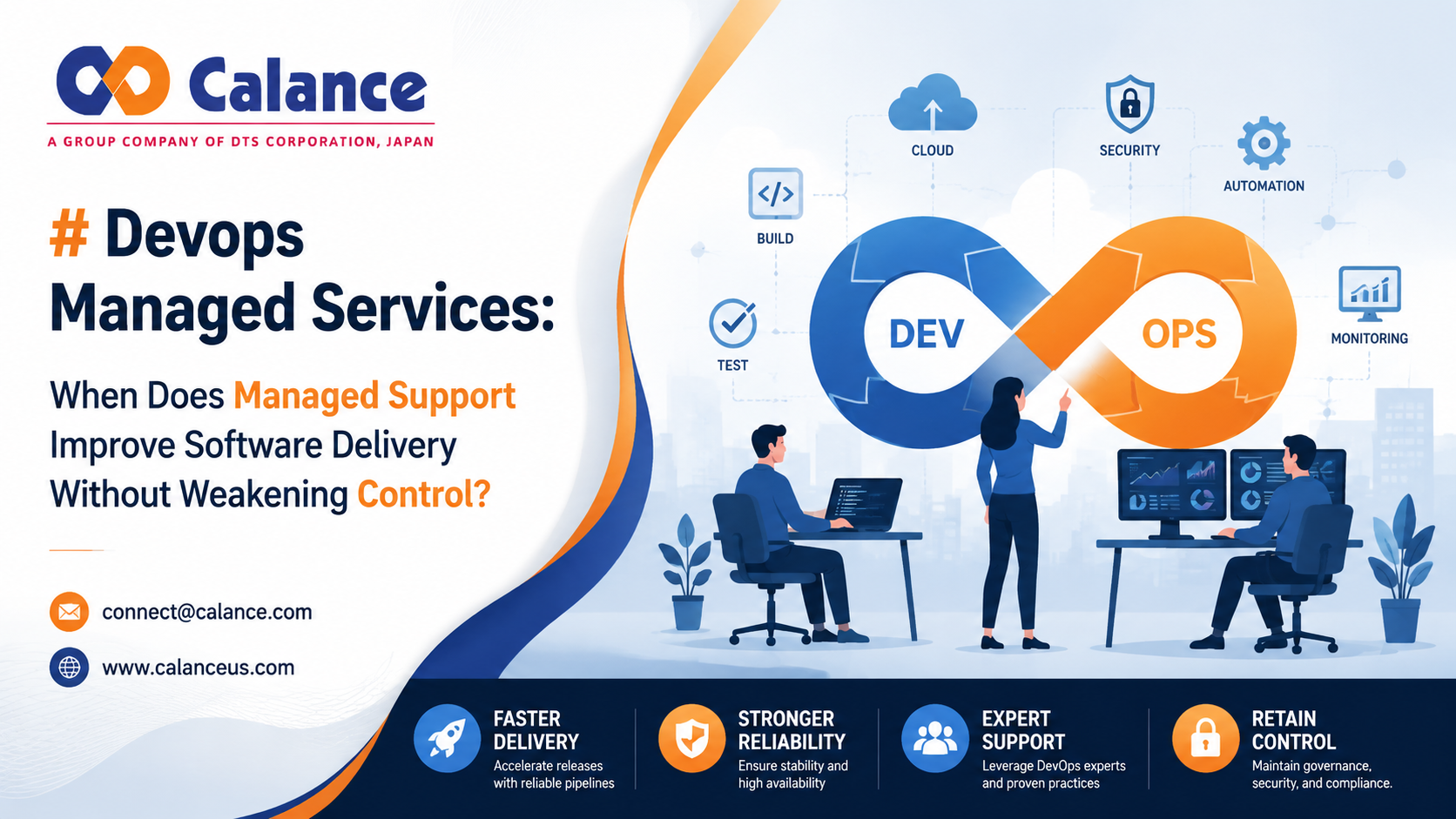
Cloud-native growth makes weak delivery processes harder to hide
Cloud-native work is now common in the groups studied by the Linux Foundation. Its Cloud Native 2024 study found that 89% of respondents used cloud-native methods in at least part of development and deployment. It also found that 91% used containers in production. Use of CI/CD in production grew 31% from 2023 to 2024.
Release activity also rose during the period. The same study found that 29% of respondents released code several times a day, up from 23% in 2023. As release work grows, manual checks and unclear handoffs can become harder to sustain. This is one reason Devops Managed Services may help when they focus on a known process problem instead of a broad tool rollout.
Calance describes its DevOps work as an assess, define, implement, and evolve process. Its service page includes CI/CD, infrastructure automation, monitoring, security work, and team enablement. That model fits the research when each change has a clear purpose. The provider should be judged by what improves in the delivery flow.
Platform research shows gains can come with tradeoffs
Evidence on internal platforms is mixed. The DORA 2024 report found that internal developer platforms were linked with better individual and team performance. It also found possible losses in change stability and throughput when platform design reduced developer independence. That matters because a central service can remove repeated work while also creating new queues or approval gates.
Work under Devops Development Services should make the path to production clearer without separating engineers from the systems they own. Shared pipeline rules can reduce repeated setup work. The internal team still needs clear runbooks, access rules, recovery steps, and ownership boundaries. These details can prevent new delays.
The 2024 and 2025 DORA findings address different parts of the same problem. The 2024 work warns that a platform can help output while hurting stability. The 2025 work says newer tools can magnify the condition of the wider system. Both findings lead to the same buying question: does the service improve how work moves?
Managed support needs a baseline before it can prove value
The evidence supports measuring the starting point before changing the delivery model. Teams should know how often they deploy and how long changes take to reach production. They should also track failed changes and recovery time. Those measures give a Devops Services Company a clear problem to work on and give the client a way to judge the result.
This approach also protects against false gains. A faster build means little if review time grows or production failures rise. A provider should explain which part of the flow each change is meant to improve. The same measure should then be checked after the change, using the same definition and time period.
Security research adds a condition that speed studies cannot settle
Delivery speed is only part of the decision. A 2026 NIST DevSecOps project uses applied examples from 14 technology companies to show how Secure Software Development Framework practices can fit into modern pipelines. The work focuses on protected development systems, software component checks, access control, and records that show what happened in the pipeline.
NIST answers a different question from DORA. Its work shows what secure pipeline practice should include, but it does not prove that managed DevOps will make a team faster. DORA studies broad patterns in software work, yet those patterns do not promise the same result for every company. Buyers need both views because a faster process still has to protect the software it ships.
Case evidence helps when its limits stay visible
A provider case study can show how a change worked in one setting. In a Calance DevOps case study, Calance reports that one product team cut deployment time from 2 hours to 10 minutes after it built a CI/CD pipeline. The same case reports that server outages fell from 5 to 10 per week to an average of 0.1 per week over 1 month.
Those figures are useful as an example of before-and-after measurement. They are not a forecast for another company because the case covers one product, comes from the service provider, and was published in 2021. Its better use is to show what a buyer should ask for: a clear starting measure and the same measure after the work is done.
What the evidence supports for a buying decision
The sources agree that tools alone do not create better software delivery. Managed support is more likely to help when it removes a measured constraint and keeps ownership clear inside the client team. It should also put security checks inside normal delivery work. These conditions matter more than a long list of platforms or automation claims.
Some uncertainty remains because the sources study different groups and use different methods. The 2025 DORA work combines survey and qualitative research, while NIST focuses on security practice and applied examples. The Linux Foundation survey comes from a cloud-native community, so its adoption rates may be higher than those in the wider business market. Buyers should use the evidence to set tests for a provider rather than expect a fixed result.
Frequently asked questions
When should a company consider managed DevOps support?
Managed support makes sense when a measured delivery problem stays unresolved because the team lacks time or operating skill. Long release cycles and repeated production issues are common signs. The company should define the problem before choosing tools or a provider.
Does managed DevOps always improve deployment speed?
Managed DevOps does not guarantee faster deployment. Research links some DevOps practices with better delivery outcomes, but the effect depends on the team and the design of the delivery system. Baseline measures are needed before speed claims can be tested.
How should security fit into managed DevOps?
Security should be part of normal pipeline work from the start. Teams need controls that protect build systems and check software components before release. They also need clear access rules and records that show which checks ran.
What should a buyer measure before choosing a provider?
The buyer should record current delivery and reliability measures before work begins. Deployment frequency and recovery time are useful starting points, though the final set should match the real business problem. The same definitions should be used after changes are made.
What remains uncertain in the research?
The research does not identify one managed service model that works for every company. The studies use different samples and methods, so their findings answer different parts of the decision. Company size, system age, and team structure can also change the result.
The evidence supports managed DevOps when it improves the work system around software delivery and leaves ownership visible. It also supports measuring the starting point and building security checks into daily delivery. The size of the gain will vary by company because team structure and current process quality differ. A sensible next step is to define the problem, record the baseline, and judge the service against those measures.
For more info contact us or send mail at [email protected] to get a quote
Comments
Log in or sign up to join the conversation.