

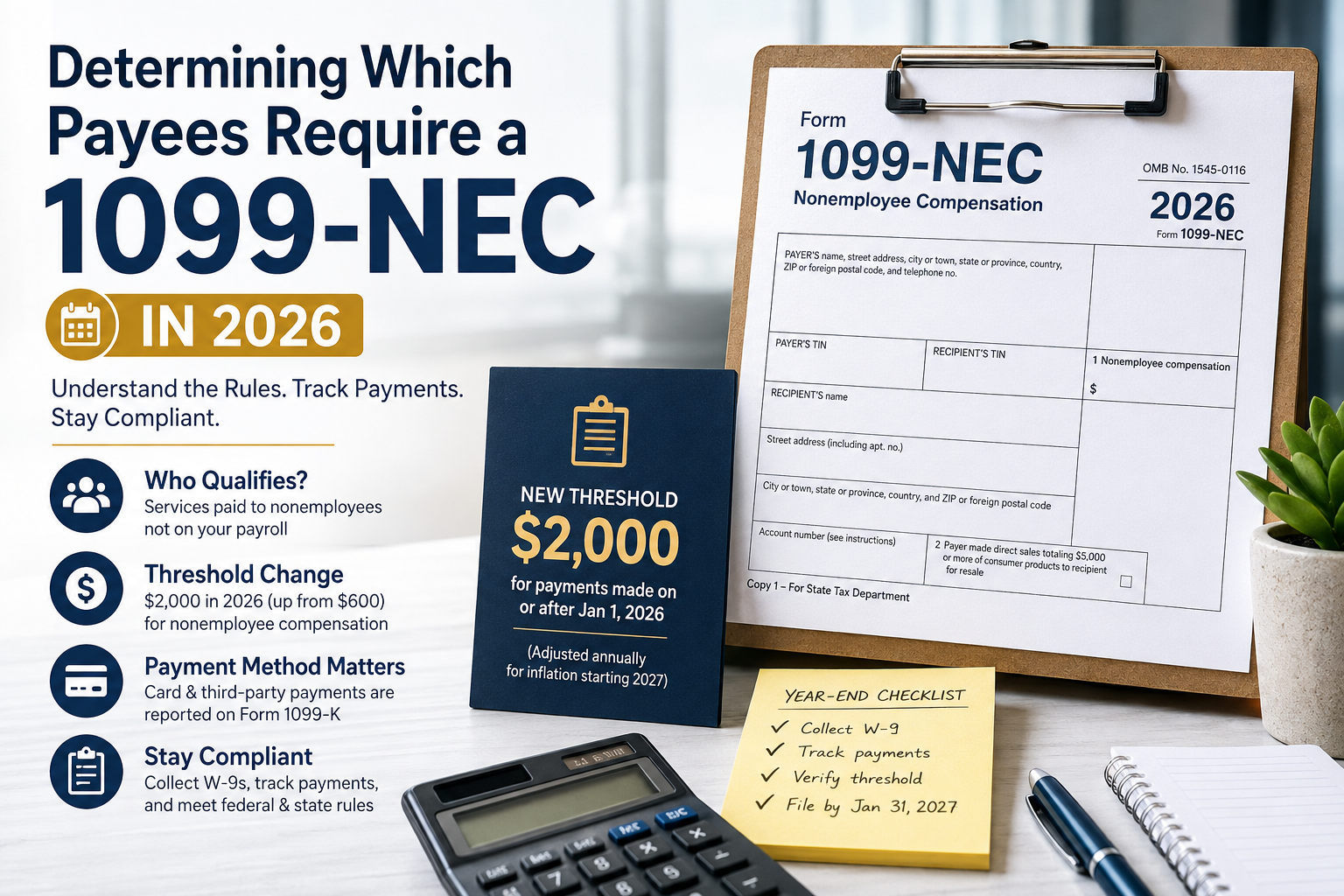
Every business that hires outside help eventually runs into the same year-end question: does this payee need a 1099 nec? Getting the answer wrong in either direction creates problems. Skip a required filing and the IRS can assess penalties. File one that wasn't needed and you've added unnecessary paperwork for both your accounts payable team and the recipient. With the reporting threshold changing for the first time in decades, payroll and accounting teams need a refreshed understanding of exactly who qualifies before the 2027 filing season arrives.
What the Form Actually Covers
Form 1099-NEC exists to report nonemployee compensation, meaning money paid to a person or entity performing services for a business without being on that business's payroll. This is different from a W-2, which documents wages, tax withholding, and benefits for employees. The nonemployee compensation form instead tells the IRS that a business paid someone for work without treating them as staff, which shifts the responsibility for self-employment tax onto the recipient.
The categories of payees who typically trigger this filing include freelance writers, graphic designers, IT consultants, marketing contractors, board members receiving director fees, and subcontractors on construction or service projects. Attorneys are a special case: fees paid for legal services fall under the same nonemployee compensation reporting rules, even though gross proceeds paid to an attorney for other purposes are handled separately on Form 1099-MISC.
The Threshold Has Changed for 2026
For years, the rule of thumb was simple: pay a nonemployee $600 or more in a calendar year, and a 1099-NEC was required. That figure had not moved since 1954. The One Big Beautiful Bill Act (OBBBA) changed this, raising the reporting threshold to $2,000 for payments made on or after January 1, 2026. Beginning in 2027, this new figure will be adjusted annually for inflation.
Practically speaking, a business that pays a freelance consultant $1,500 across the 2026 tax year no longer has a filing obligation for that payee, whereas under the old rule that payment would have crossed the line. This does not mean the income is untaxed. Contractors and consultants must still report all earnings on their own returns regardless of whether a form was issued, since the reporting threshold only affects the payer's obligation, not the recipient's tax liability.
It's also worth noting that the threshold applies to the cumulative total paid to a single payee across the year, not to any individual invoice or transaction. A business that pays a contractor $500 monthly across the year has still crossed the $2,000 mark and owes a filing, even though no single payment reached that amount.
Payment Method Changes the Picture
Not every payment to a contractor lands on a 1099-NEC. Payments made by credit card, debit card, or through a third-party network like a payment app are excluded from nonemployee compensation reporting. Those transactions are instead the responsibility of the payment processor, which reports them on Form 1099-K when applicable. Reporting the same payment on both forms would double-count the income, so businesses should track payment method carefully when reconciling contractor files at year-end.
Structuring, Not Skipping, Compliance Steps
The higher threshold reduces filing volume, but it doesn't remove the underlying compliance obligations. Businesses still need a completed Form W-9 on file for every contractor before the first payment goes out, since that document supplies the taxpayer identification number required for accurate reporting. Missing or incorrect TINs can trigger backup withholding regardless of whether the payment ultimately meets the $2,000 threshold. Payroll and AP teams should also remember that state filing requirements don't automatically mirror the federal change; several states have not yet aligned their own thresholds to the OBBBA update, which means a payment exempt from federal reporting may still require a state-level 1099-NEC.
Building the Habit Into Year-End Workflows
The safest approach for payroll and finance teams is to track every nonemployee payment throughout the year rather than reconstructing totals in January. Categorizing vendors by payment method and running periodic threshold checks avoids the scramble that typically accompanies the January 31 filing and furnishing deadline. As thresholds begin adjusting for inflation starting in 2027, this kind of ongoing tracking will only become more valuable for staying compliant year over year.
Frequently Asked Questions
Q1.Does a corporation ever need to receive a 1099-NEC?
Generally no. Payments to C-corporations and S-corporations are typically exempt, though attorney fees paid to a law firm are a notable exception and remain reportable regardless of entity type.
Q2.What happens if a contractor refuses to provide a W-9?
The payer should begin backup withholding at the applicable rate on future payments and continue requesting the form, since missing taxpayer information creates compliance exposure independent of the payment total.
Q3.Does the new $2,000 threshold apply to payments made in 2025?
No. The $600 threshold still governs all payments made during the 2025 calendar year; the $2,000 figure only applies to payments made on or after January 1, 2026.
Q4.Can a single large project invoice trigger a 1099-NEC even if it's the only payment to that vendor all year?
Yes. One invoice of $2,000 or more to a single nonemployee payee meets the threshold on its own, since the rule is based on the annual total paid, not the number of transactions.
Comments
Log in or sign up to join the conversation.