

As a result of the Great Recession and the financial crisis which caused the downturn, the US Federal Reserve increased the monetary base (often labeled as high powered money) by more than 500% between 2009 and 2014.
The Fed directly influences the size of the monetary base by buying or selling government bonds in the open market. During the recent financial crisis, the Fed also purchased mortgage backed securities, which also increased the size of the monetary base. Obviously the three recent phases of quantitative easing sparked a massive increase in the size of monetary base.
The huge and controversial increase in the monetary base was necessary to prevent the collapse of the American economy and to keep financial institutions afloat. Since the US economy has outperformed most advanced countries since the recession ended, this suggests that America’s controversial monetary policy was actually quite successful.
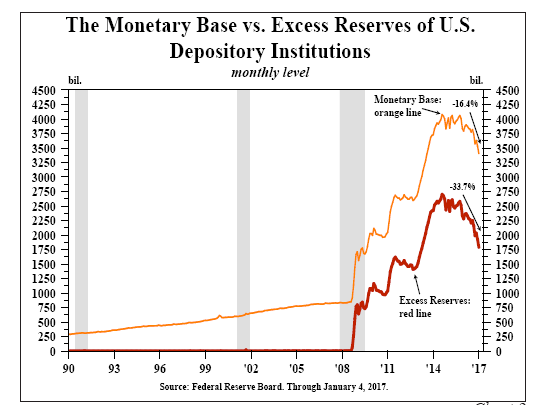
Nonetheless, as the following chart illustrates, since its peak in 2014 the central bank’s monetary base has shrunk by 16.4% and excess reserves which belong to the commercial banks have shrunk by 33.7%. (See the Fourth Quarter 2016 Hoisington Investment Management Co. Report)
Interpreting what is really going on is a bit tricky, however.
The fact that excess commercial bank reserves have shrunk is a good sign since it implies that the private banks are either investing or lending out a higher proportion of their deposits than in the past. In other words, shrinking excess bank reserves are an encouraging sign that the American economy is doing better.
But the shrinking of the monetary base can also be interpreted as a sign that monetary policy has been tightening (at least incrementally) since 2014.
As an aside, the monetary base should not be confused with the public money supply, which consists of the currency in circulation plus non-bank deposits with commercial banks. The central bank actually reports on different measures of the money supply, but this article will only focus on the M2 measure.
Under relatively normal circumstances, the Fed influences the public’s money supply by buying bonds from the commercial banks. But between 2008 and 2011, America’s banks were reluctant to lend, due to a hangover from the credit crisis and fears of a future downturn. They parked their excess reserves with the central bank.
Therefore, the increase in monetary base didn’t convert into a faster increase in the public money supply, which was really the desired outcome.
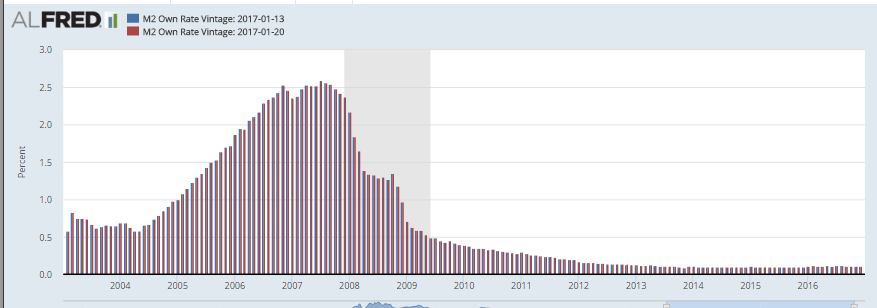
This result of this can be seen in the following chart that highlights the growth in M2, which is often referred to as the public money supply. As can be seen, the M2 money supply hardly grew even during the aggressive quantitative easing years.
In other words, despite aggressive quantitative easing, monetary policy in the US was not fully effective because it was unable to spur a higher expansion of the money supply.
A simple conclusion going forward is that financial conditions and interest rates will continue to normalize in 2017 and 2018. As the normalization process goes on, we should expect the US money supply to start growing again. This will certainly be a positive outcome for the US economy.


Comments
Log in or sign up to join the conversation.