


Image: Bigstock
Dell Technologies (DELL - Free Report) and Hewlett Packard Enterprise (HPE - Free Report) have become two of the most important names in enterprise infrastructure.
Both compete heavily in servers, storage, networking, and data-center systems. Furthermore, their growth strategies are increasingly tied to AI-driven and hybrid-cloud infrastructure.
That makes their latest earnings reports especially relevant as corporate and hyperscale spending accelerates.
Dell delivered explosive AI-server growth and sharply raised its current fiscal 2027 outlook. HPE also posted record results while lifting its FY26 and FY27 forecasts.
With both stocks carrying bullish earnings momentum, valuation may be the key factor separating the two investments.
Dell & HPE Delivered Record Quarterly Results This Month
Dell's fiscal Q2 revenue surged 58% year over year to a record $46.97 billion, surpassing estimates of $45.34 billion. Meanwhile, Q2 adjusted EPS skyrocketed 203% to a quarterly peak of $7.04 and crushed expectations of $4.97 by 41%.
Most importantly, Infrastructure Solutions Group revenue jumped 89% to $31.8 billion, led by a 100% increase in AI-optimized server revenue to $16.4 billion and a 122% surge in traditional server and networking sales to $10.5 billion.
Reflecting tremendous demand, Dell raised its current FY27 revenue guidance from $167 billion to $192 billion (69% YoY growth) and now expects adjusted EPS of $25.50, up 148% annually. Management also boosted its AI-optimized server revenue outlook from $60 billion to $74 billion, representing roughly 200% YoY growth, while forecasting Q3 revenue of $49 billion and adjusted EPS of $6.50.
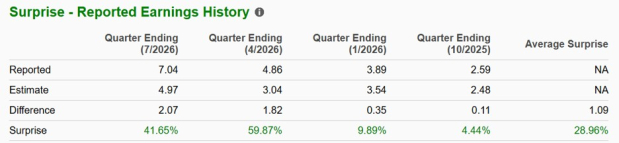
Image Source: Zacks Investment Research
HPE's fiscal Q3 was impressive as well, with record revenue rising 34% to $12.21 billion and topping estimates of $12.09 billion. On the bottom line, HPE’s Q3 adjusted EPS climbed to a quarterly peak of $1.11 from $0.44 a year ago and beat expectations of $0.95 by nearly 17%.
Cloud & AI revenue rose 25% to $9 billion, including a 35% increase in server revenue to $6.8 billion. More impressively, Networking revenue jumped 75% to $2.9 billion, attributed to the integration of Juniper Networks, which HPE acquired last year for $14 billion.
HPE now expects Q4 revenue of $13.9-$14.8 billion and adjusted EPS of $1.20-$1.30. It’s also noteworthy that management raised its full-year revenue growth forecast to a range of 34%-37% and adjusted EPS guidance to $3.75-$3.85 (+5% YoY growth). Plus, HPE’s FY27 framework calls for another 13%-17% revenue expansion and 16%-20% EPS growth.
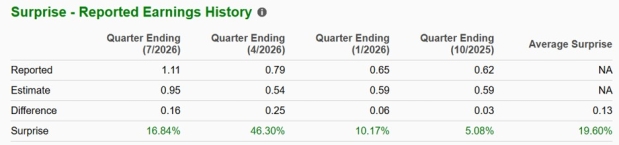
Image Source: Zacks Investment Research
Major Players in a Booming Server Market
The long-term opportunity may be even more compelling. As shown in the chart below, Grand View Research estimates that the global server market expanded from $205 billion in 2021 to $342.1 billion in 2025 and projects it to reach nearly $1.03 trillion by 2033.
That represents a robust 14.8% compound annual growth rate (CAGR) from 2026 through 2033 and would roughly triple the market from 2025 levels.
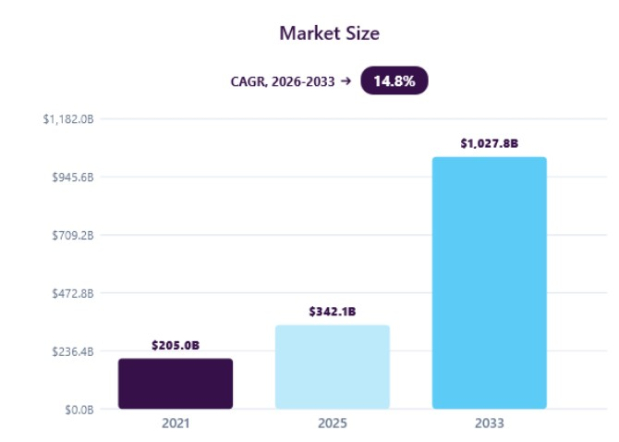
Image Source: Grand View Research
Such growth should provide a significant runway for major server vendors like Dell and HPE as AI and machine-learning workloads, edge computing, cloud expansion, and increasingly demanding data-center infrastructure requirements fuel server investment.
Dell and HPE are firmly entrenched in this opportunity. To that point, the International Data Corporation (IDC) recently reported that worldwide server revenue reached $122.6 billion in Q1 2026 alone, rising more than 30% YoY as GPU-rich AI systems and hyperscaler investment drove spending.
IDC's Q1 data placed Dell first among named server original equipment manufacturers (OEMs) with a 16.5% worldwide revenue share, while HPE remained among the five largest vendors at 3%.
Of course, Dell's much larger position gives it the advantage in AI-server scale. That said, HPE's combination of ProLiant servers, storage, GreenLake hybrid cloud services, and Juniper networking creates an increasingly comprehensive enterprise infrastructure platform.
Further strengthening their AI prospects, both Dell and HPE have extensive partnerships with Nvidia (NVDA - Free Report), integrating the chip giant's accelerated computing technology into their respective AI factories and private-cloud infrastructure platforms.
Performance & Valuation Comparison
Year to date, Dell shares have skyrocketed more than 320%, while HPE has climbed over 120%. Over the last three years, DELL has surged +630%, compared with a still-impressive +215% gain for HPE.
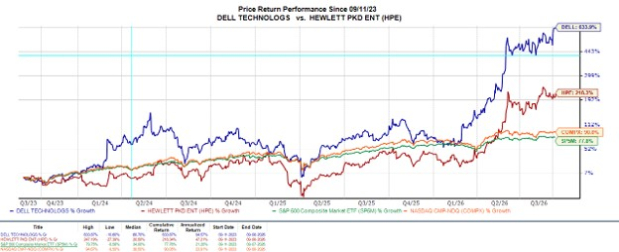
Image Source: Zacks Investment Research
Despite Dell’s superior stock performance, HPE has the clear advantage on traditional valuation metrics.
HPE is trading at roughly 17X forward earnings, compared with around 20X for Dell, while their forward price-to-sales multiples are approximately 1.5X and 1.7X, respectively.
Keeping that in mind, Dell's premium doesn't look excessive considering management is forecasting 69% FY27 revenue growth, 148% adjusted EPS growth, and a tripling of AI-server sales.
Still, HPE offers the greater valuation cushion, although Dell's extraordinary earnings expansion and substantially larger position in AI servers help justify paying more for its shares.
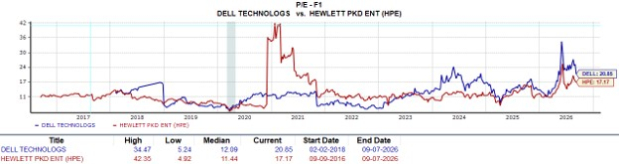
Image Source: Zacks Investment Research
Bottom Line
After their latest reports, Dell gets the slight edge as the better buy for investors seeking maximum exposure to the AI infrastructure boom.
Its massive AI-server backlog, market-leading OEM position, stronger near-term growth, and sharply raised outlook outweigh its valuation premium, especially considering DELL still trades beneath the price-to-earnings and sales valuation of the benchmark S&P 500.
HPE shouldn't be overlooked, however, as its cheaper valuation, rapidly growing server business, Juniper-enhanced networking portfolio, and expanding hybrid-cloud exposure provide an attractive alternative for value-oriented investors.
Most encouragingly, Dell Technologies and Hewlett Packard Enterprise stock both currently sport a Zacks Rank #1 (Strong Buy), indicating earnings estimate momentum remains firmly in their favor and could lead to even more upside.


Comments
Log in or sign up to join the conversation.