


We've looked at the Cambria Trinity ETF (TRTY) a couple of times lately. I am intrigued by the allocation at a high level, which is 35% trend, 25% equities, 25% fixed income, and 15% alternatives. We've looked at the asset mix many times, and I think it works. Cambria's research supports that it works; of course, the fund wouldn't exist if they researched it and it floundered.
A similar backtest to what we've done many times.
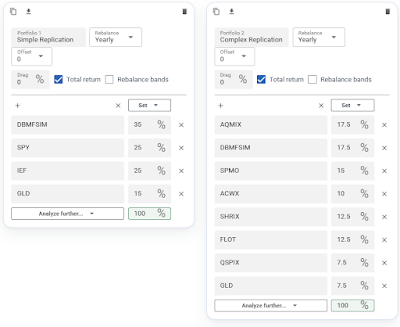
The results are consistent with what we usually see.
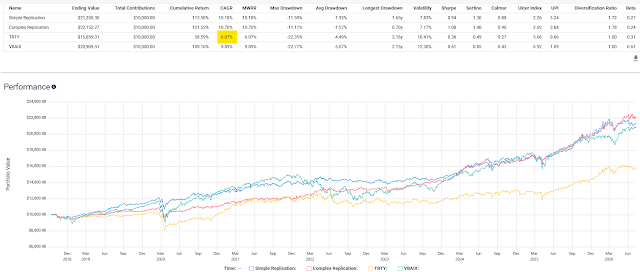
A consistent result is that the strategy works better than the actual fund most of the time. TRTY has had a couple of very strong years mixed in, but as a long-term hold, TRTY lags a long way behind Portfolio 1, but with much more volatility.
So, what's missing? I asked both Copilot and Claude. At first, Copilot blamed TRTY's lag on the mechanics of managed futures trading. That answer made no sense since Portfolios 1 and 2 have the same weighting to managed futures. It took quite a bit of back and forth to convey the point.
Claude seemed to blame it on heavy equity factor weightings with a lot of shareholder yield. The way the fund is put together, Claude says it is complexity without a clear edge, and the way the factors are assembled makes it overly vulnerable to certain market environments.
When I figured out how to tell Copilot it was looking at this incorrectly, I told it I believe TRTY is too complex relative to the concept. It replied that TRTY is over-engineered with too much structural friction. Both Portfolios 1 and 2 are simpler, it said. The "too complex" answer felt more genuine coming from Claude because it was unsolicited versus my telling Copilot what I thought.
Related to managed futures, iM Global Partners filed for an ETF that would leverage up to hold 30% in US equities and 100% in managed futures. This is the firm that runs the DBMF ETF. I saw one comment on the Tweet that brought this to my attention; it described this as being risk parity. That's a good observation; there's something to it. Maybe it's risk parity influenced or risk parity adjacent?
On testfol.io, we can simulate DBMF back to 2000.
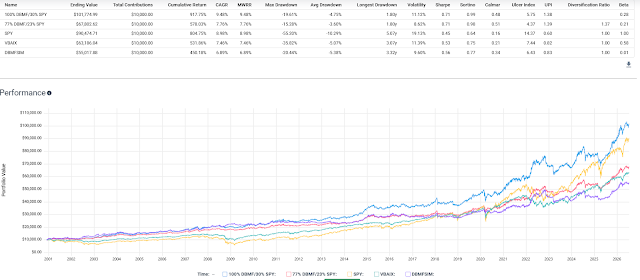
I am very surprised the result is so good.
This second look includes a more diversified mix of managed futures funds instead of 77% in one fund (yikes) and AQRIX, which used to be AQR Risk Parity and still is risk parity influenced.
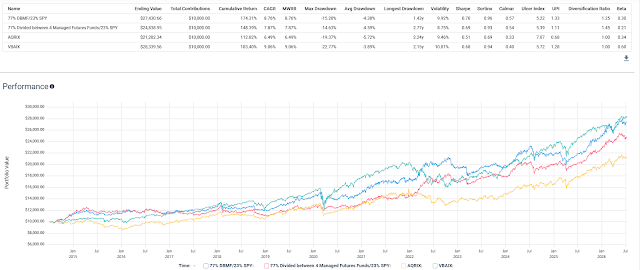
There have been some long stretches where managed futures really were a pain trade, but it's hard to argue with the underlying premise of the filing.
A final iteration in Portfolio 3, which takes the filing, reduces the managed futures/equity sleeve down proportionately to 60% of the portfolio, and combines it with 40% in fixed income.
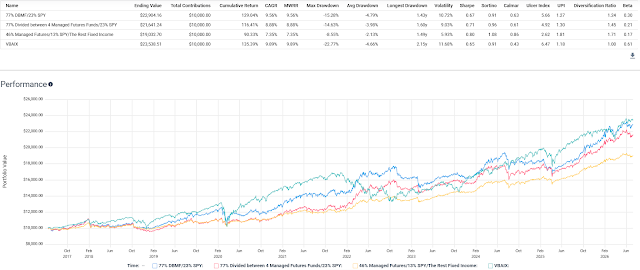
Portfolio 3 is pretty close to a 75/50 version of VBAIX. The way it weighs out, Portfolio 3 is risk parity adjacent or inspired, which, along with Trinity's allocation, is another idea that I find very intriguing.



Comments
Log in or sign up to join the conversation.