


December brings together three forces that have become increasingly difficult to separate: renewed monetary tightening, the uneasy accommodation between Washington and Beijing, and a reassessment of the artificial intelligence investment boom. The common thread is a narrowing margin for disappointment. The equity market slide that began in October accelerated in November, and although the markets continue to expect many of the major central banks to hike rates in December, market rates fell.
Perhaps one of the largest surprises in November was the resilience of the dollar in the face of that drop in market rates. The greenback did not just hold its own, but it rose to new highs for the year against most of the G10 currencies and many emerging market currencies, including the South African rand, the Mexican peso and Brazilian real. Most Asia Pacific emerging market currencies also fell against the dollar but held up better than Latam. The Chinese yuan was essentially flat against the dollar even though the PBOC set the dollar's reference rate a new low since July 2022 in late November. The Indian rupee was the strongest currency in the world last month. It appreciated by a little more than 2%, its best month since March 2025. Foreign investors bought nearly $16 bln of Indian equities last month, which appears to be a record amount. Its major equity indices rose 11-12% in November as investors embraced Indian equities as a haven from the weakening AI meme.
Central Banks: Tightening into Weakness
More than half of G10 central banks will likely hike rates before year-end. The market is confident that the Federal Reserve, European Central Bank (to be matched by Denmark), Bank of Japan, Bank of England, and the Bank of Canada will hike rates. Yet similar decisions should not obscure different circumstances. Japan is continuing its gradual withdrawal of accommodation. The BOJ announced that it will increase its ETF sales (to shrink its balance sheet) next year from an annual sales pace (book value) or about JPY330 bln (or roughly $2.1 bln) to JPY860 bln. Some of the realized profits will find their way to the government's coffers and help fund Prime Minister Takaichi's spending plans.
Encouraged by Governor Waller, the market briefly flirted with the idea of a 50 bp rate hike at the Federal Reserve's last meeting of the year. However, the dramatic decline in stocks, and evidence from the minutes that while Waller is not alone, that hawkish wing is a small minority. Given the high degree of uncertainty, the consensus is still for gradualism. The futures market has another hike fully discounted by the end of Q1, with a leaning (slightly more than 40%) of the hike being delivered in January.
The market has had little doubts but that the European Central Bank will hike its key rates by 25 bp in December. The more important question is, then what? The swaps market has a hike fully priced in by the end of H1 27. While the decline in energy prices would appear to benefit the eurozone, an early and cold winter while stocks are below historic averages poses risks. The French budget impasse has not been resolved, and although the French premium over German rates has narrowed, it has not returned to status quo ante.
Britain illustrates the distinction between market pricing and economists’ forecasts. October inflation rose to 3.6%, slightly less than the Bank of England anticipated. In early November, the market nearly split about the outlook for the BOE's decision in December. However, now the swaps market has slightly more than 85% of a quarter point hike discounted. Moreover, a little more two hikes are anticipated in 2027.
The market became more convinced that the Bank of Canada would hike rates in December as last month progressed. The low point was after the US-Canada employment reports diverged on November 6. Despite the drop in the equity market and metal and energy prices, the swaps market had almost an 85% chance of a hike discounted in late November.
Trump and Xi: A Truce Is Not a Settlement
December 14-15 G20 summit in Florida offers another opportunity for Trump and Xi to contain their rivalry. The tariff truce, extended to January 10, buys negotiating time. It does not resolve the underlying conflict over technology and strategic dependencies. Washington says Beijing has not fully honored commitments on rare earths.
While Beijing has resisted immediate retaliation, it has argued the US new controls on data centers in Asia (and Brazil) which have bought the state-of-the-art US-designed chips is violation. Still, China extended the pause in US export curbs, including for gallium, germanium, and antimony.
Washington is seeking to restrict not only China’s possession of advanced American chips but also its ability to rent their capabilities abroad. This is a potentially significant move. Estimates have suggested that next year, a third of China's advanced computing had been sourced by renting overseas data centers.
In late November, the US announced a new battery of tariffs on a wide range of countries, all found to possess "structural excess capacity" in manufacturing. US imports from China and Vietnam face a 20% tariff, while the EU, Japan, South Korea, Switzerland, and Taiwan are hit with a 15% levy. The bite might not be as strong as it appears. The new tariff is not stacked on top of existing duties, and only the higher rate applies. Oil, gas, and food products that cannot be grown in the US are exempt from the new tariffs.
On December 4, a 15% tariff on US imports of polysilicon and downstream derivatives kick-in. China is the obvious target. Ironically, between the scandal at Nvidia (NVDA) and the midterm election results, a more hawkish stance toward China is a risk in the new year. On December 9, the European Commission is expected to confirm an agreement of a major trade/economic security as enhances its ability to check China's import penetration.
AI: Raising Capital, Questioning Returns
AI sits at the intersection of these pressures. Nvidia’s leadership crisis has added governance and national-security uncertainty to questions about investment returns. Anthropic’ s record offering provides a striking counterpoint. Its IPO raised more than $80 billion, demonstrating that an enormous appetite for AI exposure survives the broader sell-off. But the capacity to raise capital is not the same as the capacity to earn an adequate return on it. Nor does enthusiasm for a new listing necessarily restore confidence in the valuations of existing suppliers and platforms.
The technical backdrop reinforces the caution. The S&P 500 and Nasdaq Composite have fallen below their 200-day moving averages. Europe’s Stoxx 600 has frayed its corresponding average, but is back above it, while the MSCI Asia Pacific Index spent November below it. These measures do not establish that a deeper decline is inevitable. They reflect a broader than an isolated US technology adjustment. The downside momentum appeared to ease as the markets headed into month-end.
December may therefore be less about resolving the year’s tensions than establishing the terms on which they carry into 2027. The extent of monetary tightening, the durability of the US-China accommodation, and the returns on AI investment will help shape the investment climate.
None offers a simple directional signal for the dollar: relative policy expectations and the demand for liquidity may pull differently. Nor should weaker equities be confused with weaker economies, although a sustained decline could eventually connect the two. The task is to distinguish a correction in expectations from a deterioration in the underlying outlook. December will test both.
Bannockburn World Currency Index
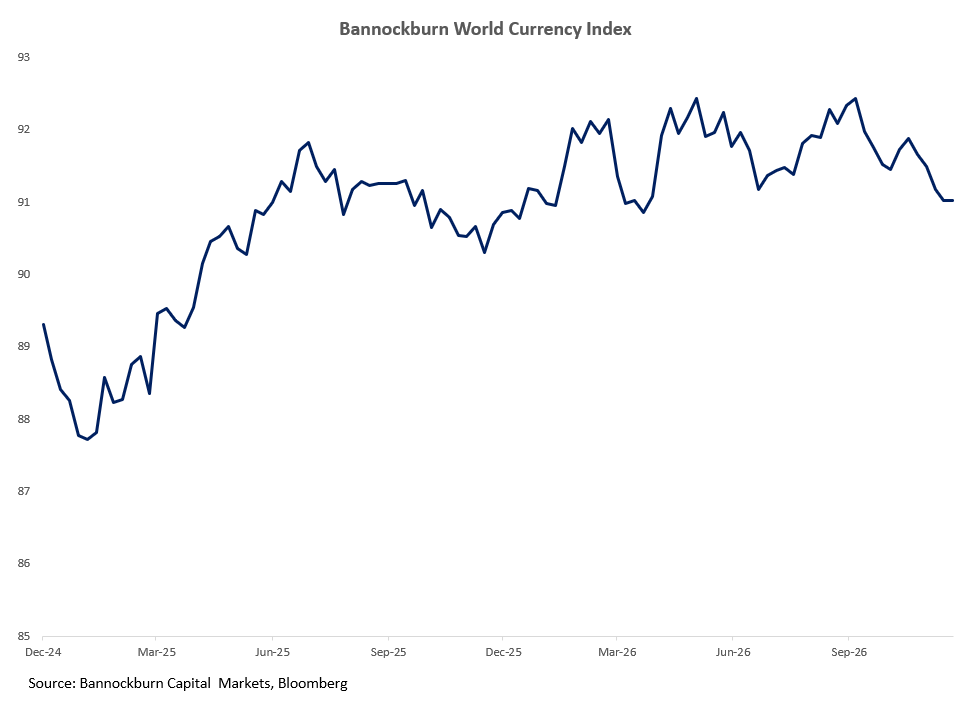
Bannockburn's World Currency Index is composed of the currencies of the dozen largest economies--half of which are from high-income countries and half from emerging markets. It fell for the third consecutive month in November, reflecting the depreciation of most of the currencies against the dollar. Still, the BWCI held above the year's low set in March. The nearly 0.70% decline was the largest since June.
All of the G10 components fell. The Australian dollar declined the most. It depreciated by about 5.5%. Sterling dropped almost 2.25% and the euro and Canadian dollar by around 2%. The yen was the best performer, losing about 1.25%.
The emerging market currency members of BWCI fell except for the Indian rupee, which gained about 2.1%. The Mexican peso had a rough month. It fell by around 4.4%. The Brazilian real was down more but recovered late in the month from the post-election drubbing after President Lula toned down his rhetoric and named a market-friendly finance minster, Bradesco's Chair, Trabuco. It still was off 1.7% on the month. The Russian ruble declined by 2.0%. The Chinese yuan and South Korean won were flat in November.
U.S. Dollar: The dollar's resilience in the face of decline of US interest rates amid the dramatic drop in equity prices and the pullback in the energy prices is notable. The greenback made new highs for the year against nearly all the G10 currencies in November, except the Japanese yen and Norwegian krone. The stronger than expected October jobs growth and hotter inflation reading solidified expectations for another hike by the Federal Reserve in December. Encouraged by Governor Waller and the FOMC minutes that suggested he was not alone, the market flirted with the possibility of a 50 bp move, but the sell-off in stocks lent support to the gradualist camp. Indicative pricing the Fed funds futures has two hikes fully discounted by the middle of 2027 and about a 40% chance of a third, quarter-point hike. A couple of days after the FOMC's decision and new economic projections on December 9, the federal government faces a funding deadline. This could be an usual clash during the lame duck session (before the new Congress is seated in early January) over funding for the war in Iran. Other provisions expire at the end of the calendar year, including Temporary Assistance for Needy Families (TANF), the Community Health Center Fund, the 2.5% Medicare physician fee increase, and Export-Import Bank authorization. In the short-term we tend to put weight on momentum and high-frequency data, but in the in the medium-term, interest rate considerations often provide the signal.
Euro: The euro depreciated by about 2.0% in November. It brings the year-to-date loss to about 6.9%. In late November, the euro was sold to new lows for the year. With the November losses to $1.0880, the euro has met a technical retracement objectives of the rally from the 2025 low near $1.0140. Last month, we warned of the risk of a move to $1.0880, but that may have exhausted the pressure on the euro, though a convincing close above $1.10 would suggest a bottom may be being forged. Still, the downside risk may extend toward the next technical target, the March 2025 low near $1.0735, and then potentially $1.06. The euro peaked in November around $1.1275 a couple of days before the greater-than-expected US job creation in October (reported November 6) and then the hotter than expected October CPI four days later. The ECB meets on December 17, and the swaps market remains confident (95%+) of an ECB rate hike. Another hike is not discounted until late in Q2 27. A grand deal appears to have been struck for the ECB's leadership next year. Pablo Hernandez De Cos, who now leads the Bank for International Settlements, will likely replace Lagarde as president at the end of February. Germany has nominated Markus Brunnermeier to replace Lane at the end of May 2027 as the ECB's chief economist, while France has nominated Laurence Boone to the executive board to replace Germany's Schnabel who is stepping down in early January to join the IMF and who oversaw market operations at the ECB.
(As of November 27, indicative closing prices, previous in parentheses)
Spot: $1.0936 ($1.1160) Median Bloomberg One-month forecast: $1.1240 ($1.1230) One-month forward: $1.1175 ($1.0955) One-month implied vol: 5.8% (5.8%)
Japanese Yen: The dollar reached a two-month high against the Japanese yen in mid-November, near JPY160.20. It arguably was bolstered by the rise in US interest rates. However, Japan officials warned that that were prepared to counter disorderly moves in the market. When interest rates fell later in the month under the weight of the sell-off in equities and energy the dollar was sold to around JPY158.40. The 30-day rolling correlation between changes in the 10-year US yield and the dollar-yen exchange rate trended higher in recent weeks and reached a new high for the year, a little above 0.75. The correlation of changes in the US two-year yield and the exchange rate also rose to a new high for the year, slightly above 0.80. The exchange rate's correlation with Japan's two-year yield (a proxy for BOJ tightening) is positive but barely (0.03). The Bank of Japan meets on December 18. The swaps market has around an 80% chance of a hike discounted, even after the unexpected contraction in Q3 GDP. With the threat of Japanese intervention stalled the greenback around JPY160 and this means appears to have deflected the dollar bulls away from the yen as they seek the path of least resistance. This has led to the yen's relative outperformance in November. With a little more than a 1.2% loss in the month, it rivaled the Swiss franc as the strongest G10 currency.
Spot: JPY159.56 (JPY157.55) Median Bloomberg One-month forecast: JPY158.05 (JPY157.25) One-month forward: JPY159.10 (JPY157.20) One-month implied vol: 6.8% (7.3%).
British Pound: Sterling’s November 23 low for the year near $1.3010 matched last November’s trough, leaving $1.2985 as nearby retracement support. That marks the halfway point of the rally from the January 2025 low, near $1.21 to the January 2026 high of almost $1.3870. The next retracement objective is around $1.2775. Still, the momentum indicators are stretched after November's five-cent decline; a reversal could target $1.3200, initially. Swaps price around an 85% chance of a December 17 BOE hike and nearly two more increases by mid-2027. Stronger than expected Q3 growth (0.7% quarter-over-quarter) is expected to slow to 0.2% in Q4, while inflation is projected to peak at 4% next year. Prime Minister Burnham’s EU agreements deepen integration through food standards, carbon markets, and youth mobility. He has changed the terms of the domestic political debate and lifted Labour fortunes in national polls. There is some speculation that the Labour Party may put returning to the EU as part its political platform ahead of the next general election. The Office for Budget Responsibility projects the budget deficit narrowing to 4.2% this year and 3.4% in 2027.
Spot: $1.3096 ($1.3390) Median Bloomberg One-month forecast: $1.3293 ($1.3345) One-month forward: $1.3100 ($1.3395) One-month implied vol: 5.9% (5.6%)
Canadian Dollar: The diverging employment reports in early November confirmed the end of the US dollar's decline in the second half of October. Amid the powerful risk-off forces, the US dollar rose to new highs for the year, near CAD1.4385 on November 23. The Federal Reserve and the Bank of Canada meet on December 9. Both will most likely deliver a 25 bp hike. The market has another bank of Canada hike be the end of H1 27 discounted and a small chance for a second. In contrast the market has 70 bp of Fed tightening by the end of H1 27. The Bank of Canada indicated it will focus on old measure called CPI-X, which excludes eight fixed sets of items from the inflation calculation to provide a consistent benchmark of how prices are evolving. The central bank will also continue to use "CPI-trim" as its other core measure, which strips out the items seeing the most extreme price changes in each month. In October, headline CPI rose 3.1% year-over-year, CPI-X was at 2%, and CPI-trim was 1.8%. Bank of Canada Macklem term ends in early June 2027 and he has indicated no intention to seek a second term. A committee of the board, with many independent members, will pick Macklem's successor with the final approval by the finance minister and the Federal cabinet. Prime Minister Carney extended the previously agreed trade pact with China, while also improving relations with Europe. September was the first full month of the US 50% levy on about 5% of Canada's exports to the US. It may be a drag on Q4 GDP.
Spot: CAD1.4247 (CAD 1.3975) Median Bloomberg One-month forecast: CAD1.4008 (CAD1.3985) One-month forward: CAD1.4225 (CAD1.3955) One-month implied vol: 4.7% (4.2%)
Australian Dollar: Poor economic data saw the derivatives market bring forward the first rate cut. This dragged the Australian dollar down by about 5.5% in November, its worst month since September 2022. In early November, the market was still discounting another hike by the end of Q1 27. Now, the market is fully confident of a cut by in Q3 27. The October employment report showed back-to-back steep losses (-36.4k in September and -43.5k in October). The unemployment rate rose to 4.9% (from 4.7%), a new cyclical high. The preliminary November Composite PMI was 46.1. It was below the 50 boom/bust level for the second consecutive month. It was above 53.0 as recently as July. Despite the weakness, the market is convinced that after hiking rates in November, the central bank is ill-positioned to cut rates when it meets on December 8. Inflation remains sticky. The headline pace rose to 4.9% year-over-year in October, a new cyclical high.
Spot: $0.6648 ($0.7030) Median Bloomberg One-month forecast: $0.6989 ($0.7070) One-month forward: $0.6640 ($0.7025) One-month implied vol: 8.1% (8.0%)
Mexican Peso: The peso's fortunes have changed. It has gone from among the strongest emerging market currencies to one of the weakest. November was the third consecutive month of a steep decline. It dropped nearly 3.5% last month after falling closer to 4% in October and 6.3% in September. At first, it seemed as if the dollar-funding trades were unwound, but then it morphed into selling local currency bonds, not just in Mexico, but throughout Latam. More recently, the risk-aversion further undermined the high-yield theme. Mexico's central bank rate cut may not have helped sentiment, but until late in November, it had outperformed the Brazilian real and the Chilean peso. The Colombian peso's 9.8% decline weas the most in the region. Mexico's central bank meets on December 17 and there is little chance of a change in policy. With the November cut, which caught many by surprise, the central bank was explicit. It was a one-off adjustment, and policy would be held steady for an extended period. The dollar reached almost MXN19.85 in late November, its highest level since May 2025. Initial support is now seen around MXN19.30.
Spot: MXN19.6526 (MXN18.7855) Median Bloomberg One-month forecast: MXN18.5372 (MXN18.38) One-month forward: MXN19.6955 (MXN18.8240) One-month implied vol: 12.7 (12.1%)
Chinese Yuan: In early November, the PBOC signaled that what appeared as a one-way yuan uptrend needed to slow. It did so through comments and an unexpected increase in the reserve requirements for foreign currency deposits. In Q3, the yuan rose every week but once a month and in October rose every week. In November, it was mixed on a weekly basis but settled little changed. Still, by most reckoning, the yuan's appreciation was modest. Over the four months, it rose by about 2%. After the signal, the dollar traded in a roughly a CNH6.6500-CNH6.7000 range against the offshore yuan and about the same against the onshore yuan. Yet, by hugging the dollar in a strong USD environment translates to yuan appreciation against most other currencies. Consider that in November, the yuan rose by about 2.0% against the euro, 5.5% against the Australian dollar, and more than 4.4% against the Mexican peso.. That brings the year-to-date gains to 11.4% against the euro, 5.2% against the Australian dollar, 5.7% against the Brazilian real, and nearly 12.75% against the Mexican peso. Given production-costs differentials, it is not totally unexpected that China's trade surplus has continued to rise. The rolling 12-month average trade surplus reached a record $105.4 bln in October. China's export growth has reflected the AI build-out. Chinese equities have underperformed, even after officials marshalled government institutions to buy shares. In late November, with explicit government approval, the major equity exchanges reduced the minimum margin from zero to 20%. The adjustment will apply to both new and existing margin purchase contracts. Some initial estimates project it would free up CNY400 bln (~$60 bln).
Spot: CNY6.6553 (CNY6.6545) Median Bloomberg One-month forecast: CNY6.6502 (CNY6.6700) One-month forward: CNY6.6860 (CNY6.900) One-month implied vol: 2.3% (2.3%)



Comments
Log in or sign up to join the conversation.