

Unfortunately, Twitter is required reading for market participants these days and not just because Donald Trump, the world’s foremost cross-asset strategist, randomly tweets out material nonpublic information on everything fromcrude to rates to FX and leaks critical economic data an hour ahead of its official release from @realDonaldTrump, the best frontrunning resource in the history of markets.
Even if @realDonaldTrump didn’t exist (if only the world would be so lucky), Twitter is a must-monitor for traders because frankly, that’s where news hits first. Before it’s anywhere, it’s on Twitter and really, it’s sometimes on Twitter before it’s even news.
Exhibit A:
Consider a scenario like that which played out on September 6, 2017, when, at roughly 5:40 A.M. New York time, the machines mistook a tweet from the British Geological Survey about North Korea’s last nuclear test as a new event. Here’s the tweet:
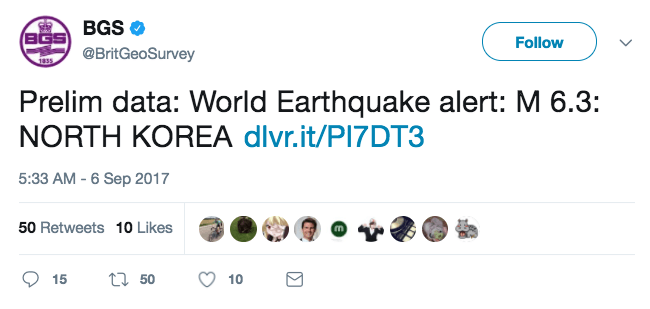
Human beings would have immediately known that tweet was in reference to the September 3 test because carbon-based traders would recognize the 6.3 number. But the robots didn’t make the connection. Here was the result:

More than a few Twitter users recognized the magnitude (no pun intended) of what had just happened. Here are two examples:

Given all of that, it makes sense (I guess) to try and retrospectively determine the extent to which tweets are affecting markets or, perhaps more to the point, simply use tweets to proxy for “news” when it comes to assessing the impact of that news (on the assumption that if markets are any semblance of efficient, they’ll incorporate incremental information as soon as it hits Twitter).
With that as the backdrop, Goldman is out with a new piece that seeks to use tweets to quantify the effects of trade tensions on FX.
While Goldman is quick to add the “important” caveat that they are “not controlling for any other variables”, they do observe that high tariff news (read: tweets) days are associated with weakness in EM Asia FX.
“We find that currencies of economies in EM Asia (KRW, CNY, THB, IDR, PHP and TWD) and those of certain commodity exporters (particularly CLP but also, to a lesser extent, COP, BRL and RUB) have seen worse returns during high-volume tariff news days year-to-date, relative to other days”, the bank goes on to write, describing the following visual:

The bank goes on to talk shop on the way to extending the news-based analysis to account for contagion via growth-channels, but in the interest of brevity, allow me to simply note that spillover to EM Asia is the first step towards transmission of trade-related yuan weakness to broader markets. So before you write this off as inconsequential, or otherwise so intuitive as to be largely meaningless, consider it in that context.
Here are a couple of possibly useful tweets (appropriately) on this from former Goldman Chief FX strategist and current Chief Economist at the IIF, Robin Brooks:
RMB contagion (1/2): one of the hardest hit currencies after the RMB step deval on August 11, 2015, was the Malaysian Ringgit, which was in focus both as a CNY proxy and oil exporter. Other EM Asia currencies held in well, in part due to official foreign exchange intervention. pic.twitter.com/NkemB1hn9O
— Robin Brooks (@RobinBrooksIIF) July 20, 2018

RMB contagion (2/2): red and pink areas show intensity with which Malaysia intervened in spot and forward markets to support the MYR following the Aug. 11, 2015, step deval. Our Exchange Market Pressure (EMP) index shows that depreciation pressure was larger than meets the eye. pic.twitter.com/O4zqhboIBL

“As was the case in 2015 and has held true of late, a quickly depreciating CNY would not happen in a vacuum”, Deutsche Bank’s Dominic Konstam wrote, in a note dated July 19, adding that “it would inevitably be accompanied by similar scale weakness in other EM Asia FX – as was the case in 2015 and has been the case for the bulk of this year.”
Meanwhile, a Goldman analysis out earlier this month showed that foreign money is fleeing Asia EM equities at the third-fastest pace in 16 years, negating 14 months of inflows in the process.

So you know, stay tuned to Twitter where, as an added perk, you’ll get to watch the death of civil discourse unfold in real time.


Comments
Log in or sign up to join the conversation.