

Not that I’m complaining. But seriously, it’s far past the “day one” of the new Administration when Donald Trump promised China would be declared a currency manipulator.
The Treasury’s report was released last week. Treasury uses the following criterion:
Pursuant to Section 701 of the Trade Facilitation and Trade Enforcement Act of 2015, this
section of the Report seeks to identify any major trading partner of the United States that
has: (1) a significant bilateral trade surplus with the United States, (2) a material current
account surplus, and (3) engaged in persistent one-sided intervention in the foreign
exchange market. Section 701 requires data on each major trading partner’s bilateral trade
balance with the United States, its current account balance as a percentage of GDP, the
three-year change in the current account balance as a percentage of GDP, foreign exchange
reserves as a percentage of short-term debt, and foreign exchange reserves as a percentage
of GDP. Data for the most recent four-quarter period (July 2016 to June 2017, unless
otherwise noted) are provided in Table 1 (on p. 15) and Table 2 (below).
These translate to $20 billion bilateral trade surplus with the US, CA surplus of 3% of GDP, and forex intervention of 2% worth of GDP. The table below shows how various countries stack up:
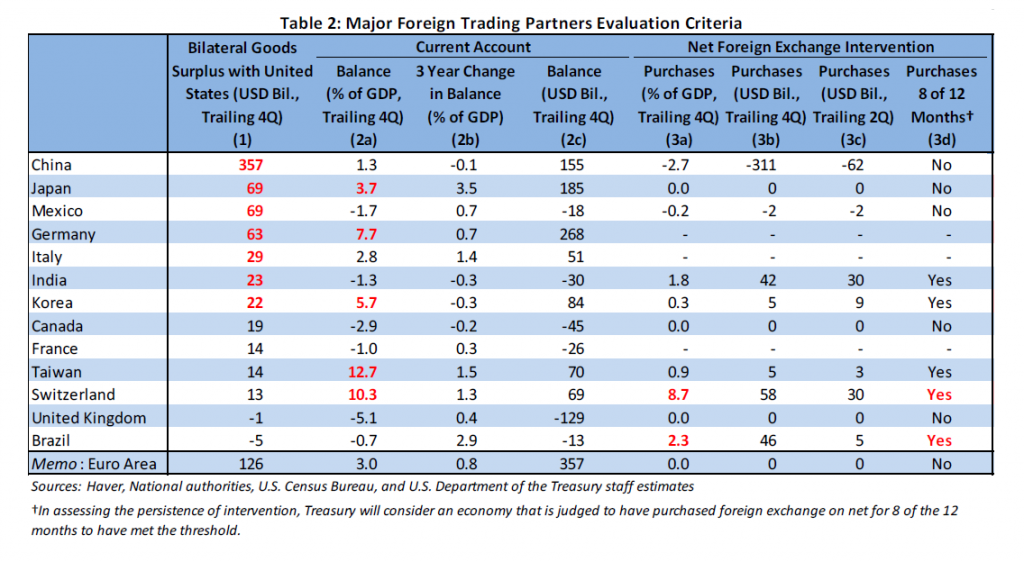
Notice that seven countries pass the bilateral trade balance threshold – but I must confess that this criterion has never made sense to me.
The more plausible CA/GDP threshold is exceeded for Japan, Germany, Korea, Taiwan and… Switzerland. And in terms of magnitude of FX intervention (the measure that most closely matches what the textbook would characterize as “manipulation”, in my opinion), Switzerland and Brazil meet the 2% of GDP threshold. Interestingly, China doesn’t meet either of the latter two thresholds.
Another perspective on misalignment (separate from “manipulation”) is provided by the price criterion. One version of the price criterion is that the exchange rate is at such a level that purchasing power parity is violated, then a currency is misaligned. However, a well known empirical phenomenon is that the price level is lower in lower income countries — the “Penn effect”.
Recently, Yin-wong Cheung, Xin Nong and I implemented a panel time-series cross-section analysis of the Penn effect (forthcoming in International Finance; discussion of working paper in this post), in which we concluded that as of 2014, the Chinese currency was not undervalued, and could have been actually been overvalued. That result was obtained using World Bank data, which lags considerably.
What about in 2017? I use Big Mac data for July 2017, and estimated real per capita income for 2017, to generate the following graph.
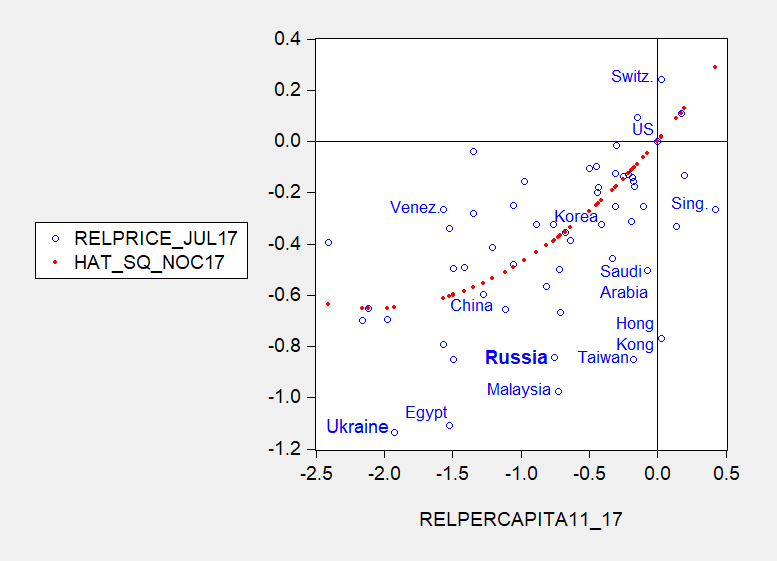
Figure 1: Log relative price of Big Mac against log relative per capita income in constant 2011 PPP prices, for July 2017 (all relative to US). Red dots are quadratic fit with no constant. Source: Economist, IMF World Economic Outlook October 2017 database, author’s calculations.
The red line is a quadratic fit imposing a no-constant specification for July 2017. According to this price approach, the Chinese yuan was only 4.3% undervalued (in log terms).
A few more observations.
- The Swiss franc is overvalued by 22.1%
- I If China were to be declared a currency manipulator on this basis, Russia would also need to be declared one, as the estimated misalignment is 45.7% undervaluation.
- On the other hand, many of the countries Brad Setser recently tagged as worthy of attention — Malaysia, Taiwan, Hong Kong, Singapore — have undervalued currencies. (Strangely, Korea does not have a substantially undervalued currency).
By the way, how does Russia stack up on the Treasury’s criteria? The current account is forecasted to by the IMF’s World Economic Outlook to be 2.8% of GDP in 2017 (not far below the 3% threshold), and reserve accumulation about 1.2% of GDP, according to the 2017 IMF Article IV report.
So, if Donald Trump ever does “pull the trigger” to declare China a currency manipulator, it would only seem appropriate to declare Russia one as well…

Comments
Log in or sign up to join the conversation.