

Building a Machine learning model is just one of the many hurdles when it comes to the data science journey. In the real world , the challenges are not over once your model is up and running - things get really interesting afterwards. How do you actually deploy it? How do you keep an eye on its performance? What happens when there's a wave of new data that starts producing different predictions? And how the heck do teams update their models without having to start from square one?
This is where a Data Science MLOps Course really starts to shine. MLOps basically brings together data science, machine learning, software development and operations all under one roof in order to make machine learning systems a heck of a lot more reliable and easier to handle once they're live in production.
Why bother learning MLOps?
Data science projects usually kick off with experimentation. A data scientist grabs some data, cleans it up, builds a model, tests its accuracy and gets some promising results. But you know what? A model that works a treat in a notebook is not automatically ready for the real world.
A practical MLOps course helps bridge that gap. Rather than just focusing on building models, learners get to understand what actually happens when those models are churning along 24/7 in a real business environment.
With the right MLOps training, you can get up to speed on things like model deployment, version control, automating the process, monitoring performance, data pipelines, CI/CD, cloud platforms and managing a model throughout its entire lifecycle.
Ultimately the goal is pretty simple, to make machine learning useful beyond just the dev stage.
What Will You Learn?
A good Machine Learning Operations (MLOps) course takes you on a complete journey from developing a model to actually getting it into production.
You start out by getting the basics of MLOps down, and that means understanding how data science teams work together with the people who write the code and keep the systems running. From there you can move on to more advanced stuff like versioning different models, tracking how experiments go, automating testing, putting models into rotation, keeping track of how they're performing, and making sure the computers they run on are being properly looked after.
One of the real key areas is model deployment - often a model behaves perfectly in a test environment, but as soon as it gets real world data flowing in, things can change. A well-set up MLOps workflow lets teams keep an eye on these changes and spring into action when needed.
This is what makes an MLOps course so valuable for folks looking to become machine learning engineers or data pros - it gives them the skills to take their models from the lab to the real world.
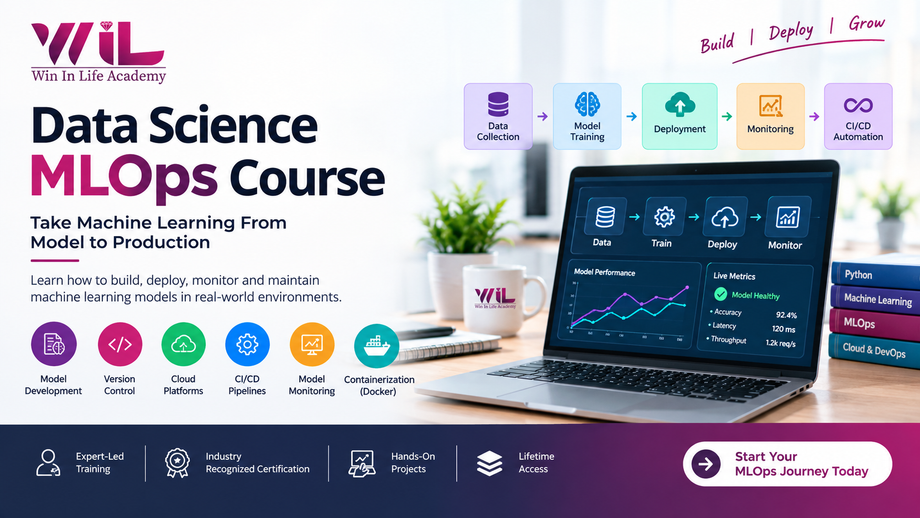
Data Science and MLOps
Data science and MLOps go hand in hand . Data scientists are laser focused on uncovering patterns, building models, and extracting insights, but MLOps makes sure those models then get properly delivered and supported.
Getting a handle on both data science and MLOps gives professionals a serious 360-degree view of the machine learning workflow. Rather than just handing off a finished model to some other team and crossing your fingers that everything magically works out , learners get to see what really goes on to get that model into actual use.
This combo is pretty valuable for organisations that are depending on machine learning to help them out with things like building recommendation systems , catching fraud , customer analysis, forecasting, automating tasks & creating a more personal experience for their customers.
Why Production Skills Matter
Imagine spending weeks developing a machine learning model only to discover that deploying it is complicated. This is a common challenge for teams moving from experimentation to production.
An MLOps professional course can help learners develop the skills required to handle this transition. You can learn how to package models, automate workflows, manage different versions, monitor performance, and create repeatable deployment processes.
Production-focused learning also encourages better collaboration between data scientists, developers, and operations teams. Everyone works toward the same goal: creating machine learning systems that are stable, scalable, and maintainable.
Tools and Technologies
MLOps involves a range of tools and technologies. Depending on the course, learners may work with Python, Git, Docker, cloud platforms, CI/CD tools, MLflow, Kubernetes, and other machine learning infrastructure.
You don't need to master every tool immediately. What matters most is understanding why these tools are used and how they fit into the overall workflow.
Hands-on projects can make this much easier. For example, instead of simply reading about model deployment, learners can take a trained model, package it, deploy it, monitor its performance, and make updates.
That practical experience can be much more valuable than memorizing definitions.
MLOps Certification and Career Growth
An MLOps certification can help demonstrate your understanding of machine learning operations and production workflows. A Data Science MLOps certification can be particularly useful for professionals who want to show skills across both data science and MLOps.
However, certification should be viewed as part of the learning journey rather than the final goal. Employers also value practical knowledge, problem-solving ability, and experience working on real projects.
Building a portfolio that demonstrates model deployment, automation, monitoring, and pipeline development can help you stand out when applying for relevant roles.
Who Should Take a Data Science MLOps Course?
A Data Science MLOps Course can be useful for data scientists, machine learning engineers, software developers, data analysts moving toward machine learning, and students interested in production-level AI.
It can also benefit professionals who already understand machine learning but want to learn what happens after a model has been built.
Whether you're starting your career or upgrading your existing skills, learning MLOps can help you understand the complete machine learning lifecycle.
Take Machine Learning Beyond the Notebook
Machine learning becomes truly valuable when it can solve real problems consistently. Building an accurate model is important, but deploying, monitoring, updating, and maintaining that model is equally important.
A Data Science MLOps Course can help you develop this broader perspective. With practical MLOps training, hands-on projects, and an understanding of deployment and automation, you can move from simply building machine learning models to helping bring them into production.
As businesses continue adopting AI and machine learning, professionals who understand both data science and production workflows can play an important role in turning experimental models into reliable solutions.
Comments
Log in or sign up to join the conversation.