

The good folks at “Our World in Data” have been putting together a data series which shows monthly spending on the “on-site work to build data centers each month, including materials and construction labor. It excludes the cost of IT hardware like servers and storage, which can account for a large share of total investment.” Here’s the just-updated figure:
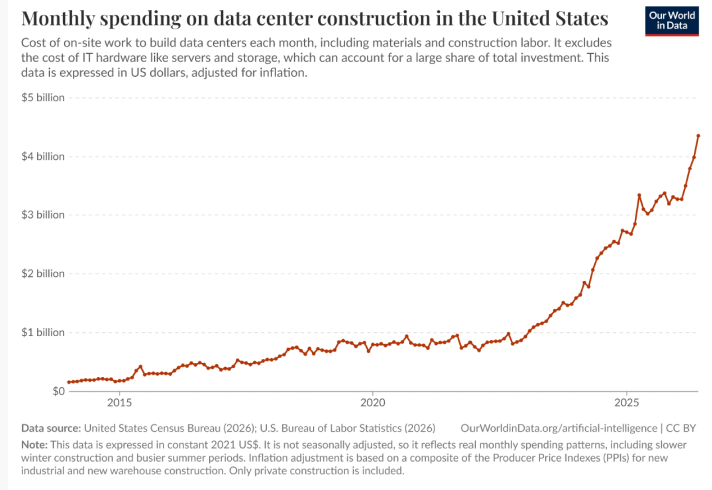
There’s an upward trend from about 2014, but the big rise kicks in around early 2023. At least as of the most recent data on this graph, for June 2026, there is no sign of the rise slowing down. Again, these are monthly figures, so on current trends, it’s plausible that just on-site construction spending for data centers will total $40 billion or more in 2026.
I’m of course aware that there is a degree of political pushback against building data centers, which the figure suggests isn’t having a dramatic effect, and which I think is largely misguided. Sure, there should be limits on where such centers can be built. But when I go on road trips around the country, I often find myself smiling when I drive into a modest-sized town, out in the countryside somewhere, and there is a sign and a turnoff for a hopefully named “industrial park”–without any actual firms or buildings visible. If the local community has already set the rules for industrial zoning, then data centers would seem to qualify. The on-site construction spending, as well as the longer-term running and maintenance of these sites, is largely blue-collar work. Yes, there are issues to work out concerning energy, water, noise, and traffic. But some version of those issues will be true for pretty much any firm that wants to build in an industrially zoned area.
Some of the opposition to data centers seems to arise because of a specific opposition to the new AI technologies, and yes, the new AI technologies are another reason for the recent surge of data center construction. But trying to limit AI in particular by hindering construction of data centers seems poorly targeted; for example, why not also try to limit AI by hindering US production of semiconductor chips, computers, smartphones, or other information technology products? Of course, if you just oppose all uses of information technology, it makes some sense. Bit If you have a smartphone, or shop online, or work from home, or stream on your computer or television, or basically use the internet in any way, then you are using data centers. As the makers of the figure note, “Data centers power a wide range of online services beyond AI, such as streaming services and cloud storage.”
I’ll also add that AI as an industry may have the worst public relations campaign I’ve ever seen. As one of many examples, Genspark ran an ad during the Super Bowl that celebrated the idea that AI could do all your work–so that you could “take the day off.” If AI is about taking everyone’s job, while producing endless online “AI slop” and deepfakes in text and video, while enabling hacking and simultaneously making a few tech bros rich beyond the dreams of avarice, then there isn’t much to celebrate. But maybe, just maybe, the worst-possible scenarios are not all there is? Maybe, just maybe, there can be positive effects as well?
As one example (among many) of potential gains, Saloni Dattani recently published an essay titled “Every disease is a policy failure” (Works in Progress, August 11, 2026). The subtitle reads: “Few people know how much medicine has progressed in their lifetimes. Fewer know how much faster it could be progressing.” You can read about the gains over time in treating heart disease, diabetes, cancer, low-birthweight babies, and many others. If AI-assisted research has the potential to speed up health and medical innovation, so that it adds a decade or two to the average healthy human life, that possibility seems to me worth being open to a building boom in data centers.


Comments
Log in or sign up to join the conversation.