


The Czech 2027 draft budget widens the deficit to 3.5% of GDP and lifts borrowing needs to a record high. Higher issuance weighs on CZGBs, although some prefunding is likely this year. Faster public sector wage growth and looser fiscal policy also raise the risk of a CNB rate hike from November
MinFin proposes the highest deficit since 2023
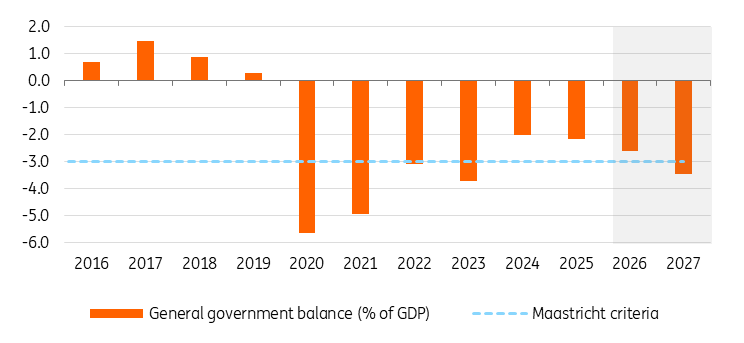
The Ministry of Finance has proposed a 2027 state budget deficit of CZK389bn, implying a general government deficit of 3.5% of GDP, an increase from this year's 2.6% and the highest since 2023. The draft remains subject to government approval by end-September and subsequent approval by the lower house of parliament. Both junior coalition parties are pressing for a smaller shortfall, so some revisions are possible, although we do not expect material changes. The ministry lists healthcare, defence, higher living standards and “above-average” economic growth as priorities. The biggest spending increases are earmarked for defence and investment in industry and transport. But at the same time, public sector wages are set to rise by 5-9%, with details due in September.
After the election, the new government pledged to keep the general government deficit below 3% of GDP. It can meet this target for European Commission reporting by invoking the escape clause for defence spending, which lowers the reported deficit to 2.8% of GDP. Looking ahead, the draft budget projects fiscal consolidation from 2028, with the deficit narrowing by 0.5ppt each year.
Public finance forecast
Record borrowing needs put CZGBs under pressure and will trigger more switches
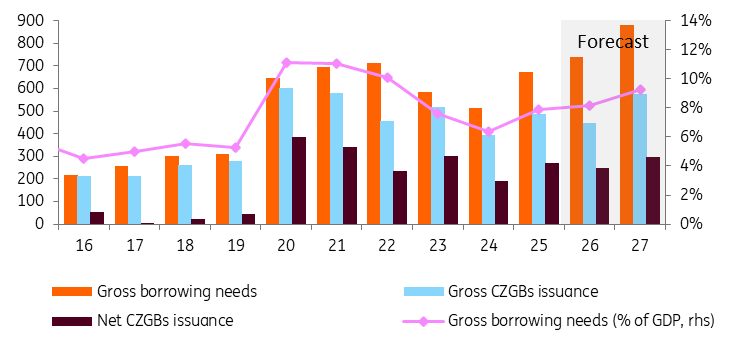
The larger-than-expected deficit will coincide with record Czech government bonds (CZGBs) redemptions of CZK278bn. By our calculations, this lifts gross borrowing needs from CZK738.2bn this year to CZK881.9bn in 2027, up 19% year-on-year to an all-time high, although they remain well below Covid-era levels as a share of GDP. On the positive side, the Ministry of Finance has gained a new funding source through retail bonds and is likely to rely on it more as borrowing needs rise.
Strong demand in the first retail bond auction this year means this year's financing already appears largely covered, giving MinFin scope to begin prefunding when global conditions allow. We expect more switches of 2027 maturities during the rest of the year to reduce record redemptions. Assuming no switches or budget changes, gross CZGB issuance would rise 28% year-on-year and net issuance 19%. Prefunding should ultimately reduce these increases, but the draft budget is clearly negative for the CZGB market.
Gross financing needs and CZGBs issuance (CZKbn)
Expansionary budget adds to CNB hawkish risks
The draft budget challenges the Czech National Bank's August forecast and adds to hawkish risks. The central bank expects the public finance deficit to reach 2.9% of GDP next year, 0.6ppt below the draft budget estimate.
The proposal also includes a 5-9% rise in public sector wages, while the government last week approved minimum wage increases of 11.2% in 2027 and 8% in 2028. This puts the CNB’s 5.7% wage-growth forecast at risk. The board identified wage growth as an upside inflation risk in August, while policymakers frequently cite expansionary fiscal policy as another concern. Our baseline remains for unchanged CNB rates in the near term, but the draft budget raises the likelihood of a hike in November or later.



Comments
Log in or sign up to join the conversation.