

When setting up a commercial kitchen, one of the most important decisions is whether to purchase standard restaurant equipment or invest in custom-made equipment.
Standard equipment is usually available in predefined sizes and configurations, while custom equipment can be designed according to the kitchen's dimensions, workflow, menu and production requirements.
There is no universal answer that custom equipment is always better or that standard equipment is always more economical. The right choice depends on the restaurant's operating requirements.
For businesses evaluating Restaurant Equipment in India, understanding the difference can help avoid unnecessary costs and improve kitchen efficiency.
What Is Standard Restaurant Equipment?
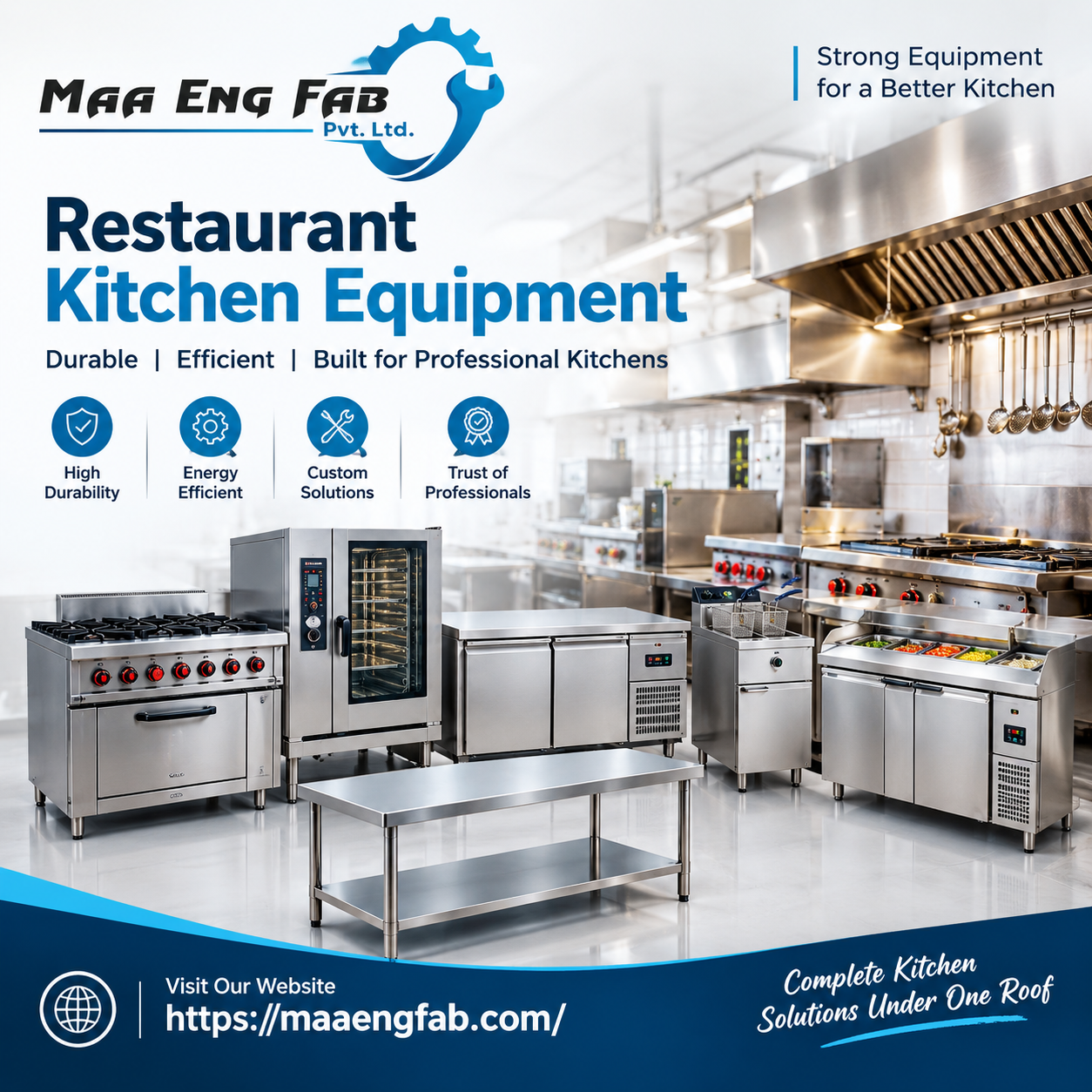
Standard restaurant equipment is manufactured according to commonly used dimensions, capacities and configurations.
Examples include:
Commercial cooking ranges
Fryers
Ovens
Refrigerators
Freezers
Mixers
Food processors
Standard worktables
Standard sinks
Storage racks
The major advantage is availability. Standard equipment is generally easier to compare, purchase and replace.
It can also be more economical when the restaurant's kitchen layout already accommodates commonly available dimensions.
What Is Custom Restaurant Equipment?
Custom equipment is designed and manufactured according to specific requirements.
Customization may involve:
Dimensions
Counter height
Equipment configuration
Burner arrangement
Storage arrangement
Sink dimensions
Workstation design
Integrated equipment
Special fabrication
Kitchen-specific layouts
Custom fabrication becomes particularly useful when standard equipment cannot efficiently utilize the available space.
For example, an unusual wall dimension may leave a significant unused gap if standard counters are installed. A properly designed custom counter can use that space more effectively.
Standard vs Custom: The Key Difference
The biggest difference is flexibility.
Factor | Standard Equipment | Custom Equipment |
|---|---|---|
Dimensions | Predefined | Made to requirement |
Availability | Usually faster | Requires manufacturing time |
Initial cost | Often lower | Can be higher |
Space utilization | Good for conventional layouts | Better for unusual spaces |
Configuration | Limited | Highly flexible |
Replacement | Generally easier | May require custom fabrication |
Menu-specific design | Limited | Can be application-specific |
Best suited for | Common requirements | Specialized requirements |
The choice should therefore be based on operational value rather than simply purchase price.
When Standard Equipment Makes More Sense
Standard equipment can be the better option when the restaurant has a conventional kitchen layout and does not require unusual configurations.
It can be particularly suitable for:
Small restaurants
Cafés
QSRs
Cloud kitchens
New businesses with standard menus
Kitchens with limited customization requirements
Another advantage is faster availability.
If a restaurant needs to open quickly, ready-made equipment can reduce waiting time compared with equipment that must be designed and fabricated.
When Custom Equipment Makes More Sense
Custom equipment becomes more valuable when the kitchen has specific constraints.
For example:
1. Limited Kitchen Space
Indian commercial kitchens can sometimes have irregular layouts, narrow spaces or difficult corners.
Custom fabrication can help use these areas more efficiently.
2. Special Menu Requirements
A restaurant specializing in a particular cuisine may need equipment configurations that are not readily available in standard models.
3. High-Volume Production
Large kitchens may benefit from equipment designed around their actual production workflow.
4. Specific Workflow Requirements
If ingredients move through a defined sequence from preparation to cooking to service, custom workstations can be designed around that process.
5. Integration
Custom fabrication can sometimes combine preparation, storage and working areas into a single coordinated workstation.
Why Kitchen Layout Matters
Equipment should not simply fit inside the kitchen. It should support the workflow.
A well-planned kitchen generally considers the movement of:
Storage → Preparation → Cooking → Holding → Plating → Service
If equipment placement forces employees to repeatedly cross the kitchen, productivity can suffer.
Custom equipment can provide an advantage where standard dimensions create unnecessary gaps or awkward movement.
However, customization should be used only when it provides a genuine operational benefit.
Cost: Is Custom Equipment Always More Expensive?
Custom equipment can have a higher initial cost because it requires additional design, fabrication and sometimes installation work.
However, purchase price alone does not determine the actual value.
Consider:
Initial Cost + Installation + Energy + Maintenance + Space Utilization + Productivity
For example, a standard counter may be cheaper initially but may leave unusable space and create inefficient staff movement.
A custom counter may cost more but improve workflow and make better use of the available area.
Therefore, the correct question is not:
"Which equipment is cheaper?"
Instead ask:
"Which equipment provides better value for this particular kitchen?"
What About Maintenance and Replacement?
Standard equipment generally has an advantage when replacement is required because common models and components may be easier to identify.
With custom equipment, replacement may require more specific fabrication or component sourcing.
Therefore, Restaurant Equipment Suppliers should provide clear information about:
Maintenance
Spare parts
Service support
Replacement components
Fabrication details
Warranty
This becomes especially important for equipment used continuously in high-volume kitchens.
How Restaurant Equipment Suppliers Can Help
A professional Restaurant Equipment Supplier should first understand the restaurant's requirements before recommending standard or custom solutions.
Important information includes:
Menu
Kitchen dimensions
Expected production volume
Peak-hour demand
Available utilities
Staff workflow
Budget
Future expansion
Restaurant Equipment Suppliers in India may offer both ready-made and customized solutions, so buyers should compare the operational advantages of each rather than selecting solely on quotation price.
Role of a Restaurant Equipment Manufacturer
A Restaurant Equipment Manufacturer can be particularly useful when the project requires customized fabrication.
The manufacturer should be able to understand:
Equipment dimensions
Material requirements
Production requirements
Workflow
Utility connections
Installation constraints
Maintenance access
When evaluating a Restaurant Equipment Manufacturer in India, ask for proper specifications and drawings before approving customized fabrication.
This can help avoid dimensional errors after installation.
A Practical Decision-Making Method
Use this simple process before choosing between custom and standard equipment:
Step 1: Measure the kitchen accurately.
Step 2: Finalize the menu and cooking processes.
Step 3: Estimate peak-hour production.
Step 4: Identify available standard equipment.
Step 5: Check whether standard equipment fits the workflow.
Step 6: Identify areas where standard equipment creates problems.
Step 7: Calculate the cost of customization.
Step 8: Compare long-term operational benefits.
Step 9: Check service and spare-parts support.
Step 10: Choose custom equipment only where it provides a measurable advantage.
The Best Approach May Be a Combination
Restaurants do not necessarily need to choose 100% standard or 100% custom equipment.
A hybrid approach can often be more practical.
For example:
Standard equipment:
Ovens, fryers, refrigerators, mixers and other commonly available machines.
Custom equipment:
Worktables, sinks, counters, storage units, exhaust hoods and application-specific fabrication.
This allows restaurants to benefit from the availability and cost advantages of standard products while using customization where the kitchen genuinely requires it.
Final Verdict
So, Custom vs Standard Restaurant Equipment: What Works Better for Indian Kitchens?
The answer depends on the kitchen.
Standard equipment is generally suitable when the restaurant has conventional dimensions, common requirements and a need for quick availability.
Custom equipment becomes more valuable when space is limited, the workflow is specialized, the menu requires specific configurations, or standard products cannot efficiently meet operational requirements.
For most Indian commercial kitchens, a combination of standard and custom Restaurant Equipment can provide the most practical solution.
Before purchasing, compare capacity, dimensions, workflow, maintenance, energy requirements, service support and long-term operating costs.
Whether you work with Restaurant Equipment Suppliers or a Restaurant Equipment Manufacturer in India, the objective should be the same: choose equipment that fits the operation, not simply equipment that fits the catalogue.
Comments
Log in or sign up to join the conversation.