
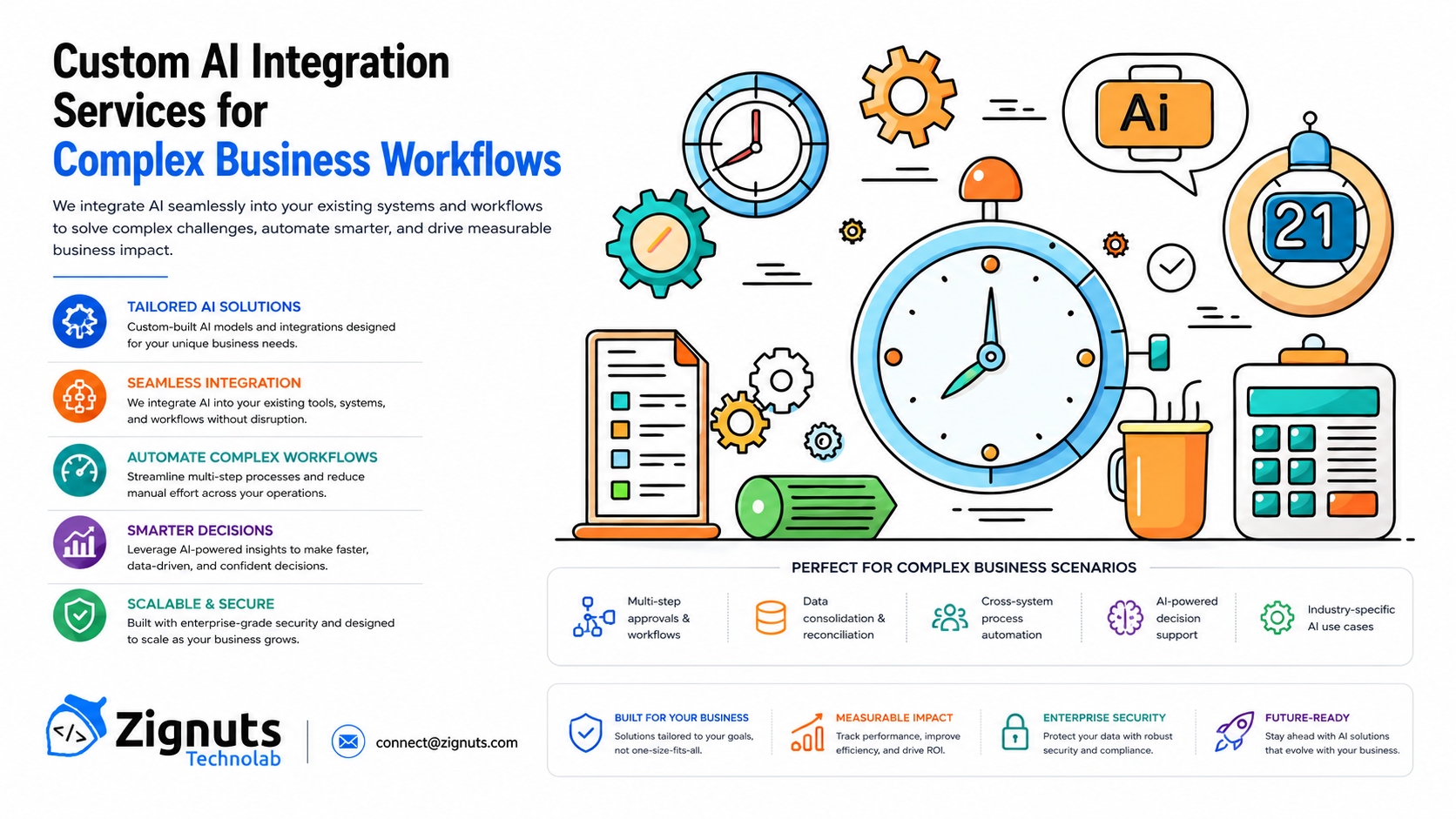
Complex business workflows rarely fit neatly inside one software platform. A single customer request can involve CRM records, financial systems, internal documents, approval rules, support tools, and several teams before it reaches completion. AI agent development is becoming valuable in these environments because AI agents can be designed to work across multiple systems, retrieve relevant information, perform defined tasks, and escalate decisions when human judgment is required.
For leaders planning toward 2027, the opportunity is less about deploying an AI agent everywhere and more about identifying workflows where intelligent coordination can remove friction. These projections describe likely strategic directions, not guaranteed outcomes, and they point to a more disciplined approach to enterprise AI investment.
2027 Insight | Business Impact | What Leaders Should Do |
|---|---|---|
AI agents become more connected to enterprise applications | Agents can support multi-step workflows instead of isolated tasks | Identify processes involving repeated system handoffs |
Agent orchestration becomes more important | Multiple specialized capabilities can coordinate around complex processes | Design clear responsibilities, permissions, and escalation rules |
Human oversight remains essential for high-impact decisions | Businesses can gain automation without surrendering accountability | Define approval points and exception handling before deployment |
Agent investments face stronger governance requirements | Greater system access increases security and operational risk | Establish identity, access, monitoring, and audit controls early |
Why Complex Workflows Need More Than Simple Automation
Traditional automation works well when a process follows predictable rules.
For example, when an invoice arrives, a system can extract information, check predefined conditions, and route the document to the appropriate person.
Complex workflows are different.
The required steps may change depending on the customer, transaction, business policy, available information, or previous interactions.
An employee may need to investigate several systems, interpret documents, decide what information is missing, contact another team, and determine the next action.
This is where AI agents can become useful.
Rather than performing only one predefined step, an agent can potentially coordinate several activities within clearly defined boundaries.
What Makes an AI Agent Different?
An AI agent is more than a conversational interface.
A business-oriented agent can be designed to:
Understand a business objective
Retrieve authorized information
Use connected tools
Reason through defined tasks
Perform approved actions
Check intermediate results
Escalate uncertain situations
Maintain workflow context
The important distinction is that the agent participates in a process.
For example, a customer service agent could receive a request, retrieve the customer's order details, check service policies, identify a potential resolution, prepare a response, and route the case to a human when the situation falls outside predefined rules.
The exact level of autonomy should depend on the business risk.
Where Custom AI Integration Can Create Value
Customer Service and Support
Complex support requests often require information from multiple systems.
An AI agent can potentially retrieve customer history, order information, product documentation, service policies, and previous interactions before recommending a next step.
This can reduce the amount of manual research required by support employees.
The agent should not automatically make every decision. Escalation rules can ensure that sensitive or unusual cases reach a human.
Sales and Account Management
Enterprise sales processes involve more than generating an email.
Teams may need to research accounts, review previous interactions, analyze opportunities, prepare proposals, check product availability, and coordinate with internal departments.
An AI agent can support these steps by retrieving information from approved systems and preparing outputs for sales professionals.
This can reduce administrative effort while allowing account teams to retain control over customer-facing decisions.
Finance Operations
Financial workflows often involve documents, business rules, approval processes, and multiple systems.
An agent can assist with tasks such as invoice review, reconciliation investigation, document classification, exception handling, and information retrieval.
Because financial processes can have significant consequences, organizations should establish strong validation and human approval mechanisms.
Operations and Procurement
Procurement workflows can involve supplier records, purchase orders, inventory information, contracts, approvals, and delivery status.
An AI agent can help coordinate information across these sources and identify situations requiring attention.
For example, if an order is delayed, the agent could gather relevant information from connected systems and prepare an exception summary for an operations manager.
The Architecture Behind a Complex AI Workflow
The value of an AI agent depends heavily on the systems surrounding it.
A simplified workflow looks like this:
Business Request → AI Agent → Authorized Data & Tools → Intelligent Processing → Action or Escalation → Business Outcome
The agent sits between the business objective and the systems required to complete the work.
Identity, permissions, APIs, data retrieval, workflow rules, monitoring, and human approval determine what the agent can actually do.
Why Custom Integration Matters
A generic AI agent may perform well in a demonstration but struggle with a company's real environment.
Every organization has different systems, terminology, approval structures, data models, and operational rules.
Custom integration can connect an agent to the specific tools it needs while enforcing the organization's security and workflow requirements.
The goal is not to give an agent access to everything.
It is to give the agent controlled access to the right systems for a defined purpose.
That distinction becomes increasingly important as agents become capable of performing more actions.
The Business Value of Agent-Based Workflows
Lower Administrative Effort
Agents can handle selected repetitive research, data retrieval, classification, and coordination activities.
Faster Workflow Completion
When information can be retrieved automatically, employees may spend less time waiting for responses from multiple systems or departments.
Better Employee Productivity
Instead of manually collecting information, employees can focus on decisions, customer relationships, problem-solving, and strategic work.
Scalable Operations
Well-designed agent workflows can help organizations handle higher volumes without simply increasing the number of manual process steps.
Better Cross-Department Coordination
Agents can help connect information across functional boundaries, particularly when a workflow crosses sales, finance, operations, and support.
Executive Decision Framework
Before approving an AI agent initiative, executives should evaluate the workflow, risk profile, integration requirements, and expected business value.
Decision Area | Key Question | Business Consideration |
|---|---|---|
Workflow | Does the process involve multiple steps or systems? | Prioritize workflows where coordination creates measurable friction |
Autonomy | What should the agent be allowed to do independently? | Match autonomy to business risk and decision complexity |
Data | What information does the agent require? | Provide only authorized, relevant data |
Security | Which systems can the agent access? | Apply identity, least-privilege access, and monitoring |
ROI | What measurable result should improve? | Define cost, productivity, speed, quality, or revenue metrics |
Agent Autonomy Should Be Earned
One of the biggest mistakes businesses can make is giving an AI agent too much authority too early.
An agent might be technically capable of changing a customer record, approving a transaction, sending an external communication, or initiating a financial action.
That does not mean it should.
A safer progression is:
Observe
Retrieve
Recommend
Prepare
Request approval
Execute within defined limits
This approach allows organizations to build confidence gradually.
High-impact actions can remain behind human approval while lower-risk activities become increasingly automated.
Data and Integration Challenges
AI agents depend on reliable access to business information.
Complex organizations may have:
Legacy systems
Inconsistent APIs
Duplicate records
Conflicting business rules
Unstructured documents
Fragmented data ownership
Different authentication systems
These challenges can make integration more difficult than model selection.
Before implementation, businesses should map the systems involved in the target workflow and identify the minimum information and permissions required.
A strong integration architecture should also make it possible to monitor agent activity and identify where failures occur.
Security and Governance
Agent-based systems require careful governance because they may have the ability to retrieve information and perform actions.
Organizations should establish:
Strong identity verification
Role-based authorization
Least-privilege access
Tool-level permissions
Audit logging
Data protection controls
Human approval policies
Error handling
Monitoring and alerting
Security should be treated as part of the architecture rather than an additional feature added after deployment.
Build or Buy?
Packaged agent platforms can be appropriate when workflows are relatively standard and existing connectors satisfy the organization's requirements.
Custom development becomes more attractive when the business has proprietary processes, complex integrations, specialized business rules, or strict control requirements.
A hybrid approach can also work.
Organizations can use established AI models and integration infrastructure while building custom workflow logic, tools, permissions, and business-specific components.
The decision should be based on long-term operational requirements rather than initial development speed alone.
A Practical Implementation Roadmap
Step 1: Select a Complex but Contained Workflow
Choose a process with multiple steps or systems, but keep the initial scope manageable.
Step 2: Define the Business Objective
Determine what the agent should improve. This could be response time, processing effort, resolution speed, productivity, or another measurable outcome.
Step 3: Map the Agent's Tools
Identify the systems, APIs, databases, documents, and applications the agent needs.
Step 4: Define Permission Boundaries
Specify what the agent can read, what it can change, and what requires human approval.
Step 5: Test With Realistic Scenarios
Include normal cases, incomplete information, conflicting data, unexpected requests, and failure conditions.
Step 6: Launch With Limited Autonomy
Start with recommendations or supervised actions before granting broader execution rights.
Step 7: Measure and Improve
Track workflow outcomes, agent errors, escalation frequency, employee feedback, and business performance.
Step 8: Expand Carefully
Once reliability and governance are established, extend the agent to additional workflows.
Risks Leaders Need to Understand
AI agents can introduce risks beyond those associated with conventional automation.
An incorrect response from a chatbot may be inconvenient. An incorrectly executed action can have operational or financial consequences.
Other risks include unauthorized access, poor data quality, prompt manipulation, unreliable tool use, unclear accountability, and excessive vendor dependency.
There is also a risk of creating an overly complicated agent architecture.
Adding agents simply because the technology makes it possible can increase maintenance and governance requirements.
The strongest strategy is selective. Use agents where their ability to coordinate information and actions solves a meaningful business problem.
Preparing for the Next Stage of Enterprise AI
Organizations should expect AI systems to become increasingly capable of interacting with business applications. But capability alone should not determine deployment.
Leaders need an operating model for agent-based systems.
That means defining who owns an agent, what it is allowed to do, how its performance is monitored, how changes are approved, and what happens when it fails.
Businesses should also design integrations with flexibility in mind. Models will change. Providers will evolve. Business processes will be redesigned.
A modular architecture makes those changes easier to manage.
Conclusion
Complex workflows require more than isolated AI features.
When business processes span multiple systems, teams, documents, and decisions, AI agents can provide a way to coordinate those activities while operating within defined boundaries.
The strategic opportunity is not to automate everything. It is to identify where intelligent coordination can remove friction, improve productivity, accelerate decisions, and help employees handle complexity more effectively.
AI agent development can support that strategy when it is combined with strong integration, reliable data, security controls, measurable objectives, and appropriate human oversight.
For executives, the best next step is to choose one meaningful workflow, define the desired outcome, establish clear boundaries, and prove the model before scaling.
FAQs
1. What is AI agent development?
AI agent development involves designing AI systems that can understand objectives, retrieve information, use connected tools, perform defined tasks, and coordinate workflow steps within specified permissions.
2. How are AI agents different from chatbots?
A chatbot primarily focuses on interaction and responses. An AI agent can potentially retrieve information, use tools, perform actions, and coordinate multiple steps within a business workflow.
3. Which business processes are suitable for AI agents?
Multi-step, information-heavy workflows are strong candidates. Examples include customer support investigations, sales operations, financial processing, procurement, internal research, and operational exception management.
4. Should AI agents have full autonomy?
Not necessarily. Autonomy should match the risk of the task. Low-risk activities may be automated, while financial, legal, sensitive customer, or other high-impact actions may require human approval.
5. Why is custom integration important for AI agents?
Business systems contain different data structures, permissions, workflows, and business rules. Custom integration allows agents to work with the specific systems and processes an organization uses while maintaining appropriate access controls.
6. How can businesses measure the ROI of AI agents?
Organizations should establish a baseline and measure improvements such as processing time, employee effort, resolution speed, error rates, workflow capacity, operational cost, or revenue impact.
7. What are the biggest risks of AI agents?
Major risks include unauthorized access, incorrect actions, unreliable outputs, poor data, insufficient oversight, integration failures, security vulnerabilities, and unclear accountability.
Comments
Log in or sign up to join the conversation.