
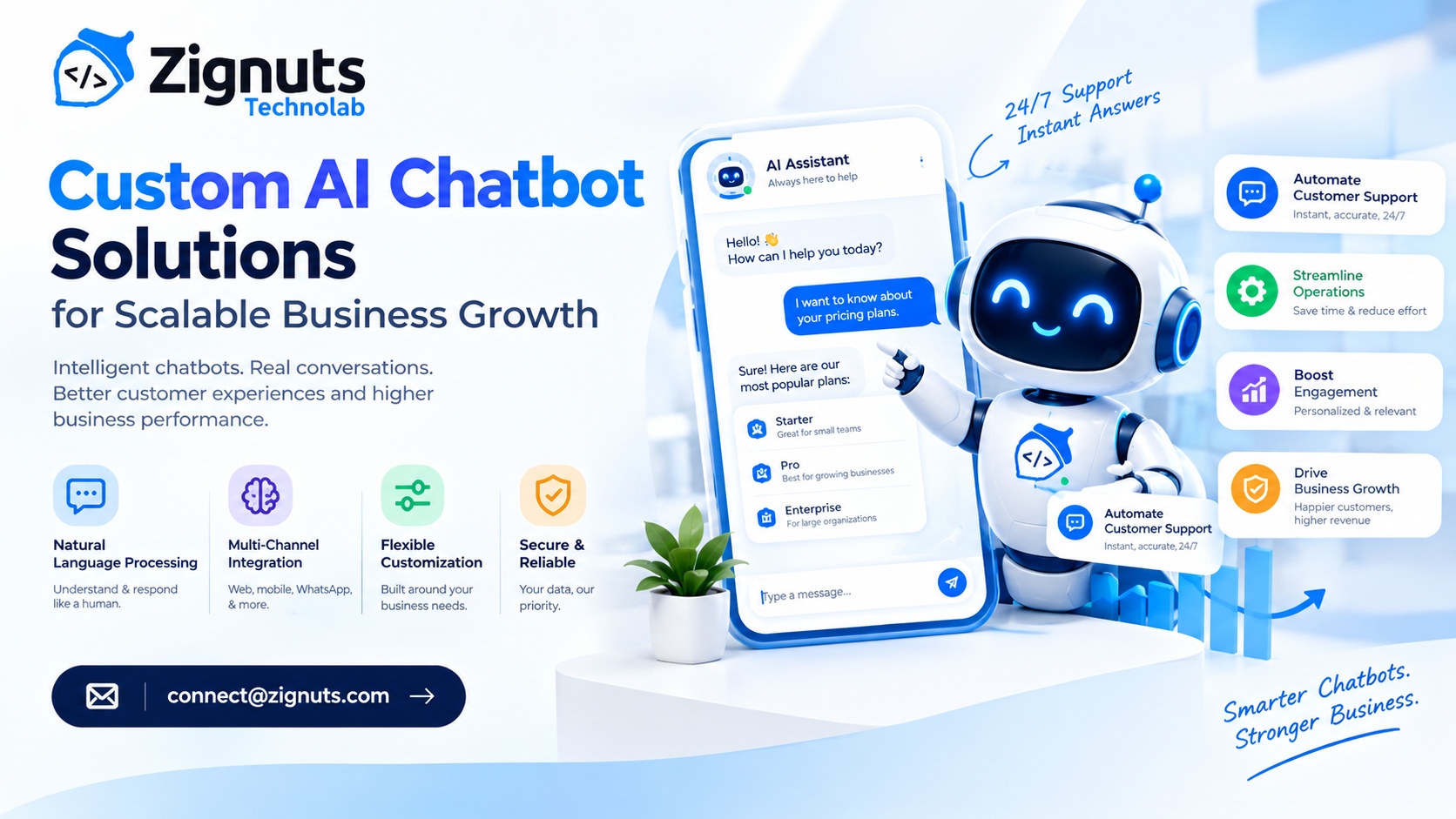
Businesses seeking sustainable growth must manage increasing customer expectations, expanding operational requirements, and rising service complexity. Standard chatbot tools may help address basic questions, but they often provide limited flexibility when organizations need specialized workflows, industry-specific knowledge, or integrations with existing business systems. Custom AI Chatbot Solutions allow businesses to design conversational experiences around their unique objectives, processes, customers, and technology environments.
A custom AI chatbot is not simply a prebuilt conversational interface with a company logo. It can be designed to connect with business applications, retrieve relevant information, support customer journeys, automate selected tasks, and provide employees with contextual assistance. The solution can evolve as the business expands into new markets, adds services, or introduces new operational requirements.
However, customization alone does not guarantee business growth. Organizations must determine which capabilities create measurable value, how the chatbot will scale, and how customer information and business workflows will be protected. A successful implementation combines strategic planning, reliable architecture, user-focused design, secure integrations, and continuous performance improvement.
Custom AI Chatbot Expectations for 2027
As businesses expand their use of conversational AI, customized chatbot systems may become more closely connected to customer service, internal operations, sales processes, and business knowledge. Organizations may increasingly focus on building chatbot capabilities that reflect their own data, workflows, and customer expectations.
The following table describes potential developments for 2027. These are strategic expectations and possible directions, not verified market statistics or guaranteed outcomes.
Expected Direction in 2027 | Potential Development | Business Implication |
|---|---|---|
Industry-specific customization | Chatbots may be designed around specialized terminology and workflows | More relevant business interactions |
Deeper business integration | Custom systems may connect with operational applications and approved APIs | Better coordination between conversations and processes |
Scalable AI architecture | Organizations may adopt modular components that support gradual expansion | Easier adaptation to changing business needs |
Personalized customer journeys | Chatbots may use authorized context to support relevant interactions | More consistent and contextual experiences |
Continuous evaluation | Businesses may monitor accuracy, cost, security, and user outcomes | More controlled long-term optimization |
The value of these developments will depend on implementation quality, data readiness, integration capabilities, and the organization's governance practices.
What Are Custom AI Chatbot Solutions?
Custom AI chatbot solutions are purpose-built conversational AI systems developed to meet the specific requirements of an organization, industry, customer group, or business process.
Unlike generic chatbot products with fixed features, custom solutions can be configured or developed around a company's:
Business objectives
Brand communication style
Customer journeys
Internal processes
Knowledge sources
Security requirements
Existing technology stack
Integration needs
Reporting and monitoring expectations
A custom chatbot may serve customers through a website or mobile application, assist employees through an internal portal, or support business teams through connected productivity and operational platforms.
For example, a SaaS company may build a chatbot that guides users through product onboarding, retrieves documentation, identifies support issues, and creates tickets. A retail organization may need a chatbot for product discovery, order tracking, returns, and personalized service guidance.
The right capabilities depend on the business problem rather than the novelty of the technology.
Why Businesses Consider Custom AI Chatbot Development
1. Aligning AI With Business Processes
Every organization has different workflows, policies, customer expectations, and operational constraints. A generic chatbot may not understand the specific terminology or sequence of steps required to complete a business task.
Custom development allows teams to design workflows around existing processes. The chatbot can be connected to relevant systems and configured to ask the right questions, retrieve approved information, and route requests appropriately.
This alignment can reduce unnecessary manual work and improve the consistency of customer or employee interactions.
2. Supporting Business Differentiation
Businesses compete through product quality, service experience, responsiveness, personalization, and operational execution. A customized chatbot can support these areas by reflecting the organization's services and customer needs.
For example, a business may develop a chatbot that:
Provides product-specific guidance
Understands industry terminology
Supports specialized onboarding
Offers personalized account assistance
Connects customers with relevant teams
Guides users through proprietary workflows
The chatbot should reinforce the overall customer experience rather than operate as an isolated technology feature.
3. Improving Scalability
As an organization grows, customer inquiries, employee requests, and operational tasks may increase. A custom chatbot architecture can be designed to support additional users, channels, workflows, and integrations over time.
Scalability planning should consider:
Expected user volume
Concurrent conversations
API capacity
Model usage
Data retrieval performance
Monitoring requirements
Infrastructure costs
Regional deployment needs
A scalable design should support growth without creating excessive complexity or uncontrolled operating expenses.
4. Improving Customer Engagement
Customers may expect businesses to provide quick and relevant assistance throughout their journey. A custom chatbot can be designed around specific customer stages, such as discovery, purchase, onboarding, support, renewal, or account management.
The chatbot may help users find information, understand product options, resolve routine issues, or connect with human support.
Engagement should be measured through meaningful outcomes rather than conversation volume alone. A high number of interactions does not necessarily indicate that customers are receiving useful assistance.
5. Connecting Disconnected Systems
Business information is often distributed across CRM platforms, support tools, knowledge repositories, billing systems, and operational applications.
A custom chatbot can serve as a conversational access layer across selected systems. With appropriate permissions and integrations, it may retrieve information or initiate approved workflows without requiring users to navigate every application separately.
System integration must be carefully planned to avoid data exposure, incorrect updates, and unreliable workflow execution.
Custom AI Chatbot Architecture
A custom chatbot architecture should reflect the business use case, security requirements, and level of automation involved.
Conversational Interface
The interface is the point where customers or employees interact with the chatbot. It may be deployed through:
Websites
Mobile applications
Customer portals
Employee dashboards
Messaging platforms
Support applications
Internal collaboration tools
The interface should provide clear prompts, accessible navigation, error messages, and a reliable path to human assistance.
AI Model Layer
The model layer interprets user messages and generates responses. The selected model should be evaluated based on the requirements of the application.
Relevant considerations include:
Response accuracy
Domain understanding
Language support
Latency
Cost
Context handling
Hosting options
Privacy requirements
Tool integration capabilities
A model should not be selected only because it performs well in general demonstrations. It should be tested using representative business scenarios.
Knowledge and Retrieval Layer
The knowledge layer provides access to approved business information. It may include product documentation, policies, service guides, technical materials, internal procedures, and frequently updated content.
Retrieval-augmented generation can help the chatbot locate relevant information before generating a response.
A reliable knowledge process should include:
Document ownership
Access controls
Content review
Version management
Source prioritization
Outdated content removal
Retrieval quality evaluation
Workflow and Tool Layer
The workflow layer manages the tasks the chatbot is authorized to perform. It may call business APIs, retrieve records, create requests, or route cases.
Tools should be limited to defined actions. The chatbot should not have unrestricted access to business systems.
Integration Layer
The integration layer connects the chatbot with enterprise applications. It may include API gateways, middleware, authentication services, data transformation, and error-handling mechanisms.
Monitoring and Governance Layer
Monitoring provides visibility into chatbot behavior, system health, security events, costs, and user outcomes.
Governance establishes policies for:
Data access
Model changes
Prompt and workflow updates
Human review
Incident management
Logging
Compliance
How Custom AI Chatbot Solutions Support Business Growth
Custom chatbots can contribute to growth by supporting customer acquisition, retention, operational efficiency, and service quality. The impact depends on how the solution is designed and measured.
Supporting Lead Qualification
A chatbot can engage website visitors, collect relevant information, answer basic questions, and route qualified inquiries to a sales team.
Potential workflow steps include:
Identify the visitor's intent.
Ask relevant qualification questions.
Collect approved contact and business information.
Classify the inquiry.
Route the lead to the appropriate team.
Provide next steps or scheduling options.
The chatbot should avoid making unsupported claims about products, pricing, or service capabilities. Information collection should also follow applicable privacy requirements.
Improving Customer Onboarding
New customers may need help understanding product features, completing setup tasks, locating documentation, or connecting their accounts.
A custom chatbot can provide guided onboarding based on the customer's product, subscription, progress, or authorized account information.
The onboarding experience may include:
Setup instructions
Product navigation
Frequently asked questions
Configuration guidance
Documentation retrieval
Support ticket creation
Progress reminders
The chatbot should provide a clear escalation option when a user encounters a technical or account-specific issue.
Supporting Customer Retention
Customer retention can be affected by service delays, unresolved issues, confusing processes, and difficulty accessing information.
A custom chatbot may help customers resolve routine questions, understand available services, retrieve account information, or reach the appropriate support team.
Chatbots should not attempt to conceal service limitations or prevent customers from accessing human assistance. Transparency is important when customer trust is involved.
Improving Internal Productivity
Custom chatbots can support employees by providing access to internal knowledge and simplifying routine requests.
Potential applications include:
Employee onboarding
IT service requests
Policy questions
Document retrieval
Equipment requests
Internal process guidance
Task status updates
Employee-facing chatbots should respect role-based access and ensure that users only receive information appropriate to their permissions.
Customization Areas That Influence Business Value
Brand and Communication Style
A chatbot can be designed to reflect the organization's communication guidelines, terminology, tone, and service expectations.
Brand consistency should not override accuracy. The chatbot should communicate clearly and acknowledge uncertainty when reliable information is unavailable.
Industry-Specific Knowledge
Different industries use specialized terms, processes, and regulations. A custom knowledge layer can help the chatbot understand the organization's domain.
Domain-specific evaluation is necessary to determine whether the chatbot handles technical language, policies, and customer questions correctly.
Role-Based Experiences
Customers, employees, managers, administrators, and partners may require different information and workflows. The chatbot should identify the user's role and enforce access restrictions.
Workflow Customization
Organizations can customize the order of steps, required fields, approval rules, and escalation paths for specific processes.
Multilingual Support
Businesses serving multiple regions may require multilingual conversations. Each language should be evaluated for translation accuracy, terminology, cultural context, and workflow consistency.
Channel-Specific Experiences
The same chatbot capability may need different interfaces across websites, mobile applications, messaging platforms, and internal portals.
Channel design should consider user expectations, authentication methods, screen size, accessibility, and available functionality.
Reporting and Analytics
Custom dashboards can help teams monitor business-specific metrics, such as support resolution, onboarding completion, lead routing, workflow failures, and customer feedback.
Custom AI Chatbot Development Process
A structured development process helps businesses connect customization decisions with measurable outcomes.
Business Discovery → Use-Case Design → Architecture Development → Integration and Testing → Deployment and Optimization
Step 1: Define Business Objectives
The first step is to identify the problem the chatbot should solve. Objectives should be specific enough to guide development and evaluation.
Possible objectives include:
Improving customer self-service
Reducing repetitive support tasks
Increasing onboarding completion
Simplifying employee access to information
Improving lead response processes
Supporting multiple service channels
Reducing workflow delays
The project should define how success will be measured before development begins.
Step 2: Identify Target Users
The chatbot's design depends on who will use it. Customers, employees, partners, and administrators may require different access levels and interaction patterns.
The team should document:
User roles
Common questions
Typical workflows
Required data
Authentication requirements
Escalation needs
Accessibility expectations
Step 3: Prioritize Use Cases
Not every possible capability should be implemented at once. Use cases should be prioritized based on business value, technical feasibility, risk, data availability, and expected adoption.
An initial release may focus on a small number of clearly defined tasks before expanding into more complex processes.
Step 4: Design the Solution Architecture
The architecture should define the model, knowledge sources, retrieval method, workflow engine, API integrations, security controls, and monitoring tools.
The team should also document failure scenarios and fallback options.
Step 5: Prepare Knowledge Sources
The chatbot's knowledge should be reviewed for accuracy, completeness, relevance, and access restrictions.
Content owners should be assigned responsibility for updating documents and resolving conflicting information.
Step 6: Build and Integrate
Development may include conversational design, prompt configuration, backend services, API integration, retrieval implementation, authentication, and workflow logic.
Each component should be tested independently before full system testing.
Step 7: Test Realistic Scenarios
Testing should include:
Common user questions
Ambiguous requests
Incomplete information
Incorrect user inputs
Unsupported requests
Sensitive data access attempts
API failures
Human escalation
High-volume usage
The test set should represent real business conditions rather than only ideal conversations.
Step 8: Launch and Monitor
The chatbot should initially be deployed to a controlled audience or limited set of use cases. Teams should monitor performance and gather user feedback.
Expansion should be based on evidence that the system is reliable, secure, and useful.
Business Applications of Custom AI Chatbots
Business Function | Custom Chatbot Use Case | Potential Growth or Operational Value |
|---|---|---|
Sales | Lead qualification and meeting coordination | More structured inquiry handling |
Customer success | Product onboarding and usage guidance | Better customer support throughout the lifecycle |
E-commerce | Product discovery, order tracking, and returns | More convenient buying and service experiences |
SaaS | Technical assistance and knowledge retrieval | Improved product adoption support |
Healthcare administration | Appointment guidance and administrative information | Easier access to routine service information |
Financial services | General service inquiries and controlled customer assistance | More accessible digital support |
Human resources | Employee onboarding and internal process guidance | Improved employee self-service |
IT operations | Issue intake, ticket creation, and knowledge support | More organized internal service delivery |
The potential value of each application depends on process design, user adoption, system integration, and the accuracy of the chatbot's responses.
Security and Privacy in Custom Chatbot Solutions
Customization often involves connecting the chatbot to company data and internal applications. Security and privacy should therefore be considered throughout the development lifecycle.
Identity Verification
The system should authenticate users before allowing access to protected information or account-specific functionality.
Role-Based Authorization
Access permissions should be enforced according to the user's role, business context, and requested action. A conversational instruction should not be sufficient to bypass authorization controls.
Data Minimization
The chatbot should collect and process only the information needed for the specific task. Unnecessary sensitive information should not be requested or retained.
Secure API Integration
Connected APIs should use secure authentication, scoped permissions, input validation, rate controls, and appropriate monitoring.
Prompt Injection Protection
The system should treat user messages, external documents, and retrieved content as potentially untrusted inputs. Tool access and business actions should be controlled by application-level safeguards.
Conversation Data Management
Organizations should define how conversation data is stored, accessed, retained, masked, and deleted. Logging requirements should be balanced with privacy and operational needs.
Human Review
High-impact workflows should include appropriate human oversight. The chatbot should be able to escalate requests when the issue exceeds its approved scope.
Scaling a Custom AI Chatbot
Scalability includes more than supporting additional conversations. A growing chatbot solution may need to handle new users, business units, languages, channels, workflows, and data sources.
Technical Scalability
The architecture should consider:
Concurrent user requests
Model capacity
API limits
Database performance
Retrieval latency
Caching requirements
Regional availability
Operational Scalability
As the chatbot expands, organizations may need dedicated ownership for knowledge management, security reviews, monitoring, customer support, and workflow maintenance.
Organizational Scalability
Different departments may request new features or integrations. A centralized governance process can help prevent duplicated functionality, inconsistent policies, and uncontrolled access.
Financial Scalability
Costs may increase with model usage, retrieval operations, infrastructure, integrations, support, and monitoring. Businesses should evaluate cost per workflow or interaction and compare it with the operational value created.
Measuring Custom Chatbot Performance
A custom chatbot should be evaluated using metrics connected to its intended purpose.
Customer Satisfaction
Measure how users perceive the chatbot's clarity, convenience, accuracy, and ability to resolve their requests.
Task Completion
Track whether users successfully complete the intended process, such as finding information, submitting a request, or completing onboarding.
Escalation Quality
Review whether the chatbot escalates the appropriate cases and transfers sufficient context to human teams.
Response Accuracy
Evaluate chatbot responses against approved reference material and domain-specific standards.
Workflow Reliability
Monitor successful API calls, failed actions, incomplete processes, and system recovery behavior.
Adoption Rate
Measure usage among the intended audience. Low adoption may indicate poor discoverability, limited usefulness, unclear communication, or insufficient trust.
Operational Impact
Relevant measures may include:
Support handling time
Manual intervention
Request processing time
Employee productivity
Customer service workload
Onboarding completion
Lead response time
Cost per interaction
Metrics should be interpreted together. For example, increased chatbot usage may not represent improvement if users frequently abandon conversations or contact support again.
Challenges of Custom AI Chatbot Solutions
Higher Initial Complexity
Custom solutions may require more planning, development, integration, and testing than basic chatbot tools. The additional effort should be justified by the business requirements.
Integration Dependencies
The chatbot may depend on external APIs, internal systems, authentication services, and data sources. Changes in these systems can affect chatbot functionality.
Knowledge Maintenance
A chatbot connected to outdated or inconsistent information may provide unreliable responses. Content ownership and review processes are essential.
Unpredictable User Language
Users may ask questions in unexpected ways, combine multiple requests, or provide incomplete information. The chatbot should be tested against varied conversation patterns.
Security Exposure
Connecting a chatbot to business systems increases the importance of access controls, monitoring, and secure integration practices.
Cost Management
Model usage, infrastructure, integrations, and ongoing maintenance can affect the total cost of ownership. Businesses should monitor usage and identify unnecessary processing.
Change Management
Employees and customers may need time to understand the chatbot's capabilities. Clear communication, training, and human support can help users adapt.
Scope Expansion
Once a chatbot is launched, stakeholders may request additional features. A governance process can help prioritize enhancements and prevent uncontrolled complexity.
Questions Business Leaders Should Ask
What makes a custom chatbot necessary for our business?
Leaders should identify whether the organization needs specialized knowledge, unique workflows, advanced integrations, or control that a standard tool cannot provide.
Which business outcome should the chatbot support?
The project should connect to a measurable objective, such as improving onboarding, reducing repetitive support work, or increasing workflow completion.
Who will own the chatbot after deployment?
Ownership should include responsibility for knowledge updates, security reviews, monitoring, user feedback, and feature prioritization.
What information can the chatbot access?
Organizations should document data sources, access levels, retention rules, and the actions the chatbot is authorized to perform.
How will the chatbot handle uncertainty?
The system should recognize unsupported requests, communicate limitations, ask clarifying questions, and escalate when appropriate.
How will the solution scale?
The architecture should support expected user growth, additional workflows, new integrations, and future maintenance requirements.
What is the complete cost of ownership?
The evaluation should include development, hosting, model usage, security, monitoring, integration maintenance, support, and ongoing improvements.
Practical Roadmap for Custom Chatbot Implementation
Phase 1: Business and User Discovery
Identify target users, business problems, customer journeys, internal processes, and desired outcomes.
Phase 2: Use-Case Prioritization
Select a focused set of workflows based on value, feasibility, risk, and data readiness.
Phase 3: Knowledge and Data Assessment
Review the quality, ownership, structure, and accessibility of the information the chatbot will use.
Phase 4: Architecture and Security Planning
Define the model strategy, retrieval architecture, workflow layer, integrations, authentication, authorization, monitoring, and data management.
Phase 5: Prototype Development
Build a limited prototype to test the conversational experience and validate the feasibility of the selected use cases.
Phase 6: Integration and Workflow Development
Connect approved business systems and implement the required actions, validation rules, and error-handling processes.
Phase 7: Testing and Evaluation
Test response accuracy, workflow completion, security, performance, accessibility, and human handoff.
Phase 8: Controlled Deployment
Launch the solution to a limited audience and monitor user behavior, errors, feedback, and operational performance.
Phase 9: Optimization
Improve prompts, workflows, knowledge sources, interface design, and integration reliability based on observed results.
Phase 10: Scalable Expansion
Add new departments, channels, languages, and workflows through a controlled governance and release process.
Customization Without Unnecessary Complexity
Customization should be purposeful. Adding features without a clear business objective can increase development costs, maintenance requirements, and user confusion.
A practical approach is to separate essential capabilities from optional enhancements.
Essential Capabilities
These may include:
Reliable responses
Accurate knowledge retrieval
Authentication
Role-based permissions
Clear escalation
Workflow validation
Monitoring
Error handling
Optional Enhancements
Depending on the use case, businesses may later introduce:
Multilingual interactions
Advanced personalization
Voice interfaces
Proactive notifications
Multi-agent coordination
Predictive recommendations
Advanced analytics
Cross-channel conversation continuity
The organization should validate the core experience before expanding into additional capabilities.
The Role of Human Support in Custom Chatbots
Custom AI chatbots should complement human teams, particularly when workflows involve sensitive information, complex exceptions, or significant business consequences.
A hybrid model may assign the chatbot responsibility for:
Collecting preliminary information
Answering routine questions
Retrieving approved documentation
Classifying requests
Preparing summaries
Initiating defined workflows
Human employees may manage:
Complex complaints
Sensitive customer situations
Exceptions to standard policies
High-impact approvals
Disputes
Requests requiring professional judgment
Human handoff should preserve relevant context and make the transfer process clear to the user. A chatbot should not make it difficult for customers or employees to reach a person when human assistance is appropriate.
Future Opportunities for Custom AI Chatbots
Custom chatbot solutions may support broader business opportunities as organizations improve their data, integration, and governance capabilities.
Potential areas of development include:
AI-assisted customer onboarding
Personalized product guidance
Internal knowledge copilots
Cross-platform service coordination
Automated request classification
AI-supported sales assistance
Multilingual customer service
Conversational analytics
Workflow recommendations
Proactive service notifications
These capabilities should be introduced through controlled testing. More advanced functionality may increase both business value and operational risk, especially when the chatbot can access sensitive information or initiate actions across multiple systems.
Organizations should maintain clear boundaries around permissions, human oversight, and accountability as their chatbot capabilities expand.
Conclusion
Custom AI Chatbot Solutions can help businesses create conversational experiences that align with their unique customers, workflows, knowledge sources, and growth objectives. Unlike generic chatbot implementations, custom solutions can be designed to integrate with existing business applications, support specialized processes, and evolve as organizational needs change.
The success of a custom chatbot depends on more than model selection or interface design. Businesses must define measurable goals, prioritize suitable use cases, prepare reliable knowledge sources, implement secure integrations, and establish ongoing monitoring.
Customization should be guided by business value. Organizations do not need to automate every process or introduce every available AI capability. A focused solution that reliably supports important customer and employee workflows may create more practical value than a complex system with unclear objectives.
By combining thoughtful architecture, user-centered design, strong governance, and continuous optimization, businesses can develop chatbot capabilities that support scalable operations and more consistent customer experiences. The long-term opportunity lies in using AI where it improves access, efficiency, and service quality while preserving human oversight and organizational control.
Frequently Asked Questions
1. What are custom AI chatbot solutions?
Custom AI chatbot solutions are conversational AI systems designed around an organization's specific business goals, workflows, knowledge sources, customer needs, and technology environment.
2. How are custom AI chatbots different from standard chatbot tools?
Custom chatbots can be designed with specialized knowledge, tailored workflows, business integrations, security controls, and user experiences. Standard tools may offer predefined capabilities with less flexibility.
3. Can custom AI chatbots support business growth?
They can support growth by improving customer self-service, assisting onboarding, organizing lead inquiries, reducing repetitive tasks, and connecting users with relevant business processes. The actual impact depends on implementation and measurement.
4. Can a custom chatbot integrate with existing business applications?
Yes. Custom chatbots can connect with approved CRM, ERP, HR, help desk, scheduling, billing, and other systems through APIs or integration services.
5. How can businesses make custom chatbots secure?
Security practices may include authentication, role-based authorization, scoped API permissions, input validation, data minimization, secure logging, monitoring, and human review for sensitive workflows.
6. How long does custom AI chatbot development take?
The timeline depends on the number of use cases, system integrations, knowledge preparation, security requirements, testing scope, deployment channels, and expected user volume.
7. How should a business start developing a custom AI chatbot?
Businesses should begin by identifying a specific problem, defining target users, prioritizing a manageable use case, assessing available data, designing the architecture, and testing a controlled prototype before expanding.
Comments
Log in or sign up to join the conversation.