

Making Sense:
On the Roman calendar, today is the “Ides of March.” This day is famous (or infamous) as the day in which Julius Caesar was assassinated. Today we mark a more modern assassination, for this is the day that the last vestiges of hope (as slim as they were) for a March 2016 Fed rate hike likely died.
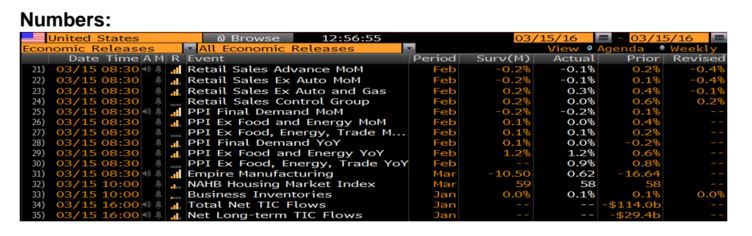
One of the catalysts for the recent recovery in risk assets markets was the stronger-than expected January Retail Sales data. So strong were that data, the Street consensus forecast expected February to report a decline from the lofty January data. Not only did February data report declines, many of the once-strong January datasets were revised to outright declines from previous positive data.
- February Retail Sales MoM came in at -0.1%, less negative than the -0.2% Street consensus. January data were revised to -0.4% from an initial reading of +0.2%.
- Feb. Retail Sales Ex Autos MoM came in at -0.1% versus a Street consensus of -0.2%, but the January data was revised to -0.4% from an initial reading of +0.1%.
- Retail Sales Ex Autos and Gasoline came in at +0.3% versus a Street consensus of +0.2%, but the January data was revised to -0.1% from an initial reading of +0.4%.
- The Retail Sales Control Group (Ex Food Auto Dealers, Building Materials and Gas Stations) Came in flat (unchanged) from a downwardly-revised +0.2% (from an initial reading of +0.6%). The Street expected a gain of +0.2% from an unrevised +0.6%.
- Headline PPI MoM came in at -0.2%, down from a prior +0.1% and in line with the Street consensus.
- Core PPI MoM came in unchanged (0.0%), down from a prior +0.4% and lower than the Street consensus of +0.1%
- Core PPI Ex Trade MoM came in at +0.1% versus a prior +0.2% and a Street consensus of +0.1%.
- Headline PPI YoY came in at 0.0%, up from a prior -0.2%, but less than the street consensus of +0.1%.
- Core PPI YoY came in at 1.2%, in line with the Street consensus and up from a prior +0.6%.
- Core PPI Ex Trade came in at +0.9%, up slightly from a prior +0.8%.
- Empire Manufacturing came in at 0.62 versus a prior -16.64 and a Street consensus of -10.50. Prints over 0.0 indicate improving conditions.
“Men in general are quick to believe that which they wish to be true.” ~ Julius Caesar
When strong January Retail Sales data hit the tape last month, the Street (desperate for good news) latched onto the idea that the economic data had finally turned. Almost instantly, market sentiment went from “recession” to “robust recovery.” As a young bond trader, one thing I was taught was to not overreact to any one economic report (positive or negative) as it was only one report. Now it seems that January Retail Sales were not as strong as originally reported. With the exception of Retail Sales Ex Autos and Gas, the February data were flat or negative and were coming off of the biggest downward revisions in two years. The result is Retail Sales which have been essentially flat for three months.
The PPI data were basically as expected. There were few signs inflation pressures are building. Yes, PPI Ex Food and Energy YoY jumped from 0.6% in January to 1.2% in February, but that speaks more to a fading of temporary disinflationary pressures than any serious build in inflation pressures. The PPI has been dominated by two main factors over the past year, declining energy prices and a stronger U.S. dollar. Recently, the USD has expressed signs of weakness (possibly due to interest rate and currency arbitrage trading). A USD which is not strengthening should help to steady import prices.
Many pundits and some economists have opined that fading disinflationary pressures should push all measures of inflation higher. My opinion is that such a scenario has its limits. If fuel prices (or food prices for that matter) rise significantly, consumers may reduce discretionary spending (spending on so-called core goods and services), causing headline and core inflation to converge, after a while.
Those who believe all inflation measures should rise in tandem may remember the days when many workers received cost of living wage increases. In this scenario, potentially near-term inflationary response was perpetuated by rising incomes, which allowed consumers to continue purchasing, in spite of rising prices. Today, comparatively few workers receive cost of living adjustments (COLA). In the current economy, I believe we are more likely to see headline and core inflation converge, probably at a lower level than many inflation hawks believe.
Positive manufacturing news came from a most unlikely source, the New York Fed’s Empire Manufacturing Index. Empire Manufacturing for March trended (barely) into positive territory at 0.62, but considering that the prior report was -16.64 and the Street was expecting -10.50, this was a good print. Significant gains occurred in important components such as new orders (9.6 in March from - 11.6 in February), shipments (13.9 from -11.6) and the average workweek (1.9 from -5.9).
This is only one report and it is from an area of the Country which is not known for its manufacturing prowess (and could have received help from an early spring), but Empire Manufacturing was a hopeful sign.
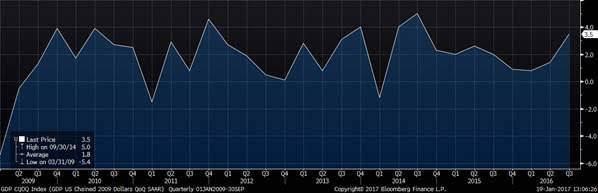
The latest reading of the Atlanta Fed’s GDPNow forecast for Q1 2016 was updated this morning to 1.9%, where it was prior to the spike in January Retail Sales, last month. Although I am not in the recession camp, if 1.9% is the rebound from a 1.0% Q4 2015, 2016 annual GDP could be in for some tough sledding if something doesn’t change for the better in the global economy or in the area of fiscal policy.
Et tu Kuroda?
The eyes of the financial world were on the Bank of Japan and BOJ president, Kuroda to see if he would follow ECB president, Draghi’s lead and plunge further into NIRP and increase asset purchases in an attempt to revitalize a moribund Japanese economy. The Bank of Japan kept its negative interest rates and asset-purchases target unchanged at its March meeting, but left the door open for further stimulus in April. The BOJ also lowered its inflation forecasts. The BOJ left its benchmark policy rate at -0.1% and will continue to purchase assets to the tune of 80 trillion yen per month.
Negative rates have led to some unfavorable responses from Japanese consumers (particularly older consumers) whose income depends on deposits and Japanese government bonds. Prime Minister Shinzo Abe has expressed concerns with negative rates ahead of the July national election.
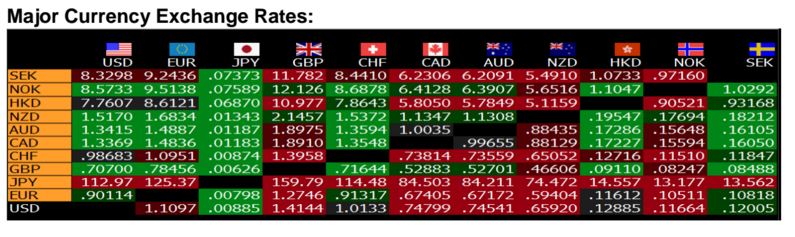
Markets have also reacted in an unexpected manner to both BOJ and ECB negative interest rate policy, with currencies strengthening as speculators have piled into euros and yen to buy the assets the central banks are also buying.
I have expressed on these pages (many times during the past two years) that moderately higher interest rates might have a positive impact on some economies (including the U.S. economy), by putting more cash flow in the pockets of the rapidly-increasing older demographic (who possess most of the wealth). I realize this runs counter to accepted economic and monetary theory, but conditions have changed significantly in the developed world since accepted theory was established.
“Cry havoc and let slip the dogs of war!”
The market’s now await tomorrow’s FOMC rate decision. I believe what slim chances which might have existed for a March Fed Funds Rate hike have evaporated following the weak and downwardly-revised Retail Sales data. In my opinion, the next likely time for a FOMC tightening is June, if Retail Sales rebound, job growth remains strong, wage pressures increase and inflation pressures acquire a steady course toward 2.0%.
I believe the FOMC will want to see final readings on Q1 economic data and have a good handle on Q2 economic data before considering tightening. If the Fed tightens in June, we could see two rate hikes in 2016. If the Fed hikes in September, we may see only one. If retails sales languish, wage growth stagnates and inflation pressures remain light, the Fed might not tighten at all in 2016.
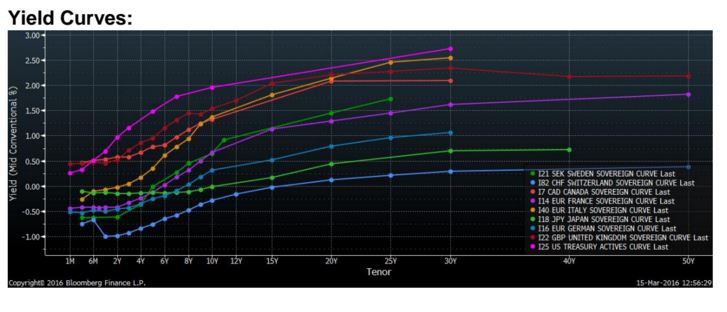
Either way, I do not expect long-term rates to rise very much. If the Fed does tighten, the UST yield curve should flatten further, with rates across the yield curve only modestly higher, in my opinion. That all rates would edge higher would be due to increased inflation pressures. Higher inflation would push long-term rates higher (if only a little) and would likely cause the Fed to raise the Fed Funds Rate. If inflation increases stall or fade, the Fed could remain on the sidelines. The lack of inflation and reduced probability of a Fed hike would likely cause the yield curve to steepen. Short-term rates would fall due to a more dovish Fed and long-term rates would likely fall because of moderating inflation pressures. Since the short end of the curve has experienced more upward rate pressure than long-term rates that is where I would expect to see more dramatic rate declines.
With few on the Street calling for a rate hike tomorrow, market participants are focused on Fed language and dots. Remember, it was in December (the last FOMC meeting at which economic forecasts were released) that the so-called Fed “dots” alluded to four rate hikes in 2016. Since then, economic data has generally moved away from that narrative, as have some Fed officials. At present, the Fed Funds Futures market is pricing in one rate hike this year and does not see Fed Funds above 1.0% until January 2018.
Some pundits have criticized the bond market for fighting the Fed. I don’t see the market as fighting the Fed. Fighting the Fed would be positioning in a way that current Fed policy was incorrect. Instead, the bond market is saying that conditions are unlikely to meet the Fed’s stated criteria for four rate hikes in 2016. I agree with the markets. It might turn out that the Fed now agrees with the bond market as well. We shall know more tomorrow afternoon.
“What a terrible era in which idiots govern the blind.”
In the past I have expressed concerns with areas of the asset-backed bond market. Recently, the quality of bonds in the commercial real estate mortgage space and in the auto loan ABS space has deteriorated noticeably. Word from the CMBS space is that some borrowers may not be able to refinance loans coming due this year and next. Meanwhile, auto lending has seen a deterioration of loan credit quality and the auto industry has increased its use of incentives and creative consumer financing to keep the sales rate above 17 million vehicles (SAAR), as they milk the demand for trucks and SUVs during a time of low fuel prices for all it is worth.
Some individual investors might be more exposed to CMBS and auto loan ABS than they realize. In a search for yield, many bond portfolio managers have added significant sums of CMBS and auto loan ABS. If we see a correction in these markets, individual investors might be inclined to fire their bond managers and liquidate holdings. Selling bonds with deteriorating credits is difficult in the best of times. However, doing so when liquidity is extremely scarce could severely negatively impact portfolios.
It is probably a good time to have a chat with your bond portfolio manager regarding portfolio exposure to CMBS and auto loan ABS.
Have a great day and remember: “The fault is not in our stars/ But in ourselves.”

Comments
Log in or sign up to join the conversation.