

Oil prices have now risen sharply for the second consecutive day, with WTI futures at one-month highs and threatening to break a key bearish trend line. The re-escalation of the conflict between the US and Iran is once again behind the latest gains.
Trump’s Venezuela oil deal offers little immediate relief to prices
While the controversial deal between the US and Venezuela could ease supply pressures in the long term, in the short-term the situation in the Strait of Hormuz is likely to continue dictating the direction for oil prices.
Trump has said that the oil secured under the new agreement with Venezuela will be used to replenish America’s Strategic Petroleum Reserve (SPR), potentially strengthening US energy security and reducing its vulnerability to future supply shocks. The SPR is currently at its lowest level in 44 years, which is partly why oil prices are this high right now.
For oil prices, the deal is potentially bearish over the longer term. If Venezuela can attract the investment needed to revive its ageing infrastructure and materially increase production, the additional supply could help loosen the global market and place downward pressure on crude prices.
But traders should be careful not to confuse reserves with immediate supply. Venezuela’s crude is expensive and technically challenging to produce, while its oil infrastructure requires substantial investment. Their oil reserves are made up of heavy, sour oil, which is harder to refine for making products like petrol, whereas the US oil is the light, sweet type. Analysts expect any meaningful increase in output to take years rather than months.
That means the deal is unlikely to provide much immediate relief to US fuel prices or materially alter the near-term oil balance. Indeed, with geopolitical risks still elevated, the market is likely to remain focused on barrels that can reach consumers now rather than reserves that may become productive in the future.
Oil rally triggers risk off trade
With oil prices rising, bond yields have broken further higher, triggering a wave of selling across risk assets. By mid-day in London, S&P 500 futures had fallen 0.6% with sharper falls seen across European markets, while gold, silver and Bitcoin were all lower at the time of writing. Should we continue to see more gains in oil, then this could start to weigh more heavily on risk appetite.
Oil prices likely heading further higher in the short run
Crude oil prices continue to press higher amid the ongoing standoff between the US and Iran. While the softness in US and Chinese data of late does point to some moderation in demand, oil prices remain predominately supply-driven. Crude oil is largely demand inelastic anyway, meaning buying stays strong when prices go up and down. Demand only gets disrupted when prices go up by significant amounts and stay elevated. I am not sure the current prices of around $85-$95 fit that bill. Unless the Strait of Hormuz re-opens, I just can’t see how oil prices will fall back meaningfully in the near-term.
WTI attempts to break key trend line
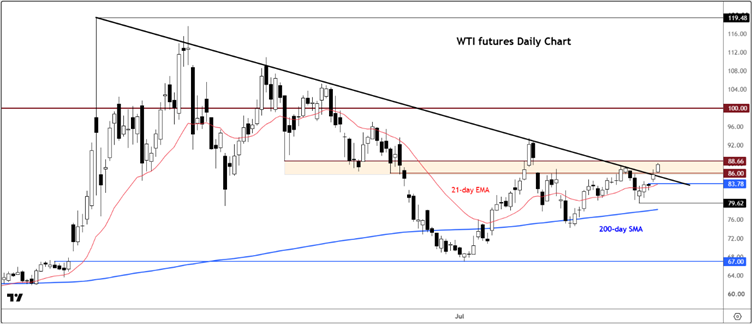
There is no doubt that the technical trend on oil is certainly right now, regardless of the timeframe. Shallow dips, followed by short periods of consolidation and then the inevitable break to the upside. Resistance after resistance levels have broken. Today, US crude oil futures were attempting to break the key $86-$88.65 region. This region is very important given that it was resistance in the past and where we have the long-term bearish trend line coming into play. At the time of writing, oil prices were above this region, suggesting that we may have seen the start of a major rally.
Key levels to watch on WTI futures
Should WTI sustain this breakout, then the next upside target is the psychologically important $90 hurdle, followed by the July high of $93.50, before it potentially climbs back towards the $100 level again.
On the downside, initial support now sits at around $85.00, followed by $83.80ish, where the 21-day exponential average comes into focus. If the latter breaks, then we could see a potential dip to near $80 next.



Comments
Log in or sign up to join the conversation.