

What is a Covered Call?
A covered call is a strategy by which you sell (write) a call option while owning shares of the underlying stock at the same time.
Why Sell a Covered Call?
The goal of selling (writing) a covered call is to increase your income while owning the stock. The income (premium) you receive from selling the call also covers a decline in the price of the stock.
Owning the stock and writing the call can outperform just owning the stock. The stock price can fall, stay the same, or rise enough to be profitable. Writing call options and owning stock will reduce volatility (the higher the volatility, the higher the risk).
Covered Call: Writing for Protection Example
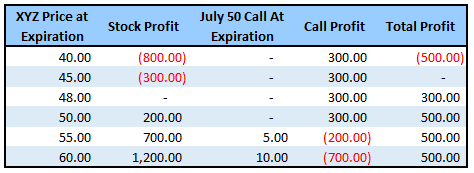
Let's start with an example. Say an investor buys 100 shares of XYZ common stock at $48. The investor then sells 1 XYZ July 50 call option. This is called a covered call. The investor would receive $300 from the sale of the July 50 call.
Profit & Loss Terms
- Max Profit: Distance between stock price & short call + premium received from selling the call.
- Breakeven: Stock price - credit from short call.
- Loss: If the stock price falls significantly below the $300 premium you received.
Which Stock Should I Choose?
I recommend you choose low-priced stocks with a high implied volatility percentile. High IV means more premium is received for selling the call. You can trade high beta stocks which will generate a lot of premium, but the stocks also move around a lot, which can be stressful. I prefer low beta stocks and ETF’s like KO, JNJ, PFE, and IYR.
Which Call Do I Choose?
The short call is usually In-The-Money (ITM) or Out-Of-The-Money (OTM). The OTM call offers a higher potential for reward, but it is riskier than the ITM call.
When do we Exit Covered Calls?
One should exit covered calls when the stock price has gone past the short call; that will give close to maximum profit. You should close a covered call if the stock price drops significantly.
How do we Exit Covered Calls?
We will roll our call down if the stock price drops. If the stock price remains roughly the same as when we executed the trade, we can roll the short call by buying back our short option and selling another call on the same strike in a further out expiration.
Risk of the Stock being “Called Away”
When you sell a call someone may exercise it, meaning you will be forced to sell your shares. Let’s see what happens with an example.
Say the example stock was $48/share when you bought it. The stock moves up to $50/share. Someone “calls away” (buys) the stock at $50. You will earn $200 on the stock (100 shares X $2 = $200). You still keep your $300 credit for the option. The total profit is $500 ($200+$300).
So being assigned is not necessarily a bad thing because it generally means you have made a profit on the trade. But you no longer own the shares and will need to look for new opportunities.
Comparison Of The Premiums & Returns For Low Vol And High Vol Stocks.
Let’s compare the returns for low volatility and high volatility stocks. AAA stock is more volatile than XYZ and therefore has higher option premium. Here are the prices:
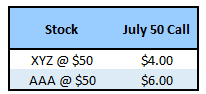
You can see from the table above that stock AAA will give you more premium ($6) than XYZ, which gives $4.
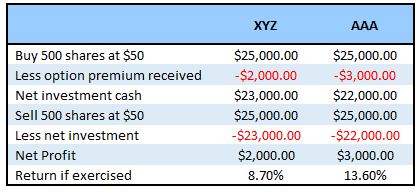
You can see from the table above that the more volatile stock AAA has a potential return of 13.6%. XYZ has a smaller return of 8.7% Note that commissions and dividends are not included. Also, there are many different ways to set up this trade. This is a basic explanation for educational purposes.


Comments
Log in or sign up to join the conversation.