

The US Federal Reserve sounded the alarm in its latest press conference by warning of the worst downturn "in our lifetime". Fed Chairman Jerome Powell painted a bleak picture for the global economy and did little to reassure investors by staying on the sidelines and keeping rates on hold. Global stock indices fell, causing some analysts to forecast a near 20% drop. Read on to find out more!
Federal Reserve sound the alarm
In Wednesday's 30 July FOMC press conference, Fed Chairman Jerome Powell kept the overnight US interest rate between 0% and 0.25% while pledging to keep them at near zero for as long as necessary and maintain its current stimulus measures.
While the central bank noted that the economy has slightly improved it also stated that employment will remain "well below their levels at the beginning of the year" and has committed to maintain its bond purchases and the different lending and liquidity programs created to deal with the coronavirus impact.
The FOMC interest rate now sits where it was during the last Great Recession with the Fed not offering any forward guidance on what they would need to see to change its monetary policy stance. In the FOMC statement release it said "the path of the economy will depend significantly on the course of the virus."
Initially, stock indices failed to react to the news announcement but sellers stepped in when Asia markets opened and that continued in the European session. The Dow Jones 30 stock market index was already trading at an interesting technical area of resistance, as we discuss next.
How to trade the Dow Jones 30 index
Below is the long-term, monthly chart of the Dow Jones 30 stock market index (DJI30):
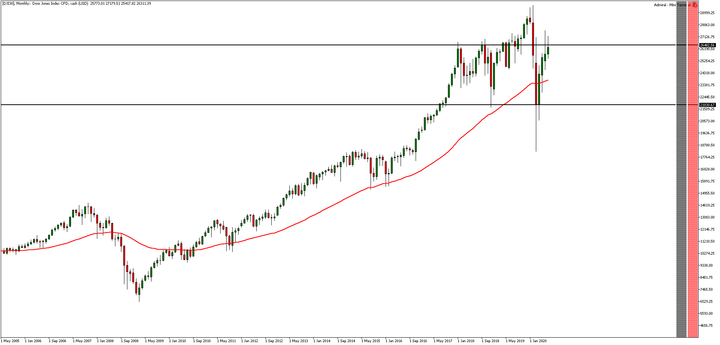
Source: Admiral Markets MetaTrader 5, DJI30, Monthly - Data range: from 1 May 2005 to 30 July 2020. Please note: Past performance is not a reliable indicator of future results.
The Dow Jones index has enjoyed an impressive rally since the March 2020 lows when central banks all around the world announced stimulus measures in response to the coronavirus pandemic. After months of investors buying back into certain sectors the index sits at a very interesting horizontal resistance line around the 26,480 price level.
Technical analysts will note that this is the top of potential sideways consolidation where buyers may struggle to break through. If liquidity dries up over the summer months and investors fear the uncertainty of the US presidential election in November, there is a case put forth by some analysts that the Dow Jones index could trade back to the lower horizontal support level on the chart around the 21,830 price level, signifying a near 20% drop.
However, both short-term traders and long-term investors should be wary of any new potential action from central banks which could help lift the index higher and race to the all-time high price level. A break above the 26,480 horizontal resistance line could be a sign of strength from buyers taking control of the market. In the short-term, however, sellers are in control after rejecting this price level after the bleak picture painted by the Fed.

Comments
Log in or sign up to join the conversation.