

The U.S. economy’s Goldilocks outlook could be at risk if the buoyant economic expansion together with Trump’s fiscal stimulus generates a too rapid increase in wages, salaries, and ultimately consumer prices.
Indeed, rising prices could well be the key indicator to watch for in forecasting when the next economic downturn will hit the U.S. and other advanced economies.
As matters currently stand, the recent weakening in the U.S. dollar and higher oil prices are increasing the U.S. inflation rate. Moreover, the weaker dollar is also boosting America’s exports and thus is providing a short-term boost to the U.S. GDP.
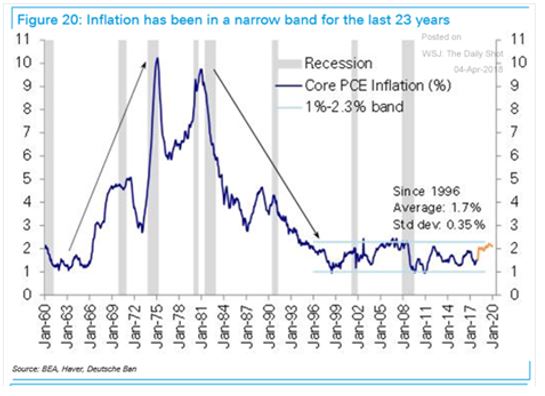
With respect to inflation trends, the key indicator the Federal Reserve focuses on is the core CPI. As the following chart prepared by the Deutsche Bank illustrates, over the last two decades core PCE inflation has ranged within a very narrow band of 1% to 2.3%. Along with many other forecasting groups, the Deutsche Bank predicts that core inflation will gradually increase towards the upper end of this long-term inflation range.
The fact that the U.S. economy is now operating at close to full capacity and with an extremely tight job market adds some credibility to the higher inflation worries. Moreover, there is little doubt that a weaker American dollar will contribute to higher inflation.
Finally, Federal Reserve Chairman Jerome Powell suggested that a more aggressive pace of interest rate hikes may be needed to keep inflation at the central bank’s target of 2%.


Comments
Log in or sign up to join the conversation.