

Market Analysis
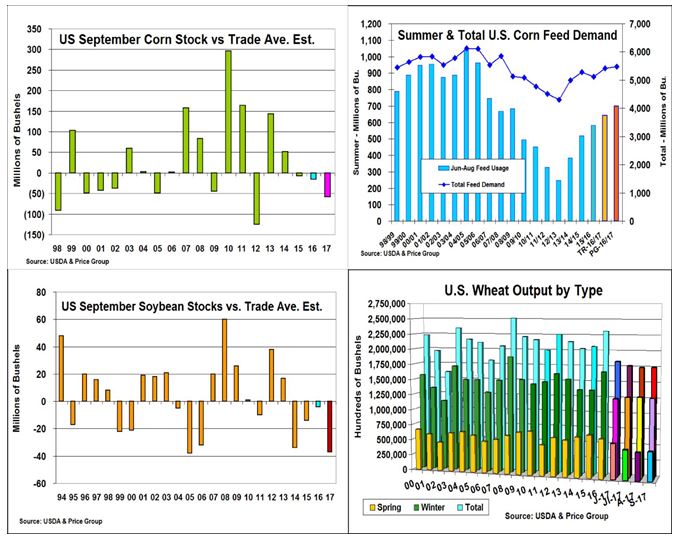
Friday’s September Quarterly Stocks & Small Grains reports provided some surprises in both corn and soy-bean final stocks and in wheat’s 2017 US crop size. This year’s final corn and bean supplies were lower than the USDA’s September levels & the trade’s expectations. The one exception was wheat’s Sept 1 stocks. Friday’s level was 48 million higher-than-expected because of a rise in spring wheat output vs. expectations of sharp decline because of a reduced harvested area.
Ahead of last week’s report, previous quarterly corn stocks suggested the possibility higher US final stocks because of reduced feed demand or underestimated the corn crop. With no change in the 2016 crop, the USDA had reduced its feed demand forecast the past 3 quarters. However, 2017’s final stocks were 58 million lower-than-expected suggesting this past summer’s higher live-stock & poultry numbers along with higher wheat prices & smaller sorghum, oat and barley supplies led to meat producers utilizing corn as their feed source. With both ethanol & export demand revised last month, the USDA is likely to up last summer’s feed demand to near 700 million bu. as corn’s final stocks are now 2.295 billion bu.
Soybean’s higher-than-expected June quarterly stocks had analysts cautious of an upward old-crop revision, but holding their breath for 5-7 million higher crush to reduce the stocks to 338 million because of stronger monthly data. Instead, bean’s final inventory was 301 million bu. prompting, the USDA to shave the 2016/17 crop by 11 million bu. to 4.296 billion and likely up its residual to the highest level since 2010/11 on its October revisions.
Wheat’s 2 million bu. rise to 1.741 billion bu. stunned this market when higher spr. wheat/durum crops actually compensated for reduced hard red & soft red wheat lev-els. Without a 20-30 million smaller crop, wheat’s 2.253 billion bu Sept 1 stocks make sense with less feed use.
What’s Ahead:
With the limited harvest activity in WCB because of excessive rainfall, this week’s US harvest progress remains behind normal keeping us cautious about this fall’s corn and soybean yield trends. However, the large size of Friday’s stocks may keep prices defensive ahead USDA Oct 12 update. Rains in Brazil’s Mato Grasso province later this week will also be a market factor.



Comments
Log in or sign up to join the conversation.