
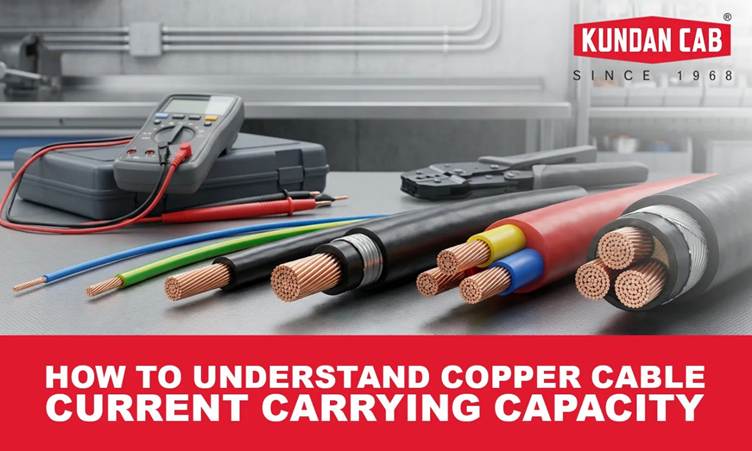
Understanding the copper cable current carrying capacity is important when selecting electrical cables for homes, commercial buildings, and industrial installations. A cable must be able to carry the expected electrical load without excessive heating or unacceptable voltage drop.
The current capacity of copper wire is not determined by conductor size alone. Factors such as insulation, installation method, ambient temperature, number of loaded cables, and circuit length can also affect the suitable rating.
What Is Current Carrying Capacity?
Current carrying capacity refers to the amount of electrical current a conductor can carry continuously under specified conditions while remaining within its permitted temperature limits.
For a copper cable, the allowable current depends on its construction and the conditions in which it is installed.
This is why a cable ampacity chart should be used as a reference rather than treating one amp rating as suitable for every installation.
Factors Affecting Copper Cable Current Carrying Capacity
Several factors can influence the current capacity of copper wire.
1. Conductor Size
The cross-sectional area of the copper conductor is one of the main factors. Generally, a larger conductor can carry more current than a smaller conductor under comparable conditions.
2. Insulation
The type and temperature rating of the insulation affect the maximum permissible conductor temperature. Different cable constructions can therefore have different ratings even when their conductor sizes are similar.
3. Installation Method
A cable installed in a conduit, trunking, underground system, or open air may have different heat-dissipation characteristics. The installation method needs to be considered when determining ampacity.
4. Ambient Temperature
Higher surrounding temperatures can reduce the amount of heat a cable can safely dissipate. This may require a suitable adjustment to the allowable current.
5. Number of Loaded Cables
When several loaded cables are grouped together, heat can accumulate around the conductors. Appropriate derating may therefore be required.
6. Cable Length
Cable length does not directly determine the thermal ampacity in the same way as conductor size and installation conditions, but it is important when checking voltage drop. A long cable run may require a larger conductor to maintain acceptable voltage at the load.
Understanding a Cable Ampacity Chart
A cable ampacity chart typically provides allowable current values for particular conductor sizes under specified installation conditions.
For example, a chart may list different conductor sizes alongside their corresponding current ratings. However, the values should always be interpreted according to the standard, cable construction, insulation temperature, installation method, and correction factors used for that particular chart.
Because conditions vary between installations, a general chart should not be used as the only basis for electrical design.
Copper Cable Load Capacity
The copper cable load capacity refers to the electrical load that a cable can suitably support under defined conditions.
For a simple resistive load, electrical power can be related to voltage and current. In practical installations, however, factors such as power factor, circuit configuration, voltage drop, and starting current may also need to be considered.
For this reason, selecting a cable based only on the appliance's wattage may not always be sufficient.
Copper Cable Amp Rating
The copper cable amp rating indicates the current that the cable can safely carry under specified conditions.
It is important to distinguish between a cable's rated capacity and the actual operating conditions. A cable may have a particular published rating, but the permissible current can change when installation conditions differ.
Protective devices such as circuit breakers should also be selected as part of the complete electrical system rather than independently of the cable.
Current Capacity of Copper Wire by Size
Copper wires are available in various conductor sizes, such as:
1.0 mm²
1.5 mm²
2.5 mm²
4 mm²
6 mm²
10 mm²
16 mm²
25 mm²
35 mm²
50 mm² and larger
The current capacity of copper wire cannot be assigned one universal amp value for each size because the allowable current depends on installation conditions and the applicable standard.
Therefore, when using a current carrying capacity chart, always check the assumptions behind the values.
Why Choosing the Correct Cable Capacity Matters
Using an unsuitable cable for an electrical load can result in excessive conductor temperature, voltage drop, insulation stress, or reduced equipment performance.
Selecting an appropriately rated cable can help:
Handle the expected electrical load
Control conductor heating
Reduce excessive voltage drop
Improve circuit reliability
Support suitable circuit protection
Increase the service life of the installation
Cable sizing should be performed as part of the overall circuit design.
How to Select a Copper Cable
Before choosing a copper cable, consider:
Determine the expected electrical load.
Identify the system voltage and phase arrangement.
Calculate or determine the expected operating current.
Select an appropriate conductor size.
Check the cable's insulation and temperature rating.
Consider the installation method.
Account for ambient temperature and cable grouping.
Check voltage drop for longer cable runs.
Select suitable circuit protection.
Verify the applicable electrical standards.
For residential and industrial installations, cable selection should be confirmed by a qualified electrical professional.
Final Thoughts
The copper cable current carrying capacity depends on more than the conductor material. Conductor size, insulation, installation method, temperature, cable grouping, and voltage-drop requirements all influence the appropriate cable selection.
A cable ampacity chart can be useful for understanding approximate ratings under defined conditions, but the actual cable specification should be selected according to the relevant standards and the conditions of the installation.
Choosing the right copper cable amp rating helps create an electrical system that can handle its intended load reliably and safely.
Comments
Log in or sign up to join the conversation.