

Intel (Nasdaq:INTC) reported strong earnings on Thursday. The company talked about strong cloud and PC trends. It gave weaker guidance on the second half of 2020 though. Still, I think the underlying trends are a real-time proof point that AMD (Nasdaq:AMD) should have a good showing on Tuesday. As for Intel, looking for more good entries.
First, What We Told Subscribers Going Into Intel Earnings
Let me show you what we said why we liked Intel going into earnings. This will tell you a little about what we look for when we like a company.
Ahead of earnings, even though we expected a strong report and a strong guide near term, we expected a weak second half, which is also what played out. Here's what we said on Wednesday ahead of Thursday's earnings:
"I'll discuss why I like this quarter but there are some hits longer term. For one, short term Windows has a big upgrade cycle that ends in the first half of 2020. That's driving a lot of demand. I think that drives Q1's guidance tomorrow but it's a shorter term driver. It's not something I can model out longer term."
That proved correct. They blew away the Street's number for Q4 and the guide for Q1. In fact, instead of our $18 billion, the company gave a guide of $19 billion for Q1.
Here's what we were looking at ahead of Thursday's report.
|
If you know us, you know we love the 2-year growth rate. It says so much. It takes 2 years of growth, which smooths out one-timers.
Intel was too conservative, as we expected based on looking at the accelerating 2-year in the last few quarters (Look at 8.6% go to 12.2% go to 18.8%). That was the tip-off to us. Comparing that acceleration in the last few quarters to an implied slowdown in their Q4 guide did not make sense to us.
That proved correct.
But That Back-Half 2020 Guide Looks Conservative Anyway
The short term showed a big beat and guide up, but the conference call heard analysts whining about the second half guide. That's also similar to what we expected based on Windows renewals coming to an end.
Here's the first analyst in Q&A on the earnings call crying about the second half because of the end of the Microsoft first-half driver we previewed.
"But it appears, by the end of this year you could even be going negative in both of those segments year-over-year. So it seems like it's a pretty significant drop. I appreciate conservatism in the end-of-life on the Windows side of things. But how do you factor in the increased competition that you mentioned and the fact that shortages should go away so you could actually have some market share gains?"
I'd like to analyze Intel's answers to show that I think the company is still being conservative.
Let's review Intel's answer to the above analyst's question, but first let's look at the implied numbers and what the analyst pointed out that "by the end of this year you could even be going negative in both of those segments year-over-year."
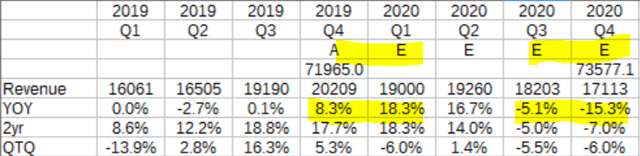
First, here's the numbers the company is looking at.
(Source: Elazar Advisors estimates and data pulled from Intel earnings reports)
Above you see the big acceleration in revenue growth in Q4 and the humongous guide in Q1. 8.3% goes to 18.3%. Wow!
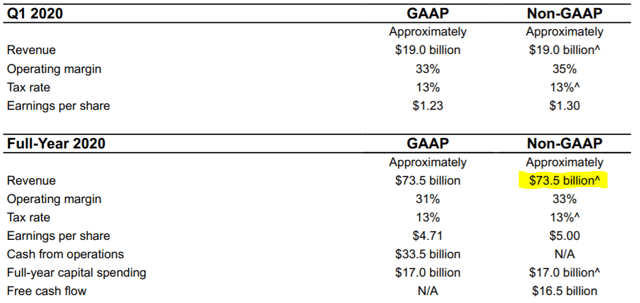
Here's the company's guide. Look at 2020's full-year guide.
(Source)
To get to its $73 billion estimate for the full year 2020, you need a massive slowdown from the trend implied in the company's Q1 guide. Now scroll up to my grid to see that slowdown. I do think it's conservative, but let's see what the company said and analyze it.
Here's what it said about expecting a slower second-half cloud business:
"So we look at first half to second half, Q1 will be in essence the third quarter in a row of real strong consumption patterns from the cloud folks. So we know from history that at some point they go into digestion mode and the buying patterns begin to slow down. And it doesn't impact medium or long term trends but it does impact cyclical trends during the course of the year. And we have tried to, based on our past learnings, take that into account as much as we can. So hopefully we are wrong. Hopefully, we are conservative. But at this stage of the game, that's kind of how we looked at cloud purchases first half to the second half."
First, the way I read the company's comments, it is being conservative. Intel said "at some point" it expects a slowdown. That means it is seeing no slowdown at this point in time. That's very very important. If they were already seeing a slowdown, the stock would have been down 8% on Friday instead of up 8%. But it is not seeing a slowdown, which is so key.
So, as for the "cloud reason" for the weak guide, I don't see current reasons for down rates of growth in the back half.
Plus, Intel flat out said "at this stage of the game... Hopefully, we are conservative." That means to me that it knows it had a great quarter and it can throw some water on a scolding hot report without hurting itself. That gives the company wiggle room for later in the year.
I will say that many semiconductor companies that we speak to always say that cloud sales are "lumpy." That means they show up sometimes and don't show up at other times. So, there is come credence to what they are saying.
P.S.: I will say that we had said on AMD (Nasdaq:AMD) back in October 2019 that cloud was a "lumpy contributor" in GPUs. That was one reason we were bullish back then ahead of this recent stock launch.
But cloud customers can make or break quarters for semi companies. That's what Intel is worried about. It doesn't see it here and now, but the company has gone through some of those lumpy and not so lumpy periods, so it wanted to reflect that in its guide.
So, while cloud is hot now, they can turn off at any time.
Here's another reason Intel gave for the weak 2020 back half:
"The second thing, PC TAM, we think is going to be flat to down a little bit this year. And the expectation is the first half will continue to be Windows 10 refresh that George flagged. And we expect that to slowdown in the second half."
This part I believe. PCs have had a big driver. You have a Windows 10 refresh upgrade cycle, as Windows 7 ended support on January 14th. That's driven sales. That's passed now. I do think that this drove, and maybe will drive, another quarter of upgrades to Windows 10.
Look at how Microsoft (Nasdaq:MSFT) works it to get people to upgrade. Here's what the company is saying to customers:
"Microsoft made a commitment to provide 10 years of product support for Windows 7 when it was released on October 22, 2009. This 10-year period has now ended, and Microsoft has discontinued Windows 7 support so that we can focus our investment on supporting newer technologies and great new experiences. The specific end of support day for Windows 7 was January 14, 2020. Technical assistance and software updates from Windows Update that help protect your PC are no longer available for the product. Microsoft strongly recommends that you move to Windows 10 to avoid a situation where you need service or support that is no longer available."
That's pretty nice of the company, right? It doesn't want its customers to get stuck without service, so it advises them to upgrade. Guess what, that upgrade is driving a ton of Windows 10 purchases.
Those Windows 10 purchases force IT managers to look at their entire PC infrastructure, and that's driving PC hardware upgrades as well. That's a huge turnover of equipment going on right now. But keep in mind, that's also a shorter-term driver that's passing.
I'm guessing not everybody has upgraded to Windows 10, but many, if not most, have. There's probably some more carryover, but most of that is behind us.
So, this part of Intel's guidance could make sense. This is something that needs watching as we get into Q2. Q2 could slow because of this.
Here's the company's third reason:
"And then the third item is modem. As we go into the second half of the year, we expect modem volume to be lower as we phase out of that business as smartphone modem moves to the 5G world."
Intel sold its modem business to Apple (Nasdaq:AAPL), so that goes away. I believe this.
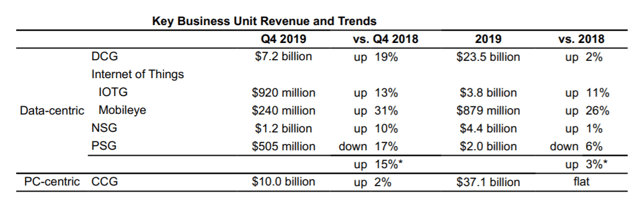
Here's the make-up of the company's revenues.
(Source: Recent earnings report)
You can see that DCG, where the cloud spending happens, was $23 billion in 2019 versus CCG, which is PCs, at $37.1 billion for 2019.
So, if the company is conservative on cloud, it's meaningful. I don't know if it is being that conservative on PCs. We'll have to take it quarter by quarter. But as I mentioned before, the Windows refresh has reason to slow down right now.
The company also said there was another reason to be conservative in the back half. It said year-ago numbers were stronger in the back half of 2019, so 2020 could slow based on that.
Here's Intel's statement:
"But I think just on a year-over-year basis, the comps in the first half of 2020 are going to be easier. And then after a very strong second half of 2019, comps will get tougher in the second half of the year."
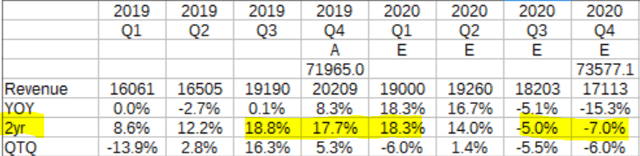
2019 growth rates by quarter were 0%, -2.7%, .1%, 8.3% Q1 to Q4. So, they do get a little tougher, but the implied 2-year growth rate assumes a big slowdown (see table below).
(Source: Elazar Advisors estimates and data pulled from Intel earnings reports)
I think the company expects too big of a slowdown, because you see the 2-year growth rate needs to slow down from teens in the first half of 2020 to negative in the second half. That's too much.
My Take On Intel
I do think there's upside to the company's guidance in the back half. I do think that cloud seems to have legs.
We also recently showed when Micron (Nasdaq:MU) reported that cloud spending was starting to pick up. ("Micron: Bullish, Easier Money With Pricing Now Up") We used some of that data as confirmation that Intel's quarter could be pretty good. That proved correct.
The PC cycle can soften, and that is key for Intel. It's also very possible that cloud slows, but the growth rates seem less out of control right now.
Here's cloud capex spending, which is so critical.
|
(Source: Elazar Advisors Models with data pulled company earnings reports)
You can see that last year had huge huge growth rates in cloud capex. Intel talked about cloud companies needing to "digest" that huge buying. Then it slowed earlier this year. But now it seems steadier. I don't expect a big slowdown.
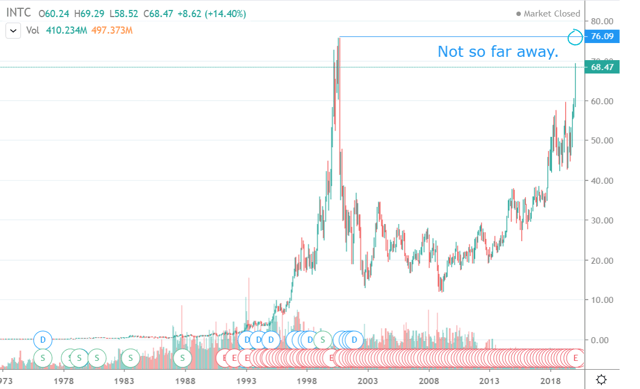
Intel Approaching 2-Decade Breakout
(Source)
Here's a chart showing the rip-roaring '90s. We're almost at those old highs. A break above would be technically pretty bullish.
Near term, I do think the stock is a little extended. It may have a little more follow-through short term, but I'm probably going to be looking for opportunities after it settles or comes back down.
AMD On Tuesday
We recently had a bullish preview on AMD.
I've seen many people think that if Intel is doing well, that's got to take share back from AMD. I don't think that's correct.
I see a lot of people looking at market share. In my career, I've never really looked at market share. I focus on bottom-up, company-specific analysis. If the underlying market trend is picking up for specific reasons, that should benefit each player.
I think market share potential and TAM is a good longer-term data point. I'm more shorter-term looking at the next two quarters and next year or so.
In tech, a rising tide lifts all ships. That's where we are right now.
If cloud and PC both slow in the second half for Intel, I believe that will be a negative for AMD.
But for now, AMD's earnings upcoming report on Tuesday, a strong cloud and a strong PC market bode well.
Conclusion
We were bullish ahead of Intel's earnings. We were happy to see the stock up big on Friday. So were subscribers. I think there may be a little near-term follow-through, but with the stock straight up, I think there will be better buying opportunities.
As for AMD, a rising tide lifts all ships. Micron talked about strong cloud. Intel's now talked about strong cloud and strong PC businesses. I have to believe, with AMD gaining share, they should be a big beneficiary. We'll see on Tuesday.


Comments
Log in or sign up to join the conversation.