

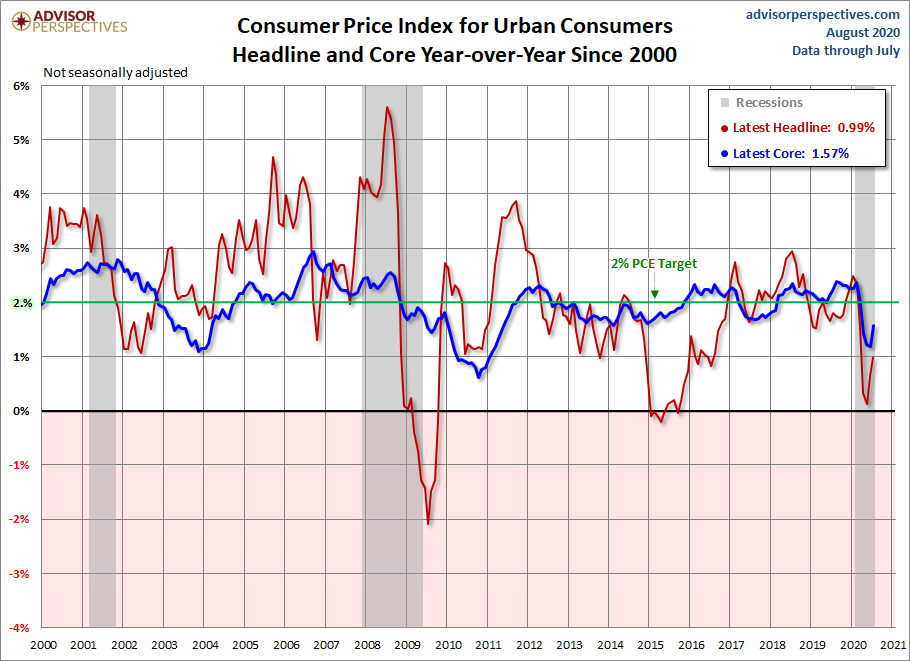
The Bureau of Labor Statistics released the July Consumer Price Index data this morning. The year-over-year non-seasonally adjusted Headline CPI came in at 0.99%, up from 0.65% the previous month. Year-over-year Core CPI (ex Food and Energy) came in at 1.57%, up from 1.19% the previous month and below the Fed's 2% PCE target.
Here is the introduction from the BLS summary, which leads with the seasonally adjusted monthly data:
The Consumer Price Index for All Urban Consumers (CPI-U) increased 0.6 percent in July on a seasonally adjusted basis, the same increase as in June, the U.S. Bureau of Labor Statistics reported today. Over the last 12 months, the all items index increased 1.0 percent before seasonal adjustment.
The gasoline index continued to rise in July after increasing sharply in June and accounted for about one quarter of the monthly increase in the seasonally adjusted all items index. The energy index increased 2.5 percent in July as the gasoline index rose 5.6 percent. This was partially offset by the food index, which decreased 0.4 percent in July, with the index for food at home declining 1.1 percent.
The index for all items less food and energy rose 0.6 percent in July, its largest increase since January 1991. The index for motor vehicle insurance increased sharply in July, as it did the previous month. The indexes for shelter, communication, used cars and trucks, and medical care also increased in July, while the index for recreation declined.
The all items index increased 1.0 percent for the 12 months ending July, a larger increase than the 0.6-percent rise for the period ending June. The index for all items less food and energy increased 1.6 percent over the last 12 months. The food index increased 4.1 percent over the last 12 months, with the index for food at home rising 4.6 percent. Despite increasing in July, the energy index fell 11.2 percent over the last 12 months.
Coronavirus (COVID-19) Pandemic Impact on July 2020 Consumer Price Index Data
Data collection by personal visit for the Consumer Price Index (CPI) program has been suspended since March 16, 2020. When possible, data normally collected by personal visit were collected either online or by phone. Additionally, data collection in July was affected by the temporary closing or limited operations of certain types of establishments. These factors resulted in an increase in the number of prices considered temporarily unavailable and imputed. While the CPI program attempted to collect as much data as possible, many indexes are based on smaller amounts of collected prices than usual, and a small number of indexes that are normally published were not published this month. Additional information is available at www.bls.gov/covid19/effects-of-covid-19-pandemic-on-consumer-price-index.htm. More…]
Investing.com was looking for a 0.3% MoM change in seasonally adjusted Headline CPI and a 0.2% in Core CPI. Year-over-year forecasts were 0.8% for Headline and 1.1% for Core.
The first chart is an overlay of Headline CPI and Core CPI (the latter excludes Food and Energy) since the turn of the century. The highlighted two percent level is the Federal Reserve's Core inflation target for the CPI's cousin index, the BEA's Personal Consumption Expenditures (PCE) price index.
The next chart shows both series since 1957, the year the government first began tracking Core Inflation.
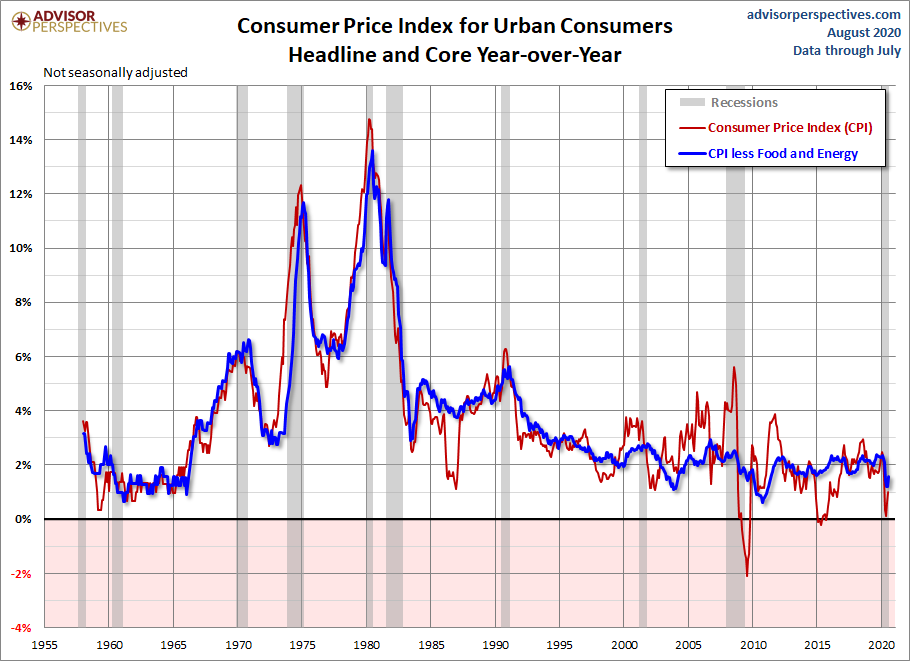
In the wake of the Great Recession, two percent has been the Fed's target for core inflation. However, at their December 2012 FOMC meeting, the inflation ceiling was raised to 2.5% while their accommodative measures (low Fed Funds Rate and quantitative easing) were in place. They have since reverted to the two percent target in their various FOMC documents.
Federal Reserve policy, which in recent history has focused on core inflation measured by the core PCE Price Index, will see that the more familiar core CPI is now at the PCE target range of 2 percent.

Comments
Log in or sign up to join the conversation.