

The Latest Conference Board Consumer Confidence Index was released this morning based on data collected through December 16. The headline number of 92.6 was an increase from the revised November final reading of 91.0, an upward revision from 88.7. Today's number was slightly below the Investing.com forecast of 93.2.
Here is an excerpt from the Conference Board press release.
Says Lynn Franco, Director of Economic Indicators at The Conference Board, “Consumer confidence rebounded modestly in December, propelled by a considerably more favorable assessment of current economic and labor market conditions. As a result, the Present Situation Index is now at its highest level since February 2008 (Index, 104.0). Consumers were moderately less optimistic about the short-term outlook in December, but even so, they are more confident at year-end than they were at the beginning of the year.”
Consumers’ appraisal of current conditions was considerably more favorable in December. Those saying business conditions are “good” was unchanged at 24.8 percent, while those claiming business conditions are “bad” decreased from 21.8 percent to 19.6 percent. Consumers were also more positive in their assessment of the job market, with the proportion stating jobs are “plentiful” increasing from 16.2 percent to 17.1 percent, and those claiming jobs are “hard to get” decreasing from 28.7 percent to 27.7 percent.
Consumers’ optimism about the short-term outlook eased moderately in December. The percentage of consumers expecting business conditions to improve over the next six months edged down from 18.3 percent to 18.0 percent, but those expecting business conditions to worsen declined slightly from 10.4 percent to 10.1 percent. Consumers’ outlook for the labor market was marginally less optimistic. Those anticipating more jobs in the months ahead decreased from 15.5 percent to 14.7 percent, while those anticipating fewer jobs rose from 16.1 percent to 16.9 percent. The proportion of consumers expecting growth in their incomes declined moderately from 16.9 percent to 16.4 percent; however the proportion expecting a decrease also declined, from 11.0 percent to 10.0 percent.
Putting the Latest Number in Context

Let's take a step back and put Lynn Franco's interpretation in a larger perspective. The table here shows the average consumer confidence levels for each of the five recessions during the history of this monthly data series, which dates from June 1977. The latest number is 23.2 points above the recession mindset and 1.6 points below the non-recession average.
The chart below is another attempt to evaluate the historical context for this index as a coincident indicator of the economy. Toward this end I have highlighted recessions and included GDP. The exponential regression through the index data shows the long-term trend and highlights the extreme volatility of this indicator. Statisticians may assign little significance to a regression through this sort of data. But the slope clearly resembles the regression trend for real GDP shown below, and it is a more revealing gauge of relative confidence than the 1985 level of 100 that the Conference Board cites as a point of reference. Today's reading of 92.6 is well above the current regression point of 78.7.
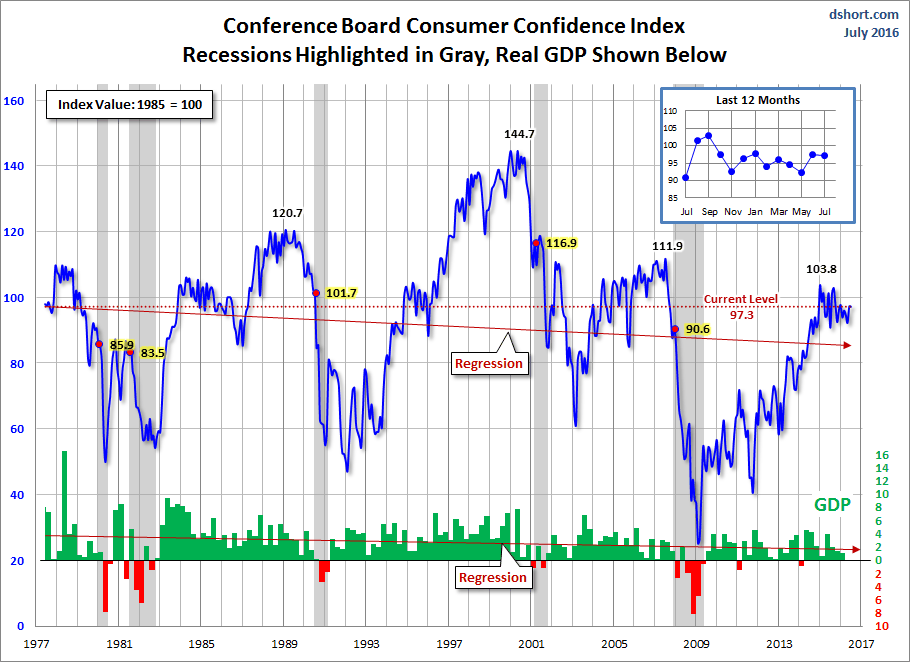
On a percentile basis, the latest reading is at the 47th percentile of all the monthly readings since the start of the monthly data series in June 1977 and at the 43rd percentile of non-recessionary months.
For an additional perspective on consumer attitudes, see my post on the most recent Reuters/University of Michigan Consumer Sentiment Index. Here is the chart from that post.

And finally, let's take a look at the correlation between consumer confidence and small business sentiment, the latter by way of the National Federation of Independent Business (NFIB) Small Business Optimism Index. As the chart illustrates, the two have tracked one another fairly closely since the onset of the Financial Crisis.

Comments
Log in or sign up to join the conversation.