

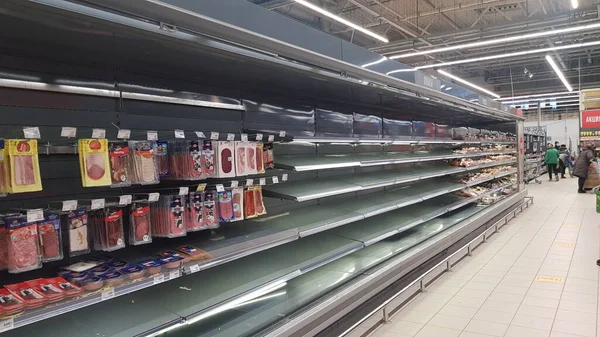
Two weeks ago I wrote about how conflict and climate change are combining to impede navigation across the globe. That same combination is also pushing food supply down and prices up worldwide. Climate change is no longer coming; it's here and we're mixing it with our human folly in war in ways that make matters worse.
A single headline can only tell a fragment of the story. For example, "Britain faces food shortages within months, warn farmers," one article blares. Why? The writer explains: "The worst harvest since 1984 and a spike in livestock deaths have left many farmers without the cash needed to sow their fields for the coming year." Contemplate that for a moment. Many farmers in Great Britain may not even be able to afford to plant crops next season. As of now, a decision to plant would almost certainly cause farmers to lose money.
But we need to dig deeper for the cause. One farm leader explained: "Rain has come too late for lost harvests and slashed yields, while livestock farmers are dealing with the worst bluetongue outbreak [a disease in sheep] to reach our shores." So we now know that climate change is likely involved as warming temperatures tend to increase both droughts and floods depending on where you are. And, there is an increase in animal disease which can be traced to the warmer temperatures: "Bluetongue, a disease that causes fertility problems and deaths in sheep, has been particularly bad this year because high temperatures have led to a larger-than-normal number of midges, which spread the virus."
And, then, of course, there are the skyrocketing prices of fertilizer and diesel, both essential to modern mechanized farming. And, those costs are up because supplies of fertilizer and the oil from which diesel is made have been dramatically curtailed from the Persian Gulf area, a major source, because of the closure of the Strait of Hormuz by Iran in response to the attack on the country by the United States and Israel.
Diesel has also become scarce because in the conflict between Ukraine and Russia, Ukraine has been damaging Russian oil refineries forcing Russia to temporarily stop all diesel exports. (For context, Russia is the second largest producer of oil in the world after the United States, and Russia routinely exports large amounts of oil and refined products such as diesel.)
In the southwestern United States long-term drought is drying up both the Colorado River upon which 40 million people including many farmers and ranchers depend for water and the Rio Grande which is crucial contributor of water for agriculture and public water systems for much of its 1,900 mile length from southwestern Colorado through New Mexico and then along the border of Texas and Mexico. But the Rio Grande at times runs almost dry in various locations below the New Mexico-Texas border because so much water is being withdrawn in the face of an ongoing drought (which, of course, increases demand for water).
According to the U.S. Department of Agriculture, as of August 26 drought is affecting large areas of U.S. cropland for key crops including barley (80 percent), durum wheat (62 percent), rice (61 percent), spring wheat (80 percent), sugarbeets (75 percent), sunflowers (80 percent), and winter wheat (56 percent). A non-food crop, cotton, is suffering, too, with 52 percent of the area cultivated under drought conditions.
The devastating heatwaves and drought in Europe are dramatically reducing yields of commodity crops such as corn, rice and soybeans as well as vegetables crops. In France, for example, vegetable production is down dramatically for lettuce (35 percent), peas (40 percent) and broccoli (60 percent). Corn harvests are expected to be down by 35 percent in France which is one of Europe's largest producers.
In Brazil a fall in sugar production is linked to a shift to increasing ethanol production from sugar. Here the line to the U.S.-Israeli war with Iran is direct. Iran's closing of the Strait of Hormuz has lifted prices for oil and especially for refined products such as gasoline. Most Brazilian gasoline-fueled automobiles and trucks are designed to run on high mixes of ethanol in gasoline. In the wake of rising oil prices the Brazilian government lifted the minimum requirement for the ethanol portion of the gasoline/ethanol mix from 30 to 32 percent. (For comparison, U.S. gasoline generally contains about 10 percent ethanol.) As long as the price of ethanol remains below that of gasoline, it makes sense for Brazilian drivers to fill up with gasoline/ethanol mixes higher in ethanol and that means that sugar mills are finding it increasingly profitable to favor production of ethanol over sugar.
Elsewhere, production of sugar and other key crops such as cotton, soybeans, corn and beans has been curtailed by the smallest monsoon rains in India in 15 years. India earlier this year suspended exports of sugar to keep domestic prices in check. The emerging El Niño—which is expected to be the strongest in history and to peak in early 2027—could further affect the Indian monsoon negatively next year. And the effects of El Niño could ripple across agriculture across the globe, having both positive and negative effects depending on where you live.
In Africa, Sudan is a prime example of the intersection of conflict and climate change. The ongoing civil war which began in 2023 has displaced millions and killed tens of thousands. Now, comes the U.S.-Israeli war with Iran which has resulted in high fuel and fertilizer costs. On top of that a drought and an emerging El Niño which could make that drought worse are robbing fields usually flooded by the Nile River of the water they need.
Meanwhile, back at the front of the Ukraine-Russia war, grains terminals and grain ships are being targeted, primarily threatening wheat exports to the world. That has sent wheat futures to their highest in three years. Both Russia and Ukraine are large wheat exporters and have been attacking each other's grain terminals and ships.
Conflict has always had consequences for commodities depending on whether major producers or consumers of particular commodities are involved in the war. But from here on out climate change will be one of the parties to every conflict, and it will be affecting farm fields around the globe whether the countries in which those fields are located are part of the conflict or not.
All this means that it is going to be increasingly difficult to import one's way out of food shortages as the whole of world agriculture becomes affected. Few in positions of civilian or military leadership have yet to comprehend this.

Comments
Log in or sign up to join the conversation.