

The latest Conference Board Leading Economic Index (LEI) for September increased to 111.8 from 111.2 in August. The Coincident Economic Index (CEI) came in at 104.4, up from 104.3 the previous month.
The Conference Board LEI for the U.S. increased again in September. Positive gains from most components, except for weekly hours in manufacturing and building permits, contributed to the recent improvement. In the six-month period ending September 2018, the leading economic index increased 2.8 percent (about a 5.6 percent annual rate), much slower than the growth of 4.1 percent (about an 8.4 percent annual rate) over the previous six months. However, the strenghts among the leading indicators remain widespread.
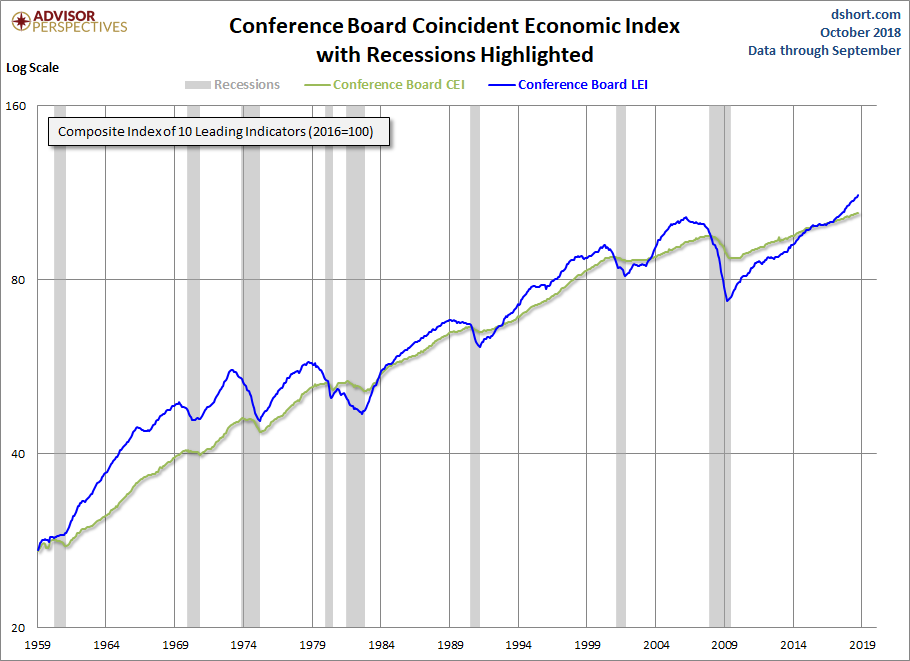
The Conference Board CEI for the U.S., a measure of current economic activity, edged up in September. The coincident economic index rose 1.1 percent (about a 2.1 percent annual rate) between March and September 2018, slightly slower than the growth of 1.3 percent (about a 2.6 percent annual rate) over the previous six months. However, the strengths among the coincident indicators have remained very widespread, with all components advancing over the past six months. The lagging economic index declined in September while the CEI increased. As a result, the coincident-to-lagging ratio is up slightly. Real GDP expanded at a 4.2 percent annual rate in the second quarter, after increasing 2.2 percent (annual rate) in the first quarter. [Full notes in PDF]
Here is a log-scale chart of the LEI series with documented recessions as identified by the NBER. The use of a log scale gives us a better sense of the relative sizes of peaks and troughs than a more conventional linear scale.
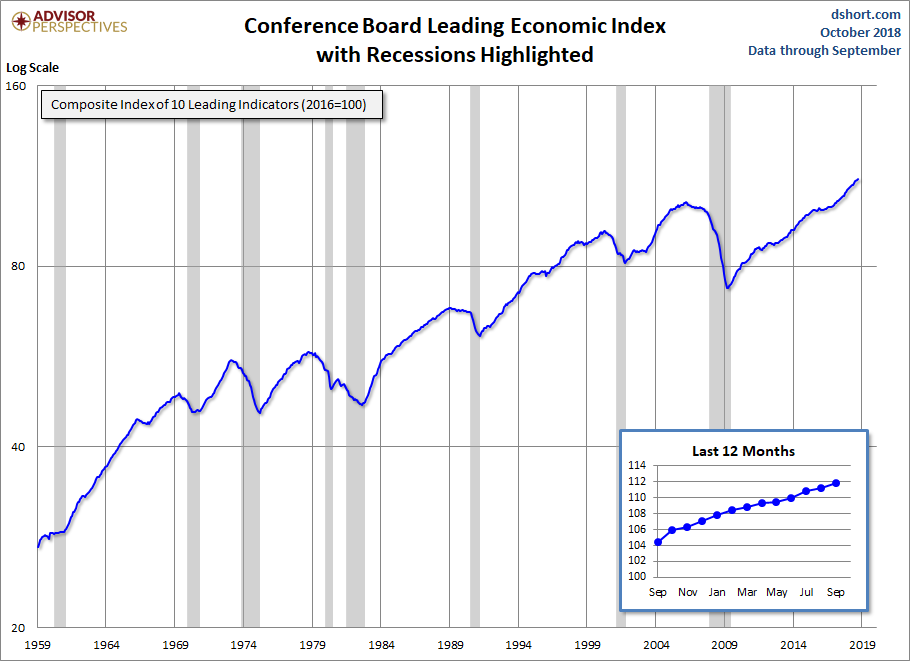
For additional perspective on this indicator, see the latest press release, which includes this overview:
“The US LEI improved further in September, suggesting the US business cycle remains on a strong growth trajectory heading into 2019. However, the LEI’s growth has slowed somewhat in recent months, suggesting the economy may be facing capacity constraints and increasingly tight labor markets,” said Ataman Ozyildirim, Director and Global Research Chair at The Conference Board. “Economic growth could exceed 3.5 percent in the second half of 2018, but, unless the momentum in housing, orders and stock prices accelerates, that pace is unlikely to be sustained in 2019.”
For a better understanding of the relationship between the LEI and recessions, the next chart shows the percentage-off the previous peak for the index and the number of months between the previous peak and official recessions.
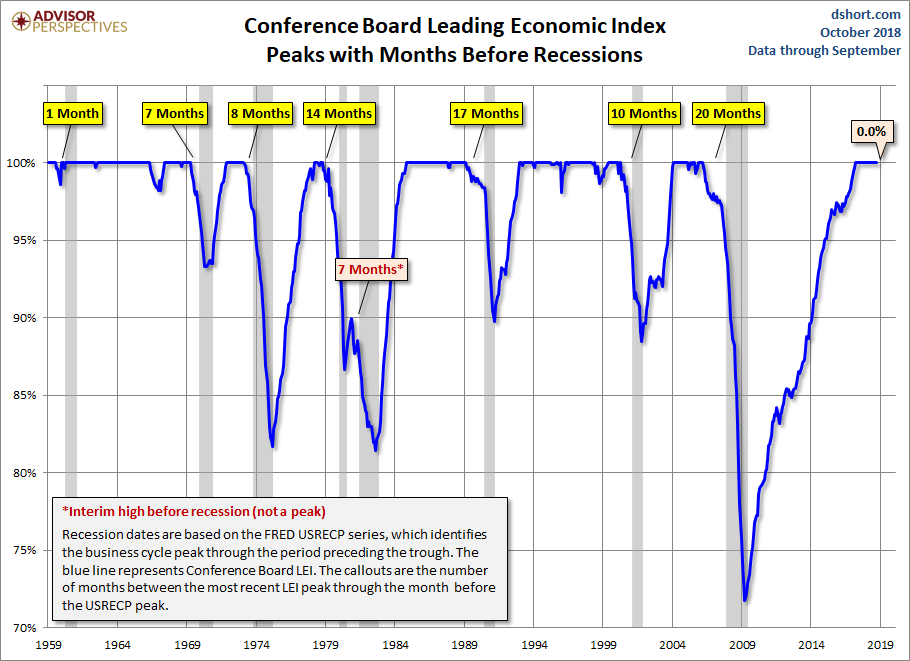
LEI and Its Six-Month Smoothed Rate of Change
Based on suggestions from Neile Wolfe of Wells Fargo Advisors and Dwaine Van Vuuren of RecessionAlert, we can tighten the recession lead times for this indicator by plotting a smoothed six-month rate of change to further enhance our use of the Conference Board's LEI as a gauge of recession risk.
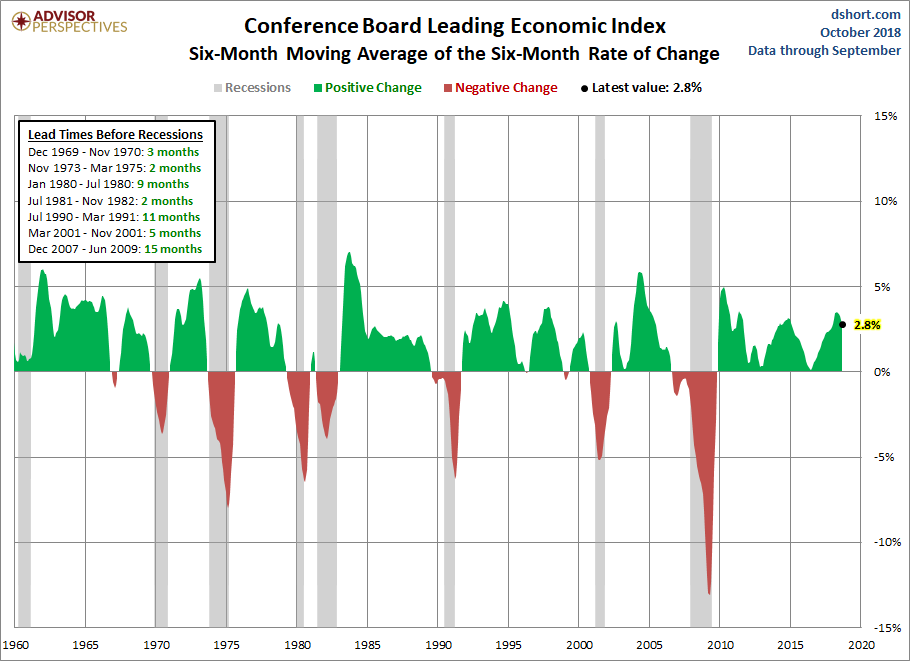
As we can see, the LEI has historically dropped below its six-month moving average anywhere between 2 to 15 months before a recession. The latest reading of this smoothed rate-of-change suggests no near-term recession risk. Here is a twelve month smoothed out version, which further eliminates the whipsaws:

The Conference Board also includes its Coincident Economic Index (CEI) in each release. It measures current economic activity and is made up of four components: nonagricultural payroll, personal income less transfer payments, manufacturing and trade sales, and industrial production. Based on observations, when the LEI begins to decline, the CEI is still rising. Here's a chart including both the CEI and LEI.
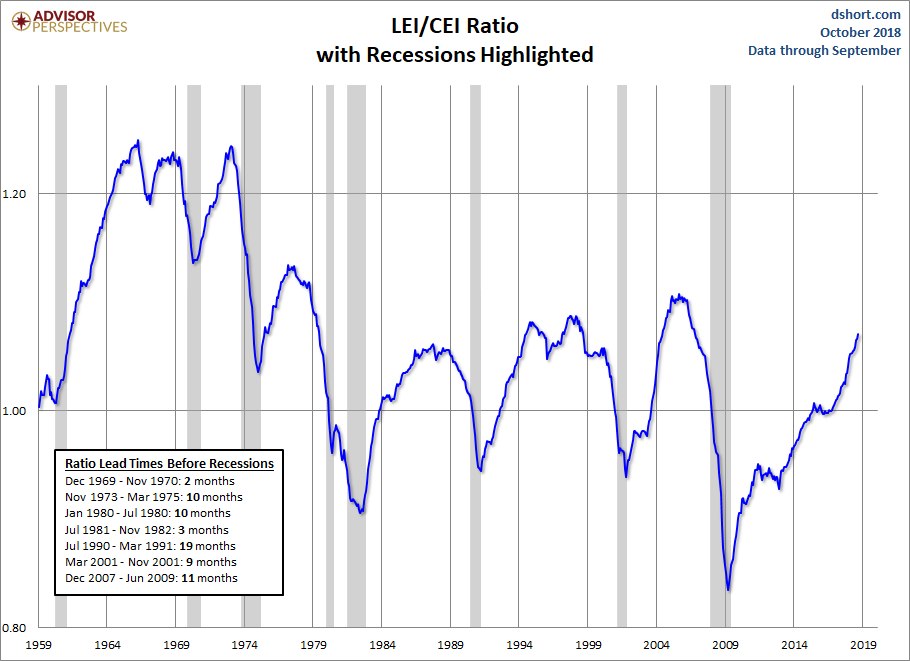
Here is a chart of the LEI/CEI ratio, which is also a leading indicator of recessions.

Comments
Log in or sign up to join the conversation.