

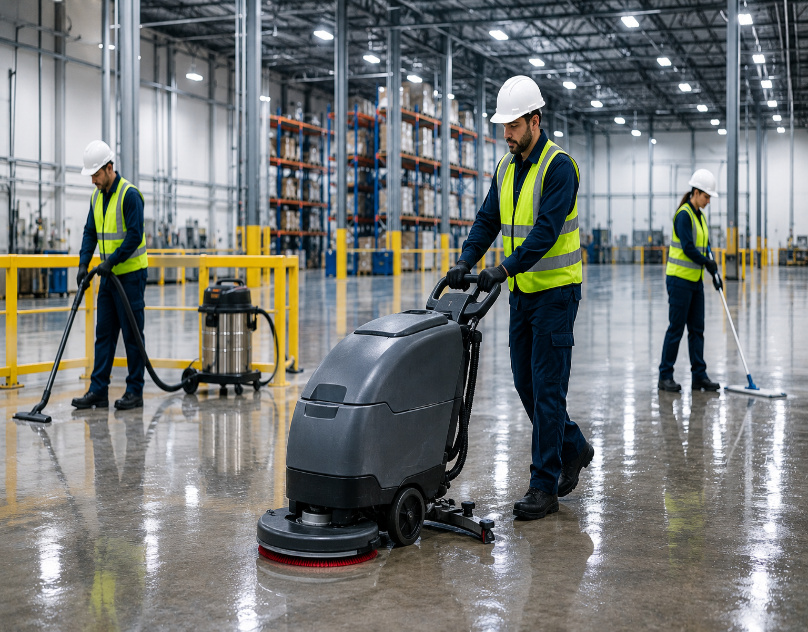
Warehouses and distribution centers present cleaning challenges that general-purpose janitorial products are not equipped to handle. Forklift tire marks on concrete, pallet oil residue, and industrial dust that settles across tens of thousands of square feet require commercial cleaning solutions formulated for the intensity and scale of industrial facility operations.
Key Takeaways
Industrial floor soiling in warehouses combines mechanical rubber transfer, oil, and abrasive particulate that diluted consumer cleaners cannot address
Commercial cleaning solutions in concentrates reduce cost-per-square-foot compared to ready-to-use products at warehouse scale
Selecting the right floor cleaner chemistry for your floor type prevents surface damage and coating adhesion failures
High-traffic receiving and staging areas accumulate soiling faster and require higher frequency cleaning than general storage zones
Documenting cleaning schedules and products used supports OSHA compliance and insurance requirements
Why Warehouse Floors Need Industrial-Grade Chemistry
Concrete warehouse floors accumulate a layered soil profile that reflects every operational activity in the facility. Forklift tire rubber transfers black marks onto sealed and unsealed concrete. Pallet wrapping film leaves adhesive residue when dragged across floors. Lubricants from conveyor systems and pallet jacks create slip-hazard film. Cardboard and paper dust settles into every surface irregularity and becomes a slip risk when wet.
Standard diluted floor cleaners used in office or retail environments do not have the surfactant concentration or alkalinity to cut this combined soiling load effectively. Commercial cleaning solutions with professional-grade chemistry penetrate the composite soiling layer in a single application, reducing the scrubbing time and labor required to achieve a clean, safe floor surface.
Floor Type Considerations in Warehouse and DC Environments
Not all warehouse floors have the same surface chemistry, and the wrong cleaner can cause damage that costs far more than the cleaning budget. Polished concrete and epoxy-coated floors used in pharmaceutical, food distribution, and electronics warehouses require neutral pH cleaners that clean without etching the polished surface or attacking epoxy adhesion. Unsealed concrete in general storage warehouses tolerates more alkaline chemistry that cuts through heavy soil loads with less mechanical scrubbing.
Coated floor systems, including polyurea and polyaspartic coatings used in high-performance distribution center environments, have specific manufacturer cleaning requirements that typically restrict highly alkaline chemistry and solvent-bearing formulas. Using a commercial floor cleaner product appropriate for coated surfaces preserves the coating warranty and prevents the delamination and bubbling that result from incompatible chemistry.
High-Traffic Zone Cleaning Strategy
Receiving docks, staging lanes, and primary forklift travel paths accumulate soil at rates five to ten times higher than general storage areas. A zone-based cleaning strategy that concentrates frequency and chemical intensity in high-traffic areas while maintaining lighter maintenance schedules in low-traffic zones optimizes both labor and product usage.
Dock areas where over-the-road trailers are spotted accumulate diesel drip, hydraulic fluid from trailer landing gear, and road film tracked in from trailer floors. Alkaline chemical cleaning products designed for combined petroleum and particulate soil handle dock area contamination effectively in a single application, eliminating the need for separate degreaser and floor cleaner applications in the busiest zones.
Integrating Commercial Cleaning Into Operational Schedules
Warehouse cleaning without shutting down operations requires products and application methods that accommodate active facility conditions. Autoscrubber-applied floor cleaners that do not require long dwell times allow cleaning to proceed through active storage lanes without halting forklift traffic. Low-foam formulas designed for machine application do not create residue on scrubber brushes that transfers to clean areas of the floor.
Scheduling intensive cleaning for receiving dock areas during shift changes, when inbound truck traffic pauses, and targeting general storage lanes during the lowest-activity periods of each shift minimizes operational disruption. A chemical supplier that understands warehouse operational realities can recommend product dilutions and application approaches that fit within your specific operational constraints.
Evaluating Suppliers for Industrial Facility Cleaning
Warehouses and distribution centers purchasing commercial cleaning solutions at scale benefit from suppliers who offer bulk ordering, consistent product supply, and technical support for product selection. A domestic manufacturer with a full product portfolio covering floor cleaners, degreasers, facility maintenance chemicals, and specialty surface solutions reduces the vendor management burden and ensures product compatibility across cleaning applications.
Fleet and facility managers at distribution operations can find the commercial cleaning solutions needed for every zone of their facility at Suppliers Chemical, where formulation depth and professional-grade product performance support high-demand industrial cleaning requirements.
Frequently Asked Questions
What type of commercial floor cleaner is safe for epoxy-coated warehouse floors?
Neutral pH commercial floor cleaners formulated for coated surfaces are appropriate for epoxy-coated floors. Highly alkaline products attack epoxy adhesion over time and should be avoided on coated surfaces regardless of soil load.
How do concentrated commercial cleaning solutions reduce cost per square foot?
Concentrated products diluted on-site deliver far more usable solution per dollar than ready-to-use formulas. At warehouse scale, where hundreds of gallons of floor cleaner may be used weekly, the cost differential is substantial and compounds across an annual cleaning budget.
What commercial cleaning solutions handle dock area petroleum contamination?
Alkaline degreasing floor cleaners with surfactant systems designed for petroleum soil handle diesel drip, hydraulic fluid, and lubricant contamination in dock areas effectively. Look for products formulated for combined petroleum and particulate soil loads.
How often should high-traffic warehouse receiving areas be cleaned?
Receiving dock areas and primary forklift travel lanes in active distribution centers typically require daily cleaning at minimum. Some high-volume operations with active traffic throughout two or three shifts clean primary travel lanes between each shift.
Do commercial cleaning solutions need to meet OSHA slip-resistance requirements?
OSHA does not specify cleaning products by name, but floors in commercial facilities must be maintained free of slip hazards. Using commercial floor cleaners that do not leave residue film on concrete surfaces and rinsing appropriately after application supports slip-resistance maintenance.
#WarehouseCleaning #IndustrialCleaning #FacilityMaintenance #CommercialCleaning #IndustrialMaintenance
Comments
Log in or sign up to join the conversation.