

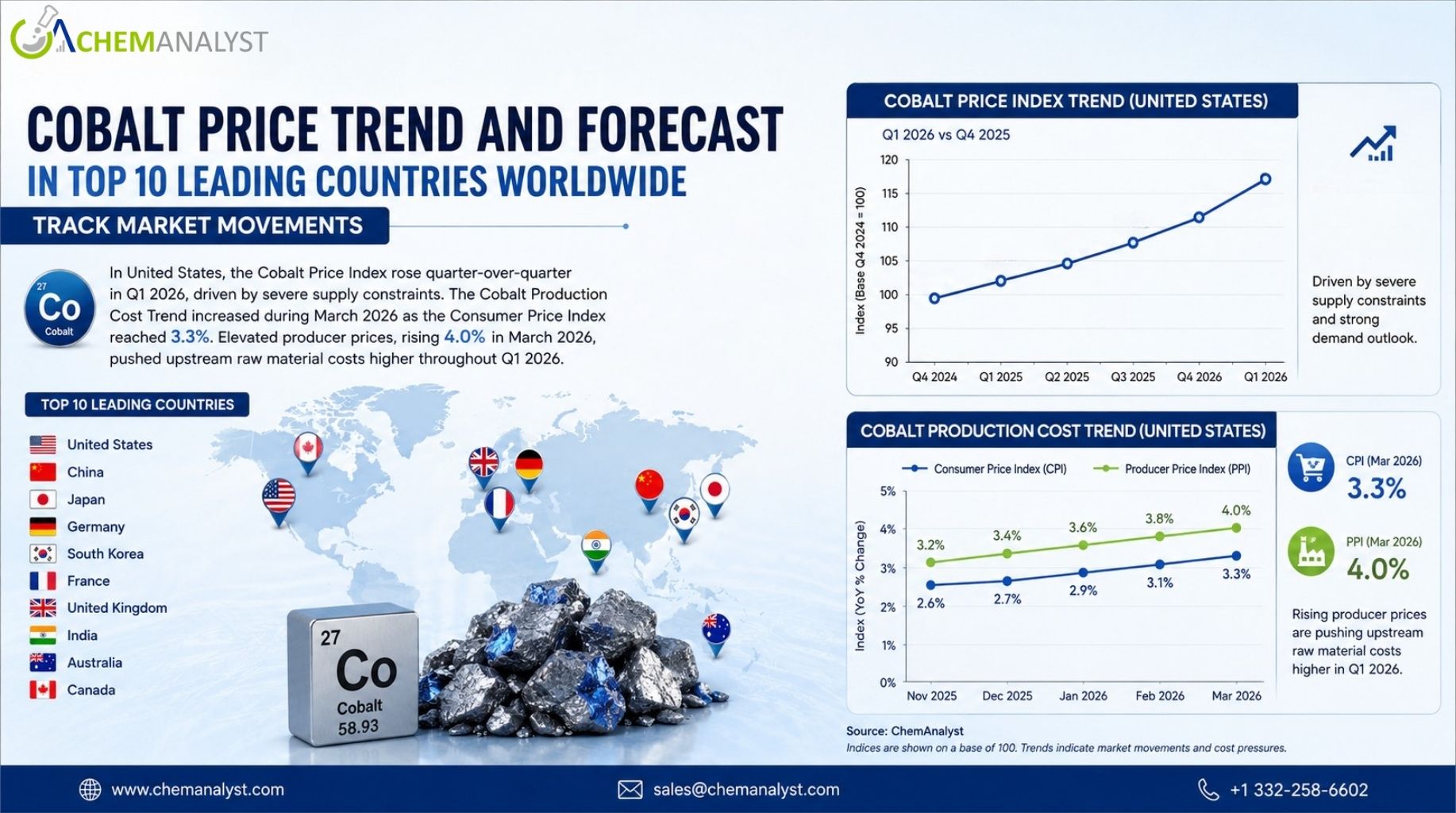
The global Cobalt Price market experienced notable volatility during the first quarter of 2026 as supply chain disruptions, rising production expenses, and uneven industrial demand reshaped pricing patterns across major economies. In North America, Europe, and Asia-Pacific, cobalt markets reacted differently to inflationary pressures, feedstock shortages, and manufacturing activity, resulting in regional disparities in cobalt pricing trends.
According to ChemAnalyst Cobalt Price: - https://www.chemanalyst.com/Pricing-data/cobalt-2518
Cobalt remains one of the most strategically important critical minerals due to its extensive use in lithium-ion batteries, electric vehicles (EVs), aerospace alloys, superalloys, energy storage systems, and consumer electronics. As governments and industries accelerate the energy transition, the global cobalt supply chain has become increasingly vulnerable to geopolitical risks, mining disruptions, and refining bottlenecks.
During Q1 2026, the Cobalt Price Index increased quarter-over-quarter in major economies including the United States, China, and Germany. Market participants monitored inflation, producer price movements, industrial production data, and downstream battery demand to assess the near-term direction of cobalt prices.
North America Cobalt Price Trend
United States Cobalt Market Witnesses Supply Tightness
In the United States, the Cobalt Price Index rose significantly during Q1 2026 due to severe supply constraints and elevated upstream production costs. The U.S. cobalt market faced persistent challenges linked to limited domestic mining output, dependence on imported refined cobalt, and logistical disruptions affecting raw material availability.
The rise in the Cobalt Production Cost Trend during March 2026 reflected broader inflationary conditions across the manufacturing sector. The Consumer Price Index (CPI) reached 3.3%, increasing operational expenses for refiners, battery producers, and alloy manufacturers.
Additionally, elevated producer prices accelerated cost pressures across the cobalt supply chain. U.S. producer prices rose 4.0% in March 2026, contributing to higher procurement expenses for cobalt feedstocks and processed materials. Rising transportation costs, labor expenses, and energy prices further intensified market pressures.
EV Battery Demand Supports Cobalt Consumption
The U.S. electric vehicle industry continued to support long-term cobalt demand despite temporary fluctuations in battery procurement activity. Battery manufacturers maintained stable purchasing volumes as automakers expanded EV production capacity to meet federal clean energy targets and consumer demand for sustainable mobility solutions.
The aerospace and defense sectors also contributed to stable cobalt consumption, particularly for high-performance superalloys used in turbine engines and advanced manufacturing applications.
However, market participants remained cautious due to global uncertainty surrounding mining output from the Democratic Republic of Congo (DRC), which accounts for a majority of the world’s cobalt supply. Any disruption in African mining exports continued to have an immediate impact on U.S. cobalt pricing sentiment.
U.S. Cobalt Price Forecast
Analysts expect the U.S. cobalt market to remain firm throughout the first half of 2026 due to constrained inventories and strong industrial demand. If inflationary pressures persist and supply disruptions continue, the Cobalt Price Forecast could remain bullish across North America.
Read the LinkedIn Article: - https://www.linkedin.com/pulse/cobalt-price-analysis-2026-inflation-ev-demand-supply-kishan-singh-avhnc/
APAC Cobalt Price Trend
China Cobalt Prices Rise Amid Feedstock Shortages
China witnessed a quarter-over-quarter increase in the Cobalt Price Index during Q1 2026 as severe feedstock shortages tightened domestic supply conditions. As the world’s largest cobalt refiner and battery manufacturer, China plays a central role in global cobalt pricing dynamics.
Chinese cobalt refiners faced mounting difficulties securing raw materials from overseas mining operations, particularly from African exporters. Shipping delays, geopolitical trade concerns, and limited concentrate availability reduced feedstock inflows during the quarter.
The resulting supply imbalance pushed cobalt prices higher across China’s battery materials market.
Industrial Production Strengthens Market Fundamentals
Industrial production in China increased 5.7% year-over-year in March 2026, supporting the broader Cobalt Demand Outlook. Manufacturing activity remained resilient across sectors including renewable energy equipment, industrial batteries, and electric mobility infrastructure.
The continued expansion of China’s EV sector also sustained demand for cobalt-containing cathode materials. Major battery producers increased procurement activity to support long-term production schedules and export commitments.
Despite these positive industrial indicators, consumer-driven cobalt demand remained relatively weak.
Weak Retail Sales Impact Consumer Electronics Demand
China’s retail sales growth slowed to 1.7% in March 2026, reflecting softer household consumption patterns and cautious consumer spending. In addition, unemployment reached 5.4%, limiting purchasing activity for smartphones, laptops, and portable electronic devices that rely on cobalt-based lithium-ion batteries.
The slowdown in consumer electronics sales partially offset stronger industrial cobalt demand, preventing more aggressive price spikes during the quarter.
China Cobalt Market Outlook
Looking ahead, China’s cobalt market is expected to remain sensitive to feedstock availability and global battery demand. Any improvement in mining exports from Africa could stabilize prices, while additional supply disruptions may trigger another upward movement in the Cobalt Price Trend during the second quarter of 2026.
Europe Cobalt Price Trend
Germany Cobalt Prices Increase Due to Global Supply Constraints
Germany experienced a quarter-over-quarter rise in the Cobalt Price Index during Q1 2026 as constrained global supply conditions tightened the European cobalt market.
European manufacturers continued to face elevated procurement costs due to dependence on imported cobalt intermediates and refined battery materials. Limited supply availability from international exporters created inventory shortages among industrial consumers.
The German market also reflected broader inflationary pressures impacting industrial operations across Europe.
Inflation Raises Production Costs
The Cobalt Production Cost Trend in Germany increased during March 2026 as inflation reached 2.7%. Higher energy costs, transportation expenses, and labor charges raised operational expenditures for battery manufacturers and metal processing companies.
Germany’s ongoing transition toward renewable energy and electrified transportation further increased strategic demand for cobalt-containing battery systems.
Automotive manufacturers across Europe continued investing heavily in EV production capacity, supporting long-term cobalt consumption despite short-term economic uncertainty.
Producer Price Decline Improves Demand Sentiment
Germany’s producer prices declined by -0.2% in March 2026, offering modest relief to downstream manufacturers and improving the broader Cobalt Demand Outlook.
The slight decline in producer prices helped stabilize manufacturing margins and encouraged cautious purchasing activity among industrial buyers.
Battery producers and specialty alloy manufacturers gradually increased procurement volumes during the latter half of Q1 2026 as pricing sentiment improved.
Europe Cobalt Price Forecast
European cobalt prices are expected to remain moderately elevated during the coming quarters due to limited domestic supply and rising EV adoption rates. However, improving manufacturing conditions and stable inflation could reduce extreme volatility in the regional cobalt market.
Factors Influencing Global Cobalt Prices in 2026
Supply Chain Disruptions
Global cobalt prices remain highly sensitive to mining output and export activity from the Democratic Republic of Congo. Political instability, regulatory changes, and transportation disruptions continue to influence supply availability worldwide.
Inflationary Pressures
Rising inflation across major economies increased production and logistics costs throughout Q1 2026. Higher labor expenses, fuel prices, and energy costs contributed to upward pressure on cobalt prices.
Electric Vehicle Expansion
The rapid growth of the electric vehicle industry remains one of the strongest drivers of cobalt demand globally. Battery manufacturers continue securing long-term supply agreements to support EV production targets.
Battery Manufacturing Growth
Expansion in energy storage systems and renewable energy infrastructure continues supporting cobalt consumption in industrial battery applications.
Consumer Electronics Demand
Weak consumer spending in some regions, particularly China, reduced cobalt demand from smartphones, laptops, and portable electronics during Q1 2026.
Global Cobalt Market Outlook for 2026
The global cobalt market is expected to remain fundamentally tight throughout 2026 due to growing industrial demand and constrained supply growth. Analysts anticipate continued volatility in the Cobalt Price Trend as geopolitical risks, mining activity, inflation, and battery demand influence market direction.
North America is likely to experience firm pricing due to strategic stockpiling and domestic EV expansion. China will remain the dominant force in cobalt refining and battery material production, while Europe’s green energy transition will continue supporting long-term cobalt demand.
Market participants are expected to closely monitor:
Mining production in Africa
EV battery manufacturing growth
Inflation and interest rate trends
Industrial production activity
Global trade policies
Renewable energy investments
As governments worldwide prioritize critical mineral security and clean energy development, cobalt will remain one of the most important strategic commodities shaping the future of global manufacturing and electrification.
Conclusion
The Cobalt Price market experienced strong upward momentum during Q1 2026 across the United States, China, and Germany. Severe supply constraints, rising production costs, inflationary pressures, and industrial demand growth supported higher cobalt prices globally.
While weak consumer electronics demand created some regional limitations, expanding EV production and battery manufacturing continued driving long-term cobalt consumption.
Going forward, the global cobalt market is expected to remain volatile yet fundamentally supported by the accelerating transition toward electrification, renewable energy, and advanced battery technologies. Industry stakeholders will continue tracking supply chain developments and macroeconomic indicators to evaluate future cobalt pricing trends throughout 2026.
Contact US:
Email-Id: - [email protected]
Contact No: - +1 (332) 258-6602
Address: - 420 Lexington Avenue, Suite 300
New York, NY
United States, 10170
Comments
Log in or sign up to join the conversation.