

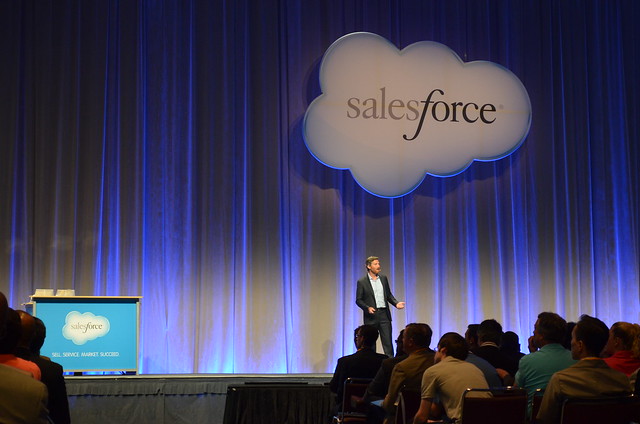
Photo Credit: Open Grid Scheduler / Grid Engine /Flickr.com
It has been another stellar quarter for Salesforce (NYSE: CRM). It announced its second quarter results this week, and what a blowout quarter it was. The company surpassed all market expectations and revised its fiscal year revenue targets upwards despite current pandemic conditions. Earlier this week, Salesforce was also added to the Dow Jones index. Post the result announcement, the stock climbed an impressive 13% in the after-hours trading session.
Salesforce’s Financials
Salesforce’s revenues for the second quarter grew 29% to $5.15 billion, above analyst estimates of $4.9 billion. Adjusted earnings of $1.44 per share was also better than the market’s forecast of $0.67 per share.
By segment, Subscription and support revenues grew 29% to $4.84 billion, Professional services and other revenues grew 23% to $310 million.
Among key metrics, remaining performance obligation grew 21% over the year to $30.6 billion. Current remaining performance obligation grew 26% to $15.2 billion.
For the third quarter, Salesforce forecast revenues of $5.24-$5.25 billion with an EPS of $0.73-$0.74. The market was looking for $5.01 billion with an EPS of $0.76. Salesforce expects to end the current fiscal with revenues of $20.8 billion and an EPS of $3.72-$3.74. The market was looking for revenues of $20.01 billion for the year with an EPS of $2.97.
Salesforce’s Growth Focus
Salesforce is focusing its efforts on addressing the current pandemic induced conditions. For instance, it recently introduced Salesforce Anywhere – an integrated platform service that will help organizations deliver productivity and customer success even in the current conditions. With Salesforce Anywhere, organizations can sell, service, and market from anywhere; collaborate from anywhere using the new Salesforce Anywhere app that embeds chat, alerts, comments and video into the Salesforce experience; work from anywhere with a new employee service solution and new employee data model ?that enable organizations to build, manage, and scale employee apps and services quickly and securely; analyze data from anywhere by leveraging its earlier acquisitions of MuleSoft and Tableau; and Skill up from anywhere by using Einstein Recommendations for Trailhead and its new learning content.
It also entered into a partnership with Siemens to help organizations manage the new normal. Together, the two companies will develop a new workplace technology suite that will support businesses to safely reopen and manage physical workplaces under the new social distancing framework. As part of the tie-up, Salesforce’s Work.com will be integrated with Siemens’ Smart Infrastructure solutions, including Comfy and Enlighted, to help workplaces create and manage processes essential to creating safe, connected workplaces. Its solutions will include a touchless office that grants safe access into buildings and elevators, an occupancy management system to allow conference room reservation and even emergency response and contact tracing capabilities.
Last quarter, Salesforce also announced the release of Government Cloud Plus, a dedicated instance of Salesforce’s cloud infrastructure isolated for U.S. federal, state, and local government customers. Government Cloud Plus has achieved a FedRAMP Provisional Authority to Operate status at the High Security Impact Level.
Salesforce’s PaaS Strategy
I think Salesforce’s PaaS strategy has been its mantra to its success. I count Salesforce as the leader of the PaaS pack because of its successful developer ecosystem. Salesforce fuels innovation among developers and, in return, is able to expand not only the capabilities of its platform, but also offer industry-specific solutions.
Salesforce had launched its AppExchange back in 2006. By 2018, the company had recorded over 3,400 apps on the platform recording over 5.6 million installs. Today, the AppExchange has over 5,000 apps with more than 6.5 million installs. It has a wide array of over a thousand consultants building apps on the platform. Salesforce reports that 95% of the Fortune 100 companies have installed a solution from its AppExchange and nearly 88% of its customers have installed Salesforce apps.
The AppExchange has helped empower companies like Vlocity to build industry-specific solutions and build sustainable businesses that translate to billion-dollar valuations and exits.
Another stellar example is that of Veeva, that has a very close relationship with Salesforce. Veeva was founded by former Salesforce SVP of Technology Peter Gassner, and it built its CRM platform powered by Force.com. Veeva has continuously integrated and expanded these offerings, all on Force.com. Today, Veeva has become a $30+ billion-dollar company in a very capital-efficient way.
Then there was MapAnything that Salesforce acquired last year. MapAnything was also built on Force was available through Salesforce’s AppExchange store and was both a Salesforce SI Partner and an ISV Premier Partner. The acquisition helped Salesforce add location-based intelligence solutions to its services that were already integrated with its offerings.
Vlocity and Veeva are illustrations of how Salesforce continued to focus on building a platform that catered to the omni-channel and multi-industry requirements while Vlocity and Veeva leveraged the platform to build vertical specific, niche offerings. MapAnything illustrates how Salesforce was able to add significant capabilities to its services without building them out on its own.
Its stock is trading at $208.46 with a market capitalization of $194.7 billion. It had touched a record high of $218.35 earlier this month. The stock fell to a 52-week low of $115.29 in March due to the global crisis.



Comments
Log in or sign up to join the conversation.