

Dan Ives is throwing his hat into the closed-end fund (CEF) ring with the upcoming Ives Ultra AI Opportunity Fund (IVAI). That article mentioned a couple of other recent closed-end funds in the AI and private tech realm. It hasn't gone well.
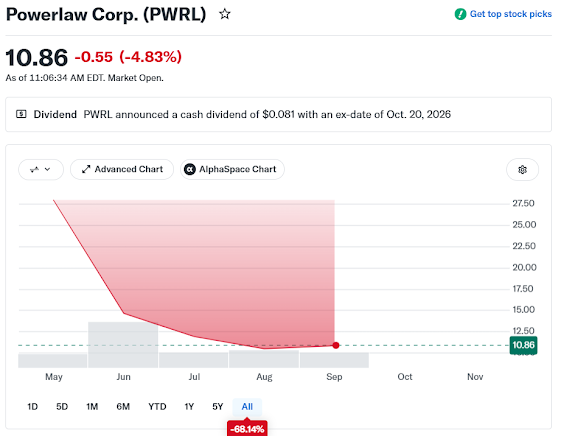
PWRL just owns private companies, and it appears as though the market price is trying to price the underlying illiquid portfolio that does price every day.
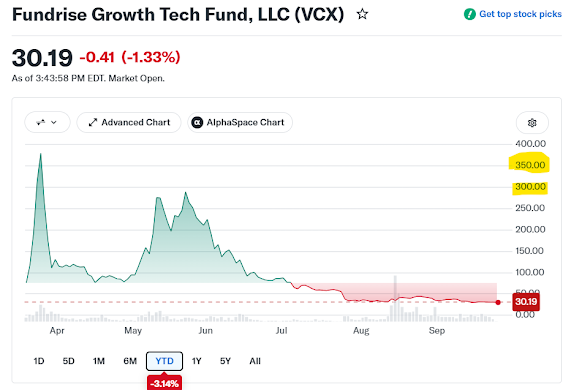
Someone bought up in the $300's, yikes. These types of funds are real hot dot stuff that tries to appeal to people's greed. You can reach whatever goal you might have without it.
Another day, another autocallable ETF. The VegaShares US Equity Autocallable Income ETF (VAIE) targets about a 16% yield, so my guess is it will be a little more volatile than CAIE; see what VegaShares did there with the symbol, which is closer to a 14% yield.
The autocallable space in the ETF market is just getting started, and I think that unlike the closed-end funds above, the lower-yielding, less volatile funds will help contribute to solving people's need for income without nauseating volatility. Matt Kaufman from Calamos was on ETF IQ this week with a helpful explanation of how they work. The conversation around these from fund providers is evolving in response, I believe, to questions not addressed when they first started trading a year and a half ago.
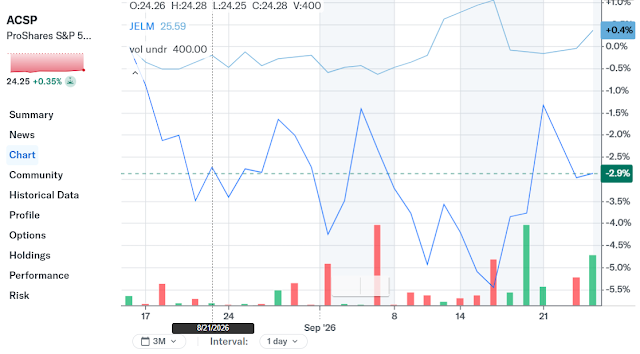
This is a good contrast in yields/volatility that we probably looked at once before. ACSP targets twice the yield, and the price is all over the place; no distributions yet per Yahoo Finance, so that is all price. JELM is the lowest-yielding autocallable ETF that I am aware of. To each his own, but if I ever allocate to one of these for clients, it will not be ACSP. If anything, it will be a small slice to a lower volatility version.
Next, a follow-up on the WisdomTree Efficient Long/Short Equity Fund (WTLS). They hosted a webinar to explain the fund and recap its results. So far, it has been lights out. It leverages up 90% beta with the S&P 500 and 90% alpha with a long/short overlay that seeks a volatility level around 7%.
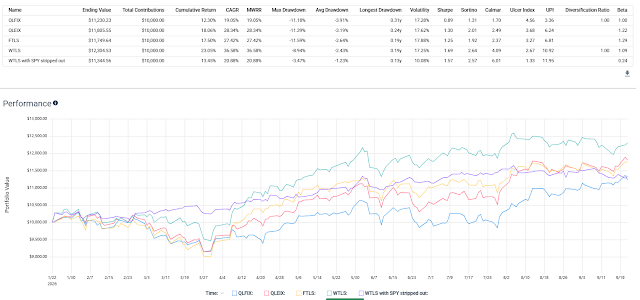
Portfolios 2 and 3 leverage up the long/short symbol with SPY in the same manner that WTLS leverages up, and you can see WTLS has favorable results. Portfolio 1 is QLFIX, which has a similar leveraged strategy. The fifth portfolio isolates just the long/short strategy by shorting SPY out of it, and although the timeframe is short, the result has been very steady but a little higher vol than 7.
When I first looked at WTLS, I just made a couple of casual comments that it was doing what it should for the most part, noting it was way too early to draw any conclusions, and I also warned about using leverage to stack betas. WisdomTree talks about WTLS as being beta and alpha, but arguably, a long-biased long/short strategy could be thought of as a beta exposure.
That frames the risk; it might turn out to actually be two betas if something nasty happens with the stock market. That was not the case in the quick drawdown when we attacked Iran. It wasn't a problem for QLFIX either, which is a fund we haven't looked at before today.
A use case for WTLS in the context we've talked about lately could be in a portfolio that barbells a high-volatility equity fund to be a small slice of the overall portfolio as the growth engine in a portfolio that is overall intended to be very low volatility or have a high distribution rate or both. In that circumstance, there still needs to be a little growth. A 10% weight to WTLS is 18% of equity exposure, and if that is the vast majority of the equity exposure, then yes, the portfolio is using leverage, but in this context I think it is closer to leveraging down than leveraging up.
Last one. We've talked a lot over the last few months about combining value, quality, and momentum for domestic equity exposure. It turns out that iShares has three funds that do different versions of that factor combo for foreign equity exposure with INTF, IDYN, and CORO. INTF is a relatively simple index fund that includes these factors, and IDYN is similar to DYNF, trying to rotate factors to try to outperform the index. CORO has been the best performer. It owns mostly country funds with a few individual stocks thrown in. The largest holdings currently, and this has been the case for a bit, are Japan EWJ, Canada EWC, and Switzerland EWL. It also currently owns Taiwan Semi (TSM) and SK Hynix (SKHHY).
The fund reports its holdings in an interesting way. It includes a look-through to the sectors.
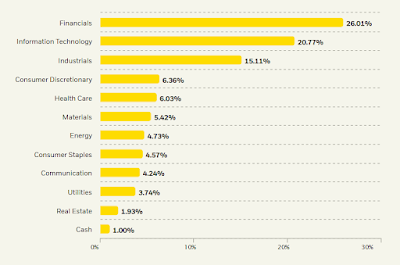
This was always part of the template I used for writing about country funds for TheStreet.com many years ago, and while I do less with country funds these days, looking through to the sectors is very important. If you want to own Taiwan, cool, go for it, but EWT is 73% technology. Owning a lot of QQQ with EWT on top of that is going to be very painful if there is ever any consequence for the excesses currently in the tech sector. Another example, iShares Singapore (EWS) has always been heavy in financials, and sure enough, during the financial crisis it fell 60%.

Comments
Log in or sign up to join the conversation.