

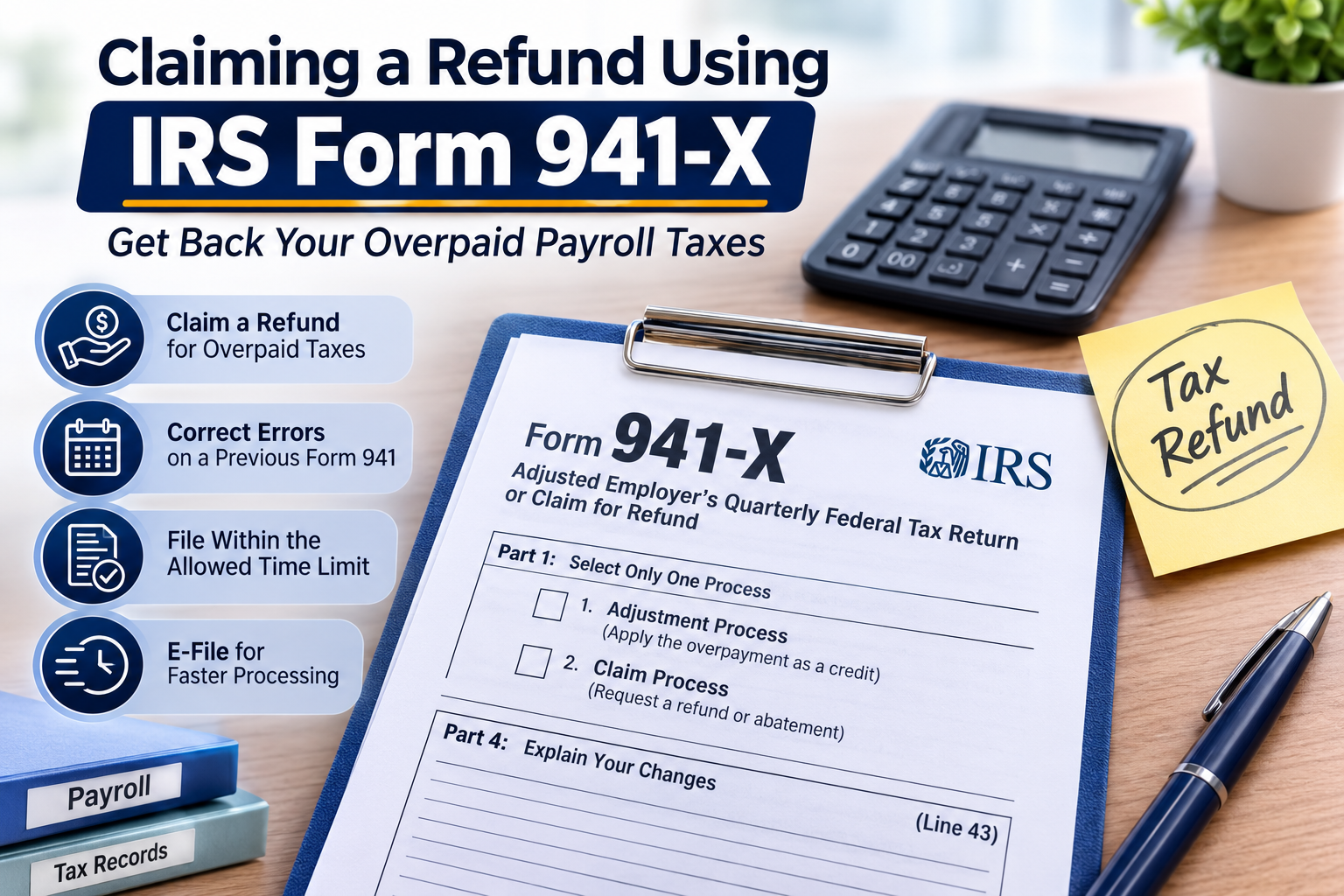
Payroll tax mistakes happen more often than most employers expect. A miscalculated Social Security wage base, a duplicated deposit, an overstated tax credit — any of these can leave a business owing less than what was actually reported and paid on Form 941. When that happens, the 941 X form, officially titled the Adjusted Employer's Quarterly Federal Tax Return or Claim for Refund, is the IRS-approved mechanism for correcting the error and getting the overpayment back.
Understanding how this form works, when it applies, and how to file it correctly can save a business real money — and real headaches during an IRS review.
What Is Form 941-X?
Form 941-X is used to correct errors on a previously filed Form 941, the quarterly payroll tax return that reports wages, tips, federal income tax withholding, and the employer and employee shares of Social Security and Medicare tax. Rather than refiling the original return, employers use this amended form to adjust specific line items and explain what changed and why.
A separate 941-X must be filed for each quarter that needs correcting. It cannot be used to fix employee headcounts or liability entries reported in Part 2 or on Schedule B — those require a different correction path.
Two Distinct Processes: Adjustment vs. Refund Claim
One of the most misunderstood parts of the form is the choice between the adjustment process and the claim process, marked on Line 1 and Line 2 respectively. These are never used together on the same form.
Adjustment process: Used when the employer wants to apply the overpayment as a credit against the current quarter's tax liability. This interest-free adjustment method is generally faster since there's no waiting on a refund check.
Claim process (refund or abatement): Used when the employer wants the IRS to send back the actual overpaid amount, typically because there's no future 941 liability to offset it against, or because employer share taxes were involved.
Choosing the wrong box is one of the most common reasons a 941-X gets delayed or rejected, so this decision should be made carefully based on cash flow needs and whether future quarterly liabilities exist to absorb the credit.
When Can You File a Refund Claim?
Under the statute of limitations tied to payroll tax corrections, a refund claim generally must be filed within three years from the date the original Form 941 was filed, or two years from the date the tax was paid — whichever is later. Missing this window closes off the refund opportunity entirely, which is why catching overreporting errors early matters.
Common Reasons Employers File for a Refund
Overreported wages, tips, or federal income tax withheld
Overpaid Social Security or Medicare tax due to a calculation or transposition error
Corrections tied to payroll tax credits, such as the qualified small business credit for increasing research activities
Retroactive adjustments discovered during an internal payroll audit
Corrections related to previously claimed COVID-era credits, which remain under active IRS review in many cases
How to File Form 941-X Correctly
Identify the exact quarter and error. Each 941-X applies to a single quarter, so pull the original Form 941 for that period before making any changes.
Select the correct process on Line 1 or Line 2. Confirm whether an adjustment or a refund claim is appropriate.
Complete the corrected figures line by line, matching the structure of the original Form 941.
Explain every change on Line 43. A vague explanation is one of the most frequent triggers for IRS follow-up requests. Be specific about what was wrong and how the correct figure was determined.
Attach supporting documentation where relevant, such as a corrected Form 8974 if adjusting a research credit claimed on Line 16.
File electronically where possible. Form 941-X can now be submitted through the IRS Modernized e-File (MeF) system, which speeds up acknowledgment and reduces the risk of processing errors compared to paper filing.
Mistakes That Slow Down Refunds
Even accurate math can get held up by process errors. The most frequent issues include mismatched process selections between Line 1 and Line 2, missing or incomplete explanations on Line 43, failing to file a separate form per quarter, and overlooking required attachments for credit-related corrections. Keeping payroll records well organized before filing dramatically reduces back-and-forth with the IRS.
Final Thoughts
Form 941-X exists because payroll tax reporting is complex, and errors are common even among well-run businesses. What separates a smooth refund process from a stalled one usually comes down to choosing the right correction path, documenting the reasoning clearly, and filing within the applicable time limits. Employers dealing with recurring payroll tax corrections may benefit from a structured review process or professional guidance to avoid repeat errors and ensure refund claims move through the IRS without unnecessary delay.
Frequently Asked Questions
Q1. Can I use Form 941-X to fix an error from several years ago?
Only if the refund statute of limitations hasn't expired — generally three years from the original filing date or two years from the date the tax was paid, whichever is later. Once that window closes, the refund claim can no longer be filed.
Q2. What's the difference between requesting a credit and requesting a refund on Form 941-X?
Requesting a credit applies the overpayment toward a future quarter's tax liability, while requesting a refund asks the IRS to return the actual overpaid funds. The choice depends on whether the business expects future payroll tax liability to offset.
Q3. Do I need to file a separate 941-X for each quarter with an error?
Yes. Form 941-X corrects one specific quarter at a time, so multiple affected quarters each require their own separately filed form.
Q4. Can Form 941-X be filed electronically?
Yes, it can be submitted through the IRS Modernized e-File (MeF) system, which typically processes faster and reduces the chance of mailing or transcription errors compared to paper submissions.
Comments
Log in or sign up to join the conversation.