

The celebration of the Trump/Xi dinner in Buenos Aries lasted about three hours. What went wrong? This reaction was not a complete surprise, but the size and rapidity were attention-grabbing.
The market reaction fits the description I suggested in May: Trading, Fast and Slow. A small piece of news leads to a cascade of trading – algorithms trained to watch for key words, humans making a short-term directional play, technicians noting the “violation of key support or resistance,” and the subsequent media explanations. This confers an undue legitimacy on noise – tidbits of news without any context.
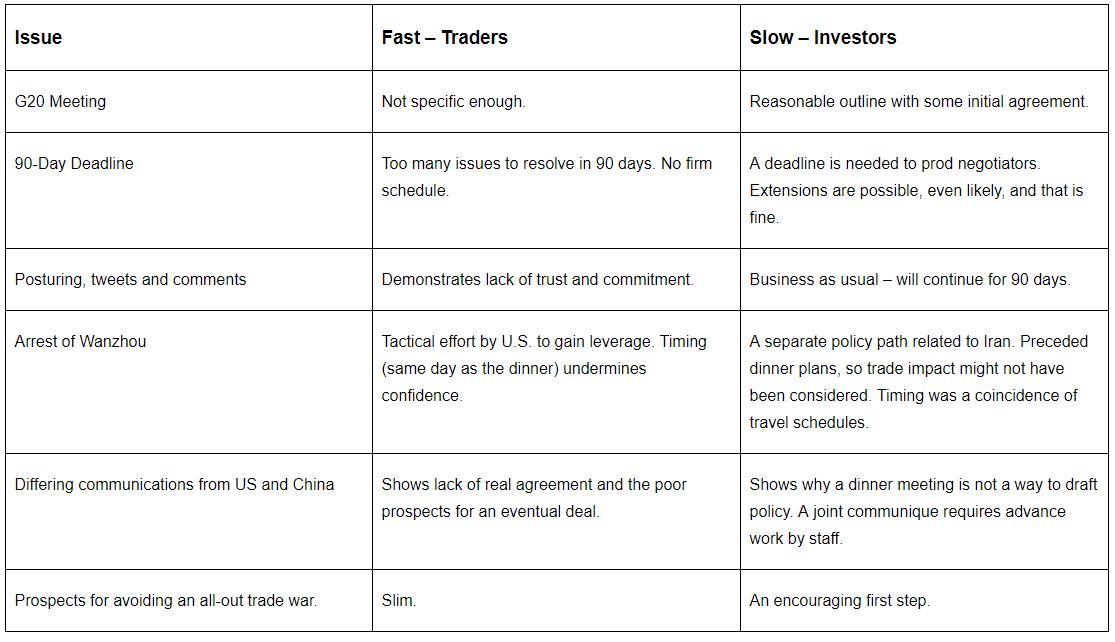
Here is how it plays out on the China/US trade story. In each case let’s try to separate trading “fast” reactions from trading “slow.”
(Click on image to enlarge)
Conclusion
This is a typical example of the trading community’s failure to understand politics, negotiation, and compromise. I have highlighted this before on issues like Greece and the asserted collapse of Europe and concerning various US policy debates.
Here is what we should expect:
- Decades of history will not be reversed in a few months. Be happy for some progress.
- The outcome will be a compromise. It will not be a complete success for either side, but each will trumpet what they have accomplished.
- Nothing big will happen until the last minute. This is the way that partisans demonstrate they have accomplished as much as possible.
- Eventual relief on the most important reciprocal tariffs.
- Some progress on the intellectual property issues.
- Some immediate relief on existing boycotts, e.g. soybeans.
I expect significant improvement from current expectations for two reasons:
- It is in the interest of all. Political processes gravitate toward these outcomes.
- Trump supporters are feeling pain and will exert increasing pressure for a deal.
Long-term investors should emphasize legitimate signs of progress or failure, avoiding the false drama of the daily “explanations.”


Comments
Log in or sign up to join the conversation.