

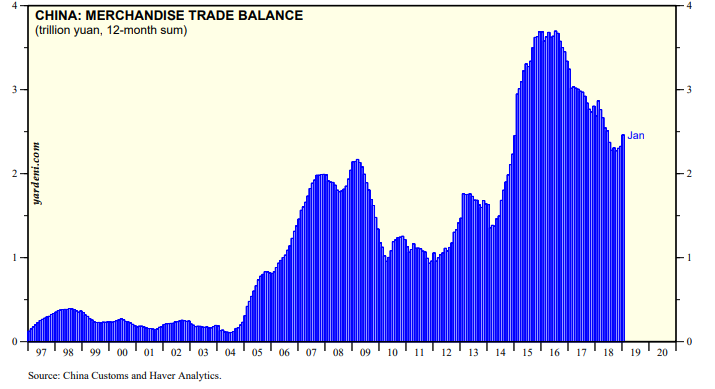
For years, China has sold much more to the world than it has bought. Now, that imbalance is shrinking, and this is helping Chinese leadership to argue that it is no longer pursuing a mercantilist policy.
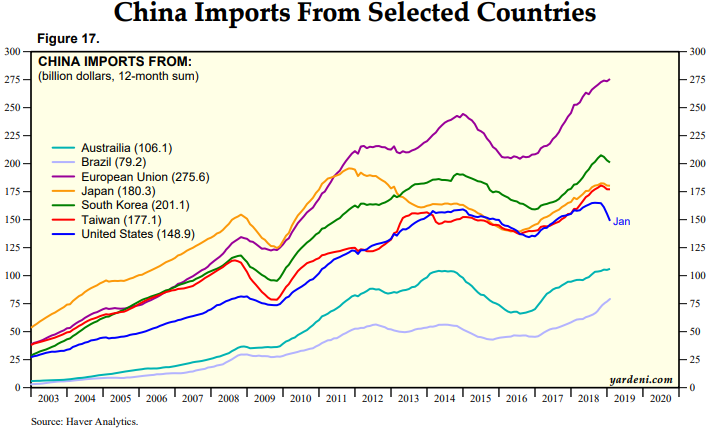
China’s exports unexpectedly declined very sharply in December of 2018, while its imports also contracted. China’s recent trade figures highlight both the weakness in the world’s second-largest economy in 2019 and as well as deteriorating global demand.
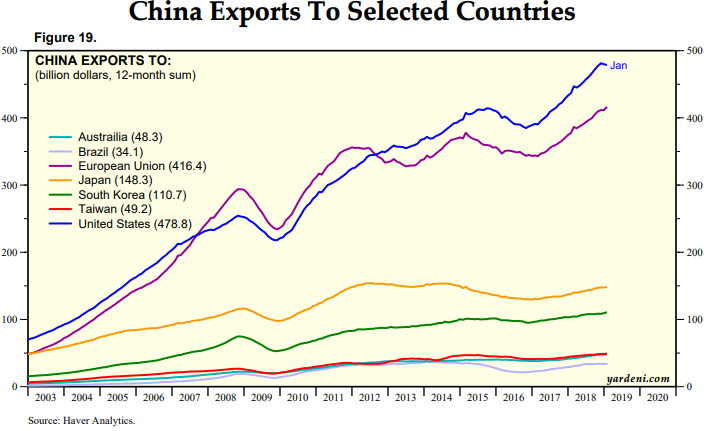
Even though China posted its largest trade surplus with the United States on record in 2018, nonetheless China’s overall trade surplus has been shrinking, a fact that worries many economists.
China’s politically sensitive trade surplus with the U.S. widened by 17.2 percent to $323.32 billion last year, the highest on record going back to 2006, according to Reuters calculations based on customs data.
Of course, the softening in China’s economic growth rate has a lot to do with this. Indeed, softening demand in China is being felt around the world, with slowing sales of goods from iPhones to automobiles, prompting warnings from firms such as Apple and Jaguar Land Rover.
The worry in all of this is that China’s economy may be cooling too quickly for the government, despite a recent slew of economic growth-boosting measures which were introduced, including higher infrastructure spending and tax cuts.
Some observers believe that China’s government will have to speed up and intensify its policy easing and stimulus measures this year due to the recent slowing in trade and industrial activity.
(Click on image to enlarge)
(Click on image to enlarge)
(Click on image to enlarge)


Comments
Log in or sign up to join the conversation.