


China's third-quarter GDP growth of 4.5% will likely keep this year's growth target on track. September data showed signs of stabilisation, though domestic demand remains underwhelming
China's 3Q GDP comes in slightly stronger than expectations
China's GDP rebounded to 4.5% year-on-year in the third quarter, up from 4.3% in the second quarter, a little stronger than expected (market: 4.4%, ING: 4.4%). This brings the year-to-date GDP growth down to 4.6% YoY.
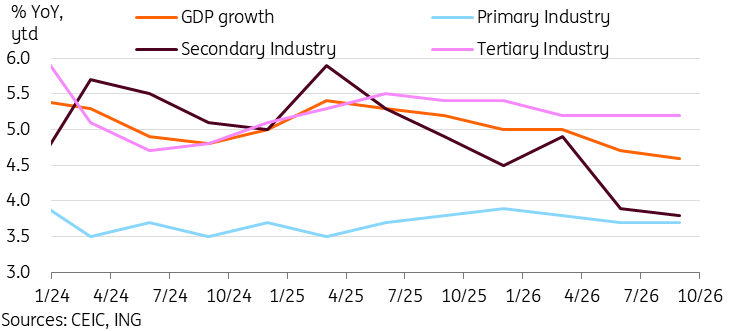
By industry, China's tertiary sector continued to grow fastest for the sixth consecutive quarter, up 5.2% YoY in 3Q, versus 3.6% and 3.4% for the primary and secondary industries, respectively. As China's economy matures, the services sector will play an even larger role.
A strong third-quarter trade surplus drove China's rebound. Final consumption expenditure's contribution to GDP, at 2.148pp, was at its lowest since 4Q22.
With a few months left in the year, we believe China's economy is well positioned to achieve its 2026 growth target of 4.5-5.0%. However, the economy remains quite unbalanced heading into 2027, leaving growth vulnerable to disruptions in external demand. Fortunately, we also saw some favourable signs from the September domestic activity data.
GDP growth should end the year on target
September's domestic data showed signs of stabilisation
September's domestic activity data generally improved from August, contributing to the 3Q26 GDP outperformance.
Below are our takeaways from the major data releases:
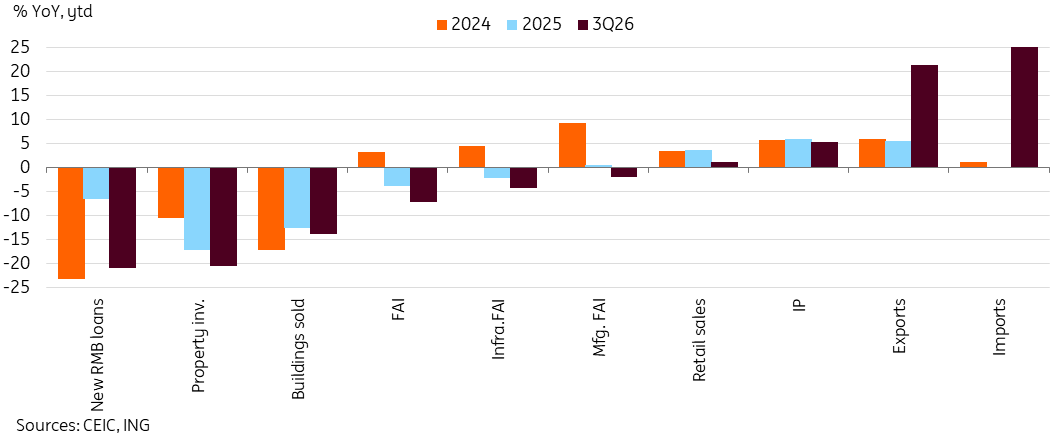
Retail sales growth was stronger than forecasts (market: 0.5%, ING: 0.6%), rising to 1.1% YoY from 0.4%. Strong communication appliance (31.1%) sales drove the data, likely benefiting from a host of new phone model launches. Beyond this category, sales of consumer staples such as tobacco and alcohol (13.8%), grains & oils (6.7%), and beverages (5.0%) all outperformed. However, many discretionary consumption categories, such as gold and jewellery (-9.6%) and autos (-21.2%), remained weak.
Fixed asset investment growth stabilised at -7.2% YoY after decelerating every month since March, coming in stronger than expectations (market: -7.3%, ING: -7.5%). This stabilisation reflects public-led (-3.2%) and manufacturing (-2.1%) FAI picking up on the month, offsetting slowdowns in private-led (-10.4%), real estate (-20.6%), and infrastructure (-4.2%) FAI. Investment has clearly been a major drag this year, so stabilisation is encouraging, possibly as efforts to accelerate fiscal spending outlined at July's Politburo meeting begin to take effect.
Industrial production continues to be the main outperformer, up 5.5% YoY from 5.2% in August, in line with market expectations (market: 5.5%, ING: 5.5%). Hi-tech manufacturing (15.3%) remains a bright spot, and export-oriented industries such as computers and communications (16.4%), rail, ships, and aerospace (11.7%), and autos (6.7%) continue to outperform.
70-city property prices continued to drop, but by less than what we saw in August's data. New home prices (-0.14% MoM) fell the least in 17 months. Prices stabilised or rose in 21 cities. Existing home prices (-0.26% MoM) saw the smallest drop in 4 months, with prices stabilising or rising in 11 cities. Tier 1 cities continued to perform well on the month, with a few tier 2 cities joining the price recovery.
Compared with rapid export growth, domestic activity continues to lag. But September's data at least shows modest positive momentum heading into 4Q26.
Growth remains unbalanced as property drag and soft domestic demand continues



Comments
Log in or sign up to join the conversation.