

The China trade news announced last week seemed like an effort to support stock prices since an actual agreement was not signed. The gap up open on Friday by the S&P 500 Index looked like short covering and then the pull back near the close looked like a disappointment. However, news that the Federal Reserve will start buying Treasury bills October 15 and will continue adding cash into overnight lending markets will keep hope alive for the bulls. Our Market Review explains.
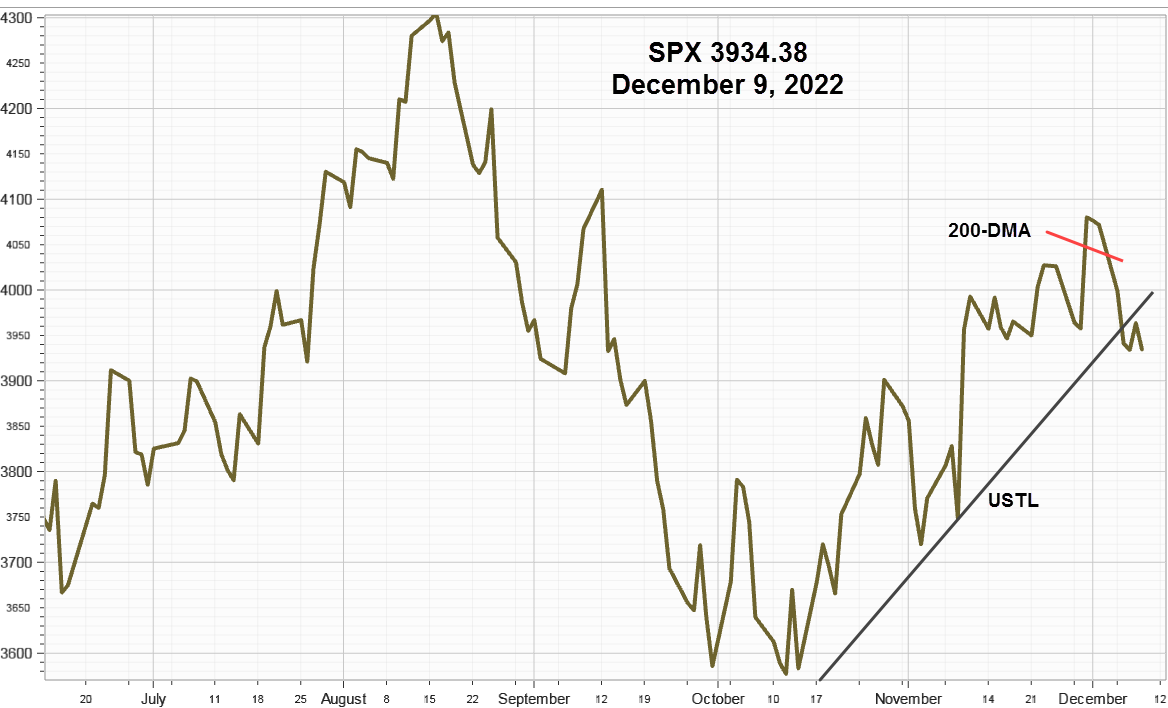
S&P 500 Index (SPX) 2970.27 added 18.26 points or +.62% last week closing well above the 50-day Moving Average, although still a long way below the operative upward sloping trendline, USTL from the December 26 low.
While the China trade news added some support, until it closes back above the September 19 high at 3021.99 it remains range-bound, rising and falling on every China trade and tariff announcement and destined to continue fluctuating until November 16 when Trump and Xi Jinping are expected to sign a limited first phase trade agreement at the Asia Pacific Economic Summit in Santiago, Chile.
Although the latest announcement from the Federal Reserve emphasized a new program to buy $60 billion per month of Treasury bills should not be considered a policy change, it will likely enhance their ability to manage the yield curve after finally acknowledging its importance to the markets. On Friday the 10-2 Treasury Note spread closed at 13 bps up from 4 bps on September 26.
CBOE Volatility Index® (VIX) 15.58 declined 1.46 points or -.57% last week after reaching 20.28 last Tuesday. Our similar IVolatility Implied Volatility Index Mean, IVXM using four at-the-money options for each expiration period along with our proprietary technique that includes the delta and vega of each option, declined 1.39 points or -9.21%, to end the week at 13.71 %, shown in the chart below.

Reflecting the SPX, the IVXM fluctuates between 13% and 20%, up or down on each China trade comment.
VIX Futures Premium
The chart below shows as our calculation of Larry McMillan’s day-weighted average between the first and second-month futures contracts.
With two trading days until October expiration, the day-weighted premium between October and November allocated 10% to October and 90% to November for a premium of 14.18%, in the green zone between 10% -20%, compared to 7.59% for the week ending October 4.

The premium measures the amount that futures currently trade above or below the cash VIX, (contango or backwardation) until front month futures contract converges with the VIX at expiration on Wednesday, October 16. On Fridays, before expiration there seems to be excess day-weighted premium that quickly fades away on Monday and Tuesday the last trading days. Friday's volume-weighted premium was 9.88%.
For daily updates, follow our end-of-day volume weighted premium version located about halfway down the home page in the Options Data Analysis section on our website.
Hedging Strategy
The caution and hedge images began appearing in the Strategy section of Digest Issue 32 "Options Spreads [Charts]" on August 12, 2019, and have remained in this space for the last ten weeks.
These two images show the current situation. "On-again, off-again", up and down on China trade news, along with the stubbornly strong US Dollar Index (DX) 98.00, driven by bond inflows and relative growth expectations.

In case you can't read the labels on the passenger's hats, they are Crude Oil, Gold, Treasuries, and Equities. Hidden in the back are other commodities as well.
If adding reserves by buying short-term Treasury bills is like putting oil on a squeaky wheel, then the Fed heard the squeaking and grabbed the oilcan. While it could be enough to keep equities from declining into year-end, it may not be enough to propel the SPX to a new high before year-end.
As third-quarter earnings reporting gets underway this week, maintaining some level of long position hedges using November 15 or December 20 out-of-the-money SPDR S&P 500 ETF (SPY) put spreads or collars still seems prudent.
Summary
Last week the two defining events were a China trade agreement, yet to be documented, and the Federal Reserve's announcement to start buying Treasury bills and injecting cash into the overnight bank lending market. While the S&P 500 Index initially responded positively at the open Friday, it pulled back later as details were released. For now, some level of long position hedging still remains prudent.
Comments
Log in or sign up to join the conversation.