

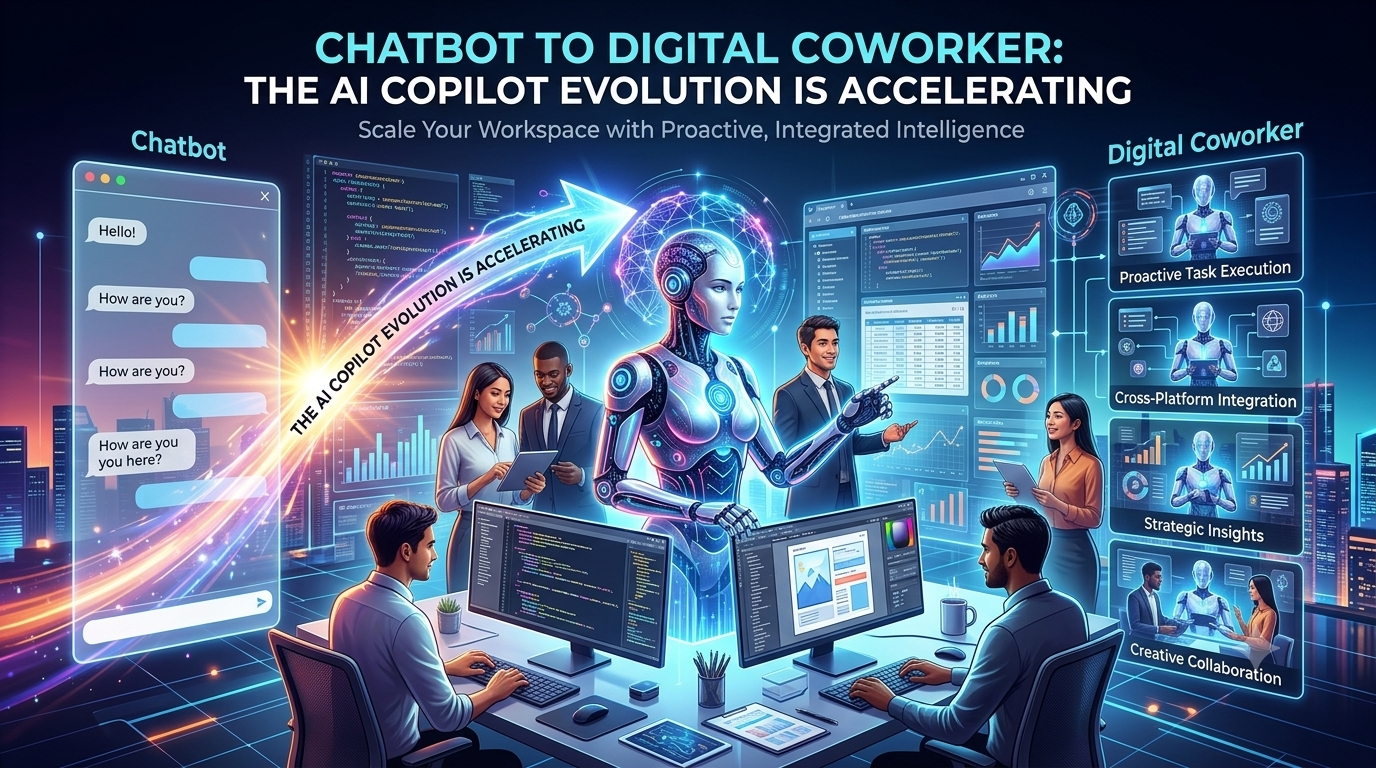
From Chatbots to Digital Coworkers
AI is moving beyond the traditional chatbot experience. Early chatbots were mainly designed to answer questions, provide basic information, or guide users through predefined workflows. Today, AI systems are becoming more capable of understanding context, reasoning through tasks, using business tools, and supporting employees throughout their daily work.
This evolution is creating a new category of intelligent assistants often described as AI copilots or digital coworkers. Instead of simply responding to prompts, these systems can help users research information, analyze data, create content, manage workflows, and support operational decisions.
Why AI Copilots Are Gaining Momentum
Modern businesses generate massive amounts of data across emails, documents, CRM platforms, communication tools, and business applications. Employees often spend significant time searching for information and completing repetitive tasks.
AI copilots can connect these scattered workflows and provide assistance directly within the tools employees already use. They can summarize documents, identify important information, generate reports, suggest next actions, and help automate routine processes.
This shift is making AI more practical for everyday business operations rather than limiting it to experimental use cases.
The Rise of Digital Coworkers
A digital coworker represents a more advanced approach to workplace AI. It can potentially monitor workflows, understand business context, interact with connected applications, and assist with multi-step tasks.
For example, a sales-focused AI assistant could analyze customer interactions, identify potential leads, prepare follow-up messages, and update CRM records. Similarly, an operations copilot could monitor processes, identify bottlenecks, and recommend actions.
The goal is not necessarily to replace employees. Instead, digital coworkers can augment human capabilities by handling repetitive work and allowing teams to focus on creativity, strategy, and complex decision-making.
Building Smarter Business Workflows
The growing demand for personalized AI assistants is also driving interest in AI Copilot Development. Businesses can create copilots tailored to their industry, internal knowledge, workflows, and technology stack.
Successful implementations typically combine large language models with business data, APIs, automation platforms, knowledge bases, security controls, and human oversight. This enables AI assistants to deliver more relevant and actionable support.
What Comes Next?
The AI landscape is gradually shifting from “ask and answer” systems toward AI that can understand, assist, recommend, and act. As businesses adopt agentic technologies and connected workflows, digital coworkers could become an important layer of enterprise productivity.
Conclusion
The journey from chatbot to digital coworker represents a major evolution in business AI. Companies that strategically adopt AI Copilot Development can explore smarter automation, faster workflows, and more intelligent decision-making. As an AI Development Company, Osiz helps businesses explore AI-powered solutions, including AI copilots designed to turn everyday business challenges into intelligent, scalable opportunities.
Comments
Log in or sign up to join the conversation.