
When organizing transportation for a large group, safety should be one of the most important considerations. Schools, sports teams, businesses, churches, wedding parties, and families often compare driving with flying before choosing how to reach their destination. Understanding group travel safety can help travelers make a more informed decision about whether a charter bus or commercial flight is the better option for their trip.
Both charter buses and commercial airplanes operate within strict transportation safety frameworks. However, the risks and advantages associated with each mode are different. Looking at driver qualifications, federal regulations, travel conditions, and the overall journey can provide a clearer picture.
How Safe Are Charter Buses?
Charter buses are designed specifically to transport groups of passengers, and professional motorcoach operators must follow applicable federal and state transportation requirements.
For interstate passenger transportation, the Federal Motor Carrier Safety Administration (FMCSA) oversees important aspects of commercial motorcoach operations. Organizations booking a bus can research a company's safety performance, operating authority, insurance, and other available records before making a decision.
This makes choosing the right transportation company especially important. A reputable operator should use qualified commercial drivers, maintain its vehicles properly, and follow applicable hours-of-service and safety requirements.
How Does Flying Compare?
Commercial aviation has an exceptionally strong safety record. Airlines operate under extensive federal oversight involving aircraft maintenance, pilot qualifications, operating procedures, and other safety requirements.
For passengers, flying can also be efficient when the destination is several hundred or thousands of miles away. A plane can cover long distances in a fraction of the time required by ground transportation.
However, the safety comparison becomes more complicated when looking at the entire journey rather than the flight itself.
Comparing the Complete Travel Experience
A flight is only one part of an air-travel journey. Travelers may need to drive to the airport, park or arrange a drop-off, pass through security, wait for boarding, collect luggage, and arrange transportation after landing.
For large groups, these additional steps can create logistical challenges.
A charter bus can provide transportation directly from a predetermined pickup location to the destination. Instead of coordinating several vehicles and drivers, the group can travel together with one professional driver.
For many regional and medium-distance trips, this can make ground transportation a practical alternative to flying.
Professional Drivers Make a Difference
One major benefit of charter bus travel is having a professional commercial driver behind the wheel.
Driving a large passenger vehicle requires specialized skills and appropriate licensing. FMCSA guidance recommends that organizations check driver qualifications and confirm that the company follows safety practices. Federal requirements also address issues such as driver qualifications, hours of service, vehicle inspections, and maintenance.
This is particularly important for groups that might otherwise divide passengers among multiple rental cars.
With several cars, there may be multiple drivers, unfamiliar routes, varying driving abilities, and different arrival times. A charter bus consolidates the group into one professionally operated vehicle.
What About Driver Fatigue?
Fatigue is an important consideration during long-distance road travel. Commercial bus drivers are subject to hours-of-service rules designed to limit excessive driving and reduce fatigue-related risks.
FMCSA specifically advises group planners to pay attention to driver qualifications and fatigue when arranging bus trips. Longer journeys may require additional planning, including the use of qualified backup drivers when necessary.
For travelers, this means that selecting an experienced operator is just as important as selecting the vehicle itself.
Safety Depends on the Operator
Not every transportation provider has the same safety record. This is true whether someone is booking a bus or arranging another form of transportation.
FMCSA recommends researching a bus company's safety performance before booking. Travelers can also verify whether an interstate passenger carrier has operating authority and required insurance.
A responsible group organizer should therefore avoid choosing a transportation provider based solely on price. Safety history, driver qualifications, vehicle condition, insurance, and customer service should all be considered.
When Is Flying the Better Choice?
Flying can be the better option when a group needs to cover a very long distance in a limited amount of time.
For example, traveling across the country by bus could take substantially longer than taking a nonstop commercial flight. When time is the primary concern, air travel can provide a significant advantage.
Flying may also make sense when the destination is too far away for a practical road trip or when the group's schedule does not allow for extended travel time.
When Does a Charter Bus Make More Sense?
Charter buses are particularly useful for groups traveling to destinations within a reasonable driving distance.
They allow everyone to remain together throughout the trip and can simplify transportation for events such as tournaments, conferences, school trips, weddings, concerts, and corporate outings.
A charter bus can also reduce the need for multiple vehicles. Instead of asking every traveler to navigate independently, organizers can establish centralized pickup locations and a coordinated travel schedule.
Charter Bus vs. Flying: The Safety Verdict
So, which is safer: a charter bus or a commercial airplane?
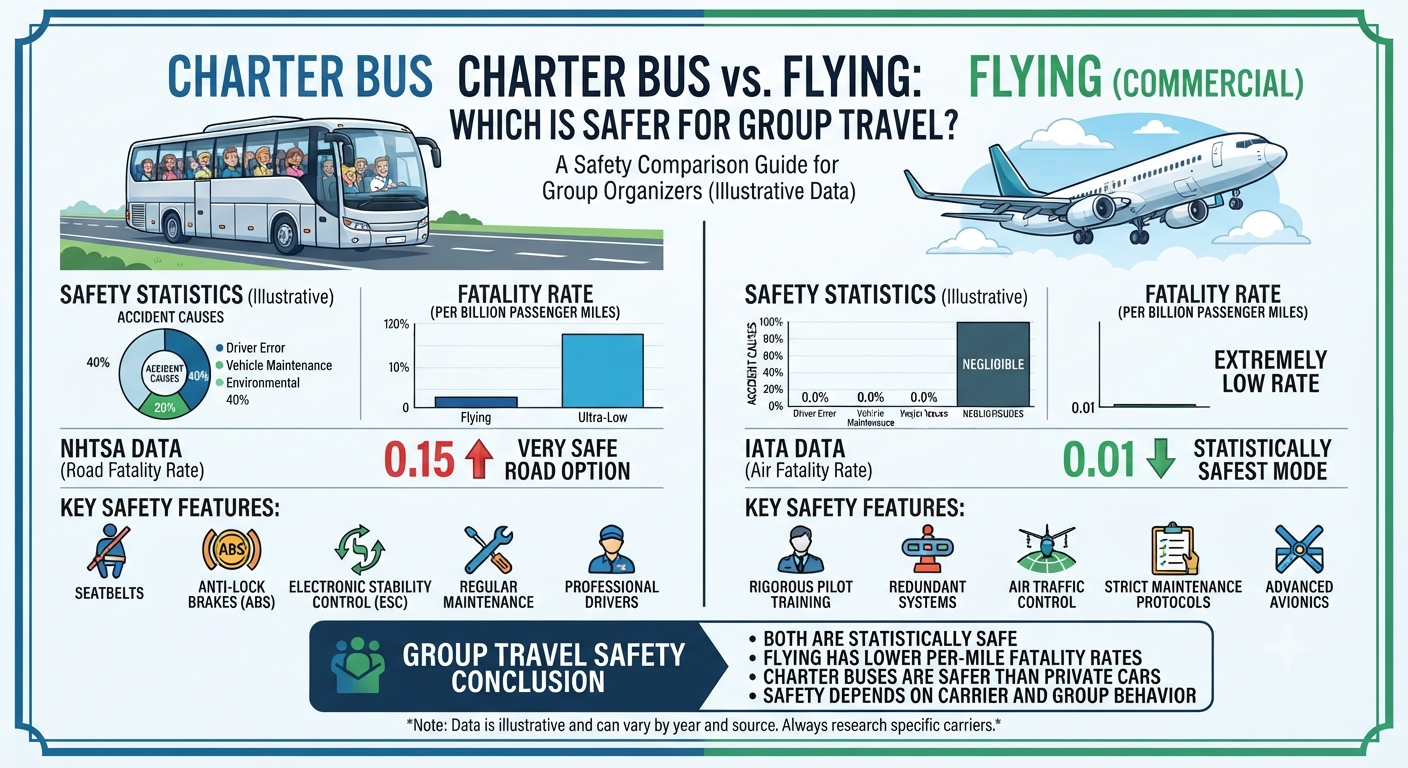
There is no simple answer that applies to every journey. Commercial aviation has an excellent safety record, particularly when safety is evaluated over passenger miles traveled. Charter buses are also a highly regulated form of passenger transportation, with professional drivers and federal safety requirements applying to interstate operations.
The most important factor is not simply choosing one mode over the other. Travelers should evaluate the complete journey and select a reputable, properly regulated transportation provider.
For long-distance travel where speed is critical, flying may be the practical choice. For groups traveling moderate distances, a charter bus can provide a safe, organized, and convenient way to keep everyone together.
Final Thoughts
Safety should always come before convenience when planning group transportation. Whether your group chooses an airplane or a charter bus, researching the provider and understanding the relevant safety requirements can help reduce unnecessary risks.
For charter bus trips, checking the operator's safety record, driver qualifications, insurance, and maintenance practices is an important part of responsible planning. FMCSA's guidance specifically encourages travelers to research bus companies before booking.
Ultimately, the best transportation choice depends on distance, schedule, group size, budget, and logistics. When these factors are evaluated together, organizers can choose the option that provides the right balance of safety and convenience for their travelers.
Comments
Log in or sign up to join the conversation.