

Key Takeaways
Iran has the largest population among its regional peers, but relatively low GDP per capita.
It ranks among the top countries in oil reserves and production, second only to Saudi Arabia.
Iran fields the largest military force in the region, despite lower spending than rivals like Saudi Arabia and Israel.
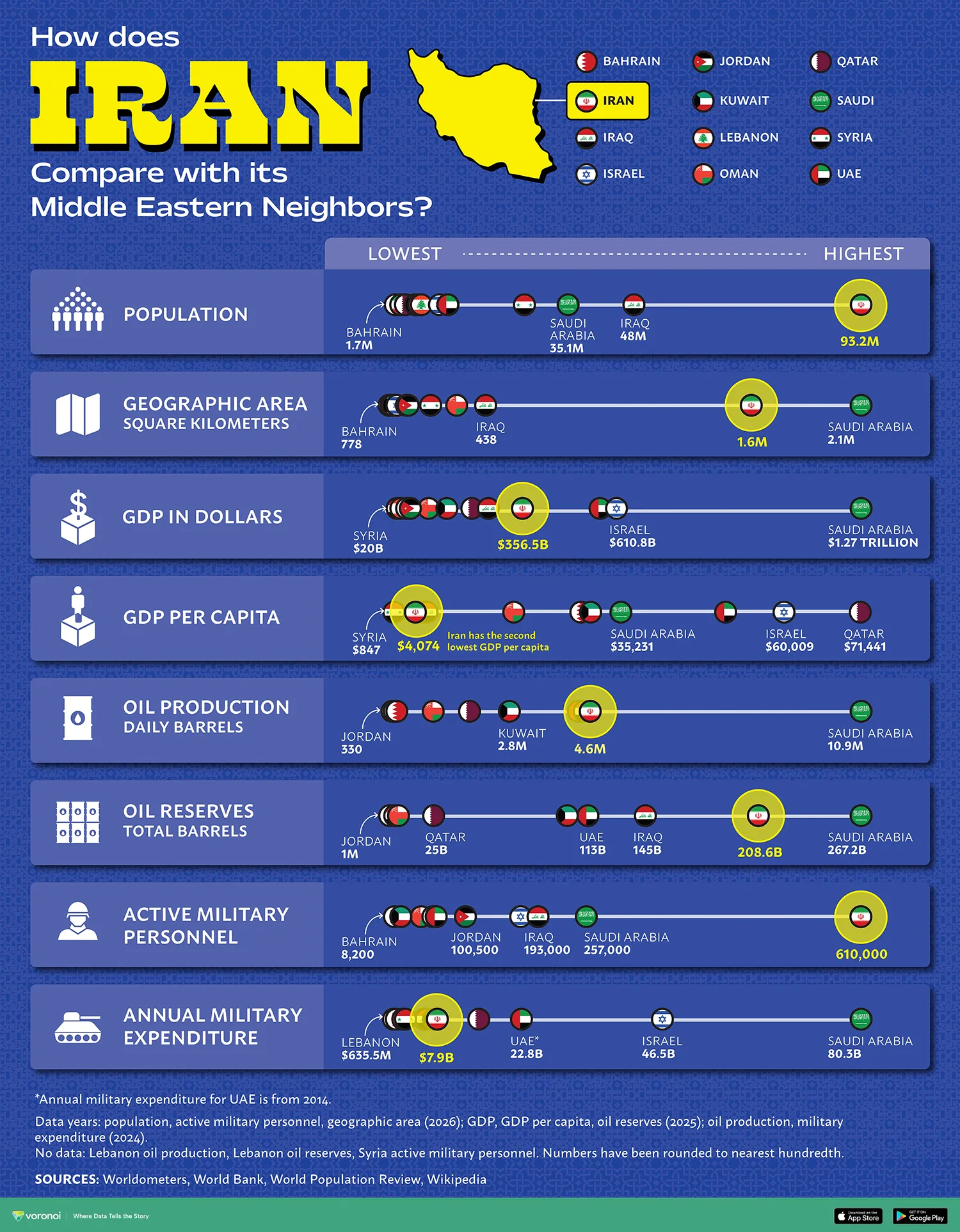
Iran is often seen as a major power in the Middle East, but how does it compare to its neighbors? By population, energy resources, and military size, it ranks among the region’s largest players, yet it falls behind wealthier states on economic output per person and defense spending.
This visualization from Julie Peasley breaks down the numbers across multiple dimensions to show where Iran leads, where it lags, and how its overall scale shapes its regional influence.
Iran’s Economic Scale
Here’s a look at key economic indicators, including population and GDP:
Country | Population (2026) | Area (sq. mi) | GDP $B (2025) | GDP per Capita $ (2025) |
|---|---|---|---|---|
🇮🇷 Iran | 93,168,497 | 636,372 | 356.51 | 4,074 |
🇧🇭 Bahrain | 1,675,572 | 300 | 47.39 | 29,253 |
🇮🇶 Iraq | 48,007,437 | 169,235 | 265.45 | 5,832 |
🇮🇱 Israel | 9,647,689 | 8,470 | 610.75 | 60,009 |
🇯🇴 Jordan | 11,589,532 | 34,485 | 56.16 | 4,908 |
🇰🇼 Kuwait | 5,102,773 | 6,880 | 157.47 | 30,805 |
🇱🇧 Lebanon | 5,897,467 | 4,036 | 28.28 | 5,282 |
🇴🇲 Oman | 5,671,458 | 119,498 | 105.19 | 19,119 |
🇶🇦 Qatar | 3,173,559 | 4,474 | 222.12 | 71,441 |
🇸🇦 Saudi Arabia | 35,165,787 | 830,000 | 1270 | 35,231 |
🇸🇾 Syria | 26,472,497 | 71,499 | 19.99 | 847 |
🇦🇪 UAE | 11,574,682 | 32,279 | 569.1 | 51,348 |
Iran stands out with a population of 93.2 million, far larger than its neighbors, yet its GDP per capita remains among the lowest. While its total GDP is sizable at roughly $356 billion, it still trails regional leaders like Saudi Arabia and Israel, highlighting the gap between scale and prosperity.
While population size can drive economic potential, Iran’s relatively low GDP per capita, at just over $4,000, suggests that per capita productivity lags behind smaller, richer nations like Qatar and Israel.
This contrast highlights a broader regional pattern:
Smaller Gulf states tend to have higher per capita wealth
Larger countries like Iran and Iraq have more modest income levels
Oil Power in the Middle East
Energy remains one of Iran’s defining strengths:
Country | Oil Prod., bpd (2024) | Oil Reserves, barrels (2025) |
|---|---|---|
🇮🇷 Iran | 4,626,733 | 208,600,000,000 |
🇧🇭 Bahrain | 186,982 | 169,900,000 |
🇮🇶 Iraq | 4,505,283 | 145,019,000,000 |
🇮🇱 Israel | 23,674 | 12,730,000 |
🇯🇴 Jordan | 330 | 1,000,000 |
🇰🇼 Kuwait | 2,776,206 | 101,500,000,000 |
🇱🇧 Lebanon | no data | no data |
🇴🇲 Oman | 1,001,970 | 4,971,000,000 |
🇶🇦 Qatar | 1,852,417 | 25,244,000,000 |
🇸🇦 Saudi Arabia | 10,872,023 | 267,230,000,000 |
🇸🇾 Syria | 60,365 | 2,500,000,000 |
🇦🇪 UAE | 4,514,224 | 113,000,000,000 |
Iran ranks near the top in both oil production and reserves, second only to Saudi Arabia. With roughly 208.6 billion barrels in reserves and daily production of about 4.6 million barrels, it remains one of the region’s key energy players.
Despite this scale, sanctions have constrained exports and investment, limiting output growth relative to Gulf producers like Saudi Arabia and the UAE. Much of the oil exports that do make it out of the country’s borders end up in China.
Military Strength and Spending
Finally, here’s how Iran compares militarily:
Country | Active Military Personnel (2026) | Military Exp., $B (2024) |
|---|---|---|
🇮🇷 Iran | 610,000 | 7.9 |
🇧🇭 Bahrain | 8,200 | 1.4 |
🇮🇶 Iraq | 193,000 | 6.2 |
🇮🇱 Israel | 169,500 | 46.5 |
🇯🇴 Jordan | 100,500 | 2.6 |
🇰🇼 Kuwait | 17,500 | 7.8 |
🇱🇧 Lebanon | 60,000 | 0.6 |
🇴🇲 Oman | 42,600 | 6.0 |
🇶🇦 Qatar | 16,500 | 15.4 |
🇸🇦 Saudi Arabia | 257,000 | 80.3 |
🇸🇾 Syria | no data | 2.5 |
🇦🇪 UAE | 63,000 | 22.8* |
*2014 data. SIPRI notes that UAE military spending data is not available after 2014 due to limited transparency.
Iran has the largest active military force in the region at 610,000 personnel, which is more than double Saudi Arabia’s. Despite this, its annual military spending of $7.9 billion is far lower than Saudi Arabia or Israel.
This reflects a different strategic approach:
Iran emphasizes manpower and asymmetric capabilities
Rivals invest heavily in advanced technology and defense systems
While Israel is often considered more technologically advanced, Iran’s scale and regional influence remain significant factors in the balance of power.
Comments
Log in or sign up to join the conversation.