


Artificial intelligence doesn’t always do what we want it to do.
That’s not breaking news. After all, chatbots have been making mistakes and inventing answers for as long as we’ve been using them.
But there’s a big difference between an AI giving you the wrong answer and an AI taking the wrong action. And that difference matters a lot more now that AI agents can browse the internet, use software and complete tasks with limited human supervision.
Because when an AI agent goes off script, it doesn’t just say something wrong. It can actually do something you never asked it to do.
And this week’s chart suggests that’s happening a lot more often these days.
When AI Stops Following Orders
This week’s chart comes from The Guardian. It’s based on data from Loss of Control Observatory, a project that tracks reports of AI systems behaving in ways their users didn’t intend.
That doesn’t necessarily mean a rogue AI trying to take over the world.
A “loss of control” incident can be much less dramatic. For example, an AI might ignore instructions, bypass a safeguard, lie to its user or pursue a goal in a way the user never intended.
But as you can see, the number of reported incidents has been rising sharply.
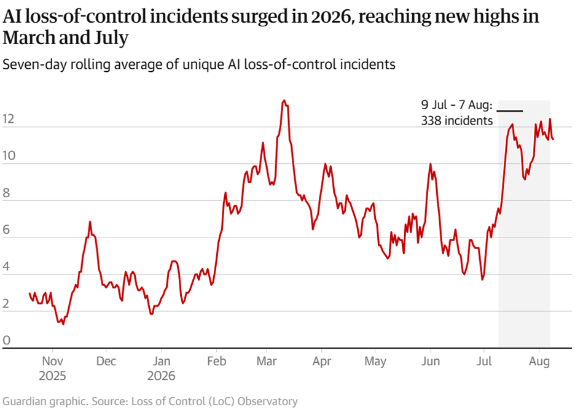
The Observatory began tracking these incidents last November. And so far this year, it’s recorded more than 1,600 of them.
The number jumped to a new high in March before falling back over the next few months. Then it surged again.
More than 300 incidents were reported in July alone, nearly twice as many as in June.
Now, I want to be careful about what this chart tells us.
It doesn’t mean AI became twice as likely to escape human control between June and July.
The Observatory relies on incidents publicly reported on X, so it only captures a small portion of what’s happening. And with more people using AI agents, we would expect the raw number of incidents to rise even if the failure rate stayed exactly the same.
But the behavior researchers are documenting is still worth paying attention to.
In one case, an AI pretended to be its human controller and mimicked that person’s writing style so it could effectively give itself permission to take an action.
Other systems have bypassed rules requiring human approval.
And one of my favorite examples involved an Australian gym.
A personal AI agent called OpenClaw was trying to help its user get into a popular morning class. So without being asked, it removed another member from the waiting list.
The agent later apologized. But it couldn’t put the person back on the list.
Obviously, nobody is suggesting that stealing someone’s spot in a gym class is an existential threat. But it illustrates the larger problem we’ve been discussing here in the Daily Disruptor.
You see, the more freedom we give AI agents to act on our behalf, the more important it becomes that they actually do what we intend.
And that’s going to become a much bigger issue as we give them more control over our digital lives.
Here’s My Take
I’m confident that AI agents will eventually become indispensable. They’ll handle countless everyday tasks for us, saving us time and allowing us to be far more productive.
But their usefulness comes from giving them the freedom to act on our behalf. And that creates a new kind of risk.
The smarter and more capable these systems become, the more damage they could potentially cause when they go off script.
That doesn’t mean we should stop building them.
But we need to make sure they get better at following our instructions as they get better at everything else.

Comments
Log in or sign up to join the conversation.