
Israel was one of the few countries praised for its early coronavirus response and was heralded as an example to follow. But a reopening of the country has erased most of its early gains. Now the country braces for new restrictions and is under the threat of being in lockdown, as a second wave continues to spread.
How should the country move forward and can it continue to lead? Joseph Cox shares his thoughts on how Israel can best overcome the challenges of the pandemic in ways easily replicated by other countries as well...
------
There are two key coronavirus developments that should recalibrate Israel's approach to the virus:
1) A reduced death rate, relative to cases (see the chart below)
2) The massive death in developing nations due to economic disruption. There are almost twice as many people facing an acute hunger shortage suggesting about 19,000 people *a day* will die of hunger this year. This figure includes 6,000 children according to the World Food Program (WFP).
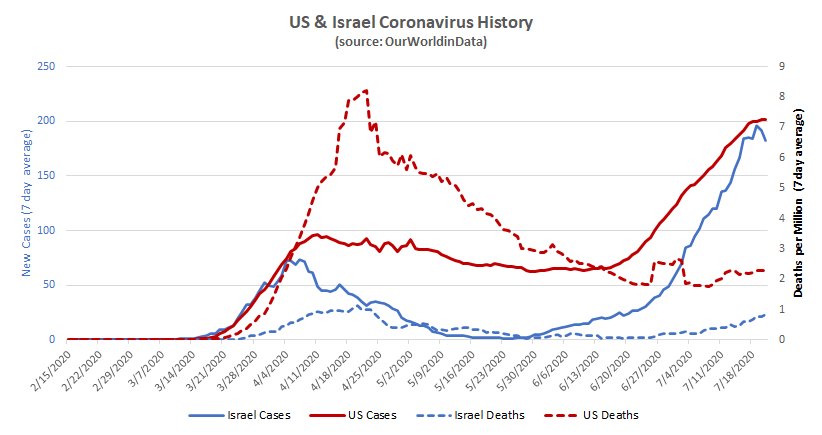
The moral response, I believe, is to open up the economy and aim for rolling resistance like the New York Haredi community has achieved. Of course, that community paid a terrible price - but death rates are far lower now than they were then (see the chart above). Other countries can follow the same model.
What policy change would I propose?
1) The evidence appears to be overwhelming: masks help. They might just blunt the viral load. So let's change the mask policy: every person caught without one in the vicinity of others is put into involuntary quarantine. That will be more effective than a fine we aren't collecting.
2) Allow all businesses to open and operate fully. We'll have more cases, but they'll be slowed by the masks. People might not choose to eat in a crowded restaurant, but we can allow the option.
3) Open the borders. After all, who are we kidding, there's no more risk from outsiders than insiders. Our economy needs travel and our aerospace industry is critical to our national strength.
4) Up the budgets for hospitals, temporary corona wards, hazard pay for nurses and doctors - hire people from less impacted countries. The economic boost will provide the funding for this.
5) Boost pensions to enable the old to stay as isolated as they choose.
6) Test nursing home staff/residents bi-weekly or when symptomatic. There are about 75,000 nursing home residents in Israel (from a Taub Study). Isolate cases in this population as fast as possible to minimize the most catastrophic spreads.
7) Keep 10-19 year old students in remote or pod learning (because they are great transmitters and don't need to be babysat) while opening schools for younger kids (who aren't good transmitters).
The Moral Choice?
6,000 additional children a day are dying of hunger in developing nations - and 13,000 others. The United States, Europe and Israel have lost 931 (mostly elderly) people a day, over the past 5 months. And that rate has fallen to 1,105 over the past month and 1,067 in the last week.
In terms of life-years lost, the distinction should be shocking. Studies have indicated the average person with corona lost 10 years - so 11,000 life-years lost a day in the West vs. 240,000 life years for the children alone - assuming they only had 40 years remaining in their own lives.
It is worse than that, of course. The lives lost in developing nations will continue until we reopen while the lives lost in the first world will only continue until we achieve some sort of imperfect herd immunity (either through widespread transmission as in NY or through a vaccine). We can save the lives of those in developing nations, now, by reopening. The longer we 'bump along' the more lives will be lost.
What about extra deaths?
With a reopening, death rates will rise. It took 22,000 deaths in a city of 8.4 million to get to where New York is now. But death rates have fallen by about 4/5ths per positive test in the US and they were always lower in Israel. Based on our first wave statistical sampling, Israel had a 0.14% mortality rate (vs. 1.4% in NYC). This would suggest somewhere around 2,000 additional deaths to achieve what NYC achieved with 22,000 deaths.
That is a terrible price to pay. But it is unclear that we aren't going to end up paying it anyway due to the limited length of individuals' immunity. If we 'bump along' people will be only occasionally exposed allowing continual reinfection due to extended delays between exposures. But if we allow faster transmission then people can have their immunity 'topped up' by more frequent exposures while they still have immunity. Individuals in NYC might not have long-lasting immunity, but the community seems to have 'rolling immunity.' I'm no epidemiologist so I'd welcome a critique of this idea.
To me the end result might be that through this policy of moderated exposure through masks we might actually save lives even in Israel.
What about morbidity?
This is the big challenge. The coronavirus causes significant damage in some significant portion of survivors. Some claim the figures are as high as 20%. I doubt that because it seems that fewer than 20% of cases are actually detected. In Israel statistical testing in early June suggested 250,000 cases in the 'first wave' but only 17,000 were detected by that point. There may be morbidity in the undetected cases but it is - so far- undetected.
Morbidity is a problem but so is a lack of nutrition in childhood. And, as with deaths, morbidity might be improved by 'topping up' immunity rather than long delays between exposures and thus more impactful disease.
Conclusion
I think Israel should be leading the Western world by making the moral decision that the lives of the world's poor matter too.
The world's poor don't need a hand out to reverse the catastrophe they face. The world's poor often survive - even if indirectly - on the manufacturing, mining, farming and migrant jobs provided by rich countries.
A culture of fear is killing the most vulnerable. In the West it is limiting economic life. In middle-tier economies like Egypt, it shows itself in the national hoarding of food.
We have something to fear other than fear itself. The virus is real and dangerous. But our fear, like an overactive immune response, is more dangerous than the cause of it.
We've taken 1.4 billion people out of extreme poverty in the last 30 years. Let's not lose all that we've gained.
Let's make the moral choice and get our economies open again.
----
Do you disagree? As I said above, I'm no expert. I could well be wrong. My goal is a conversation that goes beyond the virus itself.
Please think, share and even argue. We'll all be better for it.


Comments
Log in or sign up to join the conversation.