

Chandra Bhagavan, the gentle and radiant Moon God of Hindu tradition, is one of the nine Navagrahas who preside over the destinies of all living beings. Also known as Soma, he is envisioned riding a chariot drawn by ten pure white horses across the night sky, his cool silver light governing the mind, the emotions and the rhythm of the tides.
Unlike the fierce, fiery energy of the sun, Chandra's presence is calm, reflective and nurturing = qualities that have made him one of the most beloved of the nine planetary deities. For anyone drawn to the deeper layers of Hindu cosmology, or simply seeking a sense of mental peace and balance, Chandra Bhagavan's story offers a beautiful lesson in humility, forgiveness and renewal, and it is this very spirit that Idol Bronze seeks to capture in every handcrafted piece.
Who Is Chandra Bhagavan?
Position Among the Navagrahas
Chandra is counted among the Navagrahas, the nine celestial bodies that Hindu astrology holds responsible for shaping human destiny. While Surya, the Sun God, represents vitality, authority and the soul, Chandra represents the mind, emotions and the subconscious. Together, Surya and Chandra are often described as the two eyes of the cosmic being, one governing outer energy and the other inner feeling.
Parentage and Family
Puranic tradition offers more than one account of Chandra's birth. In one telling, he is the son of the sage Atri and his wife Anasuya, born of their deep penance and devotion. In another, older tradition tied to the churning of the cosmic ocean, Chandra is said to have risen from the waters during the Samudra Manthan, appearing alongside the goddess Lakshmi and the nectar of immortality — a lineage that places him among the most auspicious of celestial beings.
Marriage and the Nakshatras
Chandra was wed to all twenty-seven nakshatras, the lunar constellations, who were the daughters of the sage-king Daksha. Each night, tradition holds, Chandra visits one nakshatra in turn as the moon moves through the zodiac — a poetic explanation for the moon's steady passage through the sky.
Iconography and Symbolism of Chandra Bhagavan
Form and Attributes
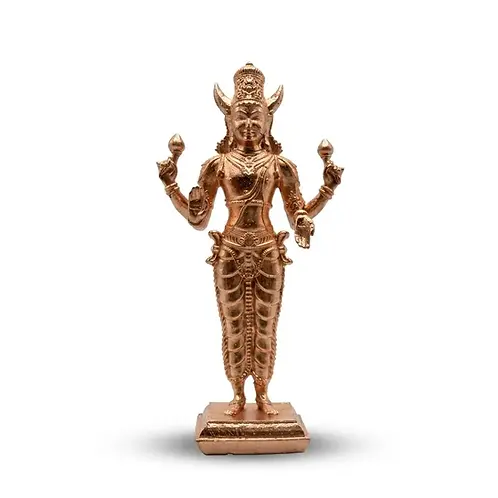
Chandra Bhagavan is typically depicted as a youthful, fair-complexioned deity with a serene expression, often holding a lotus and a mace or club, symbols of purity and quiet strength. His crown or crescent bears the shape of the waxing moon, and he is sometimes shown with two arms, sometimes with four, depending on regional and temple traditions.
The Chariot of Ten Horses
Chandra's chariot is drawn by ten pure white horses, a detail unique among the Navagraha deities. Some interpretations link the ten horses to the ten pranas, or vital life forces, that Chandra is said to govern within every living being, reinforcing his connection to breath, mind and inner vitality.
Colour, Gemstone and Day
Chandra is associated with the colour white or silver, reflecting his cool, luminous nature. The pearl is considered his gemstone, worn by devotees seeking emotional balance and mental clarity, and Monday is regarded as his sacred day for prayer and observance.
The Legend of Chandra's Waxing and Waning
A Marriage Favoured Unevenly
Though wed to all twenty-seven nakshatras, Chandra grew deeply devoted to one wife above all others — Rohini. He spent so much of his time in her company that his other wives felt neglected and unloved, their nights passing without his presence or attention.
Daksha's Anger and the Curse
Aggrieved on their behalf, Daksha, father of the nakshatras, warned Chandra repeatedly to treat all his wives with equal affection. When Chandra continued to favour Rohini, Daksha's patience broke, and in his fury he cursed Chandra to lose his brilliance entirely, condemning him to fade away into darkness.
Refuge at Shiva's Feet
As the curse took hold and Chandra's light began to vanish, he turned in desperation to Lord Shiva, performing intense penance and seeking his protection. Moved by Chandra's devotion, Shiva agreed to place the fading moon upon his own head, nestled within his matted locks, earning him the name Chandrashekhara — "he who wears the moon."
A Curse Softened, Not Lifted
Even Shiva's grace, however, could not undo Daksha's curse entirely; it could only be tempered. And so Chandra was destined to wax and wane forever, growing full over fifteen nights and fading into darkness over the next fifteen, a cycle that continues to this day. What might have been a story of ruin instead became the very explanation for the lunar phases — a reminder that even divine missteps can be transformed into something enduring and meaningful.
Chandra Bhagavan and the Kailasanathar Temple at Thingalur
Among the nine sacred Navagraha shrines of Tamil Nadu, the temple dedicated to Chandra Bhagavan stands at Thingalur, a small village in the fertile Cauvery delta near Thanjavur. Here, within the Kailasanathar Temple complex, Chandra is enshrined as the presiding planetary deity, drawing pilgrims who undertake the traditional Navagraha temple circuit to seek relief from astrological afflictions linked to the moon.
The temple's sanctum is built facing the moon's direction, and devotees offer white flowers, rice, milk and pearls in Chandra's honour, particularly on Mondays and during the full moon. Legend holds that it was at this very site that Chandra worshipped Shiva and found relief from Daksha's curse, making Thingalur a place closely tied to the deity's own story of redemption.
Spiritual Significance of Chandra Bhagavan
Ruler of the Mind and Emotions
In Vedic thought, Chandra is considered the presiding deity of the manas, or mind. A well-placed Chandra in one's astrological chart is said to bring emotional stability, intuition and inner peace, while an afflicted Chandra is linked to anxiety, restlessness and a wavering temperament.
Governance Over Tides and Nature
Beyond the inner world, Chandra's influence is seen in the rise and fall of ocean tides, in agricultural cycles tied to the lunar calendar, and in the timing of festivals across the Hindu year, most of which follow the phases of the moon.
Monday Worship and Remedies
Devotees seeking Chandra's blessings often observe fasts on Mondays, wear pearls, or offer white items such as rice, milk and jasmine flowers. These practices are believed to soothe emotional turbulence and restore a sense of calm and clarity to the mind.
A Deity of Second Chances
Perhaps the most enduring lesson of Chandra's story is one of forgiveness and renewal. Having faltered and faced the consequences, he was neither destroyed nor abandoned, but given a path back to light — a cycle that repeats every month as a quiet reminder that darkness is never permanent.
Why Is Chandra Bhagavan Different from Other Navagraha Forms?
Nature of influence: Where Surya governs vitality, authority and the outward self, Chandra governs the mind, emotions and the inward self.
Temperament: Surya's energy is fiery and commanding; Chandra's is cool, reflective and nurturing.
Visual character: Surya is depicted in radiant gold and red, riding seven horses that represent the colours of light; Chandra is silver-white, riding ten horses linked to the vital life forces.
Cycle of presence: Unlike most Navagrahas, whose iconographic form remains constant, Chandra alone is defined by continual change — waxing, waning and returning, night after night.
Nature of worship: Devotees turn to Surya for strength, confidence and success, while Chandra is invoked for peace of mind, emotional healing and relief from mental unrest.
Conclusion
Chandra Bhagavan's journey - from a marriage marked by favouritism, through a father's curse, to redemption at the feet of Lord Shiva - is far more than an ancient tale. It is a meditation on the mind's own restlessness, and on the quiet possibility of renewal that exists in every cycle of loss and light. As the keeper of the tides, the seasons and the inner self, Chandra Bhagavan continues to be worshipped by those seeking calm in a turbulent world, his crescent glow a lasting symbol of grace after struggle.
Comments
Log in or sign up to join the conversation.