

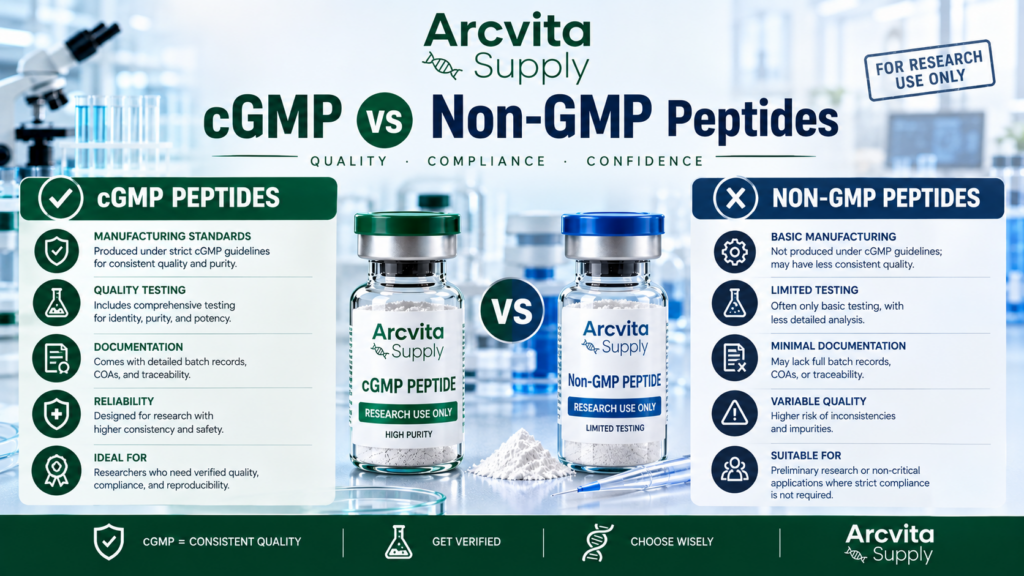
Understanding manufacturing standards is an important part of evaluating research peptides. Researchers, laboratories, and procurement teams often compare cGMP and non-GMP materials when reviewing quality documentation, supplier information, and laboratory requirements. But what do these terms actually mean, and how should they influence research material evaluation?
This guide explains cGMP vs Non-GMP Peptides, the role of quality systems, purity testing, Certificates of Analysis, storage, and legal considerations. The goal is to provide clear, factual information that supports responsible laboratory research.
What Are cGMP Peptides?
cGMP stands for Current Good Manufacturing Practice. In the United States, the FDA uses cGMP regulations to establish minimum requirements for covered drug manufacturing operations, including methods, facilities, and controls.
According to the FDA, cGMP helps ensure that drug products meet applicable requirements for identity, strength, quality, and purity. These systems include manufacturing controls, quality management, appropriate testing, and reliable documentation.
When discussing cGMP research chemicals, it is important to understand that the term describes a manufacturing quality framework. It does not automatically mean that every material described as cGMP is suitable for every research application.
For peptide research, relevant quality considerations may include:
Manufacturing process controls.
Raw material management.
Equipment suitability and maintenance.
Quality control procedures.
Batch records and traceability.
Analytical testing.
Storage and packaging controls.
The exact requirements depend on the material, its intended use, and the applicable regulatory framework.
What Are Non-GMP Peptides?
Non-GMP peptides generally refer to materials manufactured outside a full GMP framework applicable to the relevant product or manufacturing operation. These materials may be produced for laboratory research, analytical work, development, or other purposes.
The term “non-GMP” alone does not establish whether a peptide is pure, impure, correctly identified, or suitable for a particular experiment. It is a description of the manufacturing framework, not a complete quality assessment.
Similarly, non-GMP does not automatically mean that a material is poor quality. Researchers should review actual documentation and testing evidence rather than relying only on a product label.
Important evaluation factors can include:
Peptide identity.
Reported purity.
Impurity information.
Batch-specific testing.
Manufacturing documentation.
Storage conditions.
Intended research application.
The distinction between cGMP and non-GMP should therefore be understood in context.
cGMP vs Non-GMP Peptides: Key Differences
The primary difference concerns the manufacturing quality system and the requirements applicable to the product.
1. Manufacturing standards
cGMP manufacturing involves documented systems and controls intended to support consistent product quality within the applicable regulatory framework.
Non-GMP manufacturing does not operate under the same complete GMP framework for the relevant material or process. However, individual manufacturers may still use quality procedures and analytical testing.
2. Quality documentation
cGMP operations generally involve extensive quality documentation appropriate to their regulatory requirements. This may include controlled procedures, batch records, deviation investigations, and quality oversight.
Non-GMP materials may also have documentation, but the type, extent, and reliability of records can vary between suppliers.
3. Testing and verification
Both types of material may be evaluated through analytical testing. However, the existence of a test result does not by itself demonstrate that a material was manufactured under cGMP.
Researchers should consider the analytical method, sample identification, testing date, and whether the results relate to the specific batch.
4. Intended use
A material manufactured under a particular quality system may still be unsuitable for a specific research application. The intended use, material specifications, and applicable requirements must be considered together.
Why Purity Testing Matters
Research peptide quality testing is an important part of material evaluation. Peptides are often assessed using analytical methods that help identify the substance and characterize its composition.
Common methods may include:
High-performance liquid chromatography (HPLC): Used to separate components and assess chromatographic purity.
Mass spectrometry: Used to help confirm molecular mass and support identity assessment.
Additional analytical methods: Depending on the peptide and research requirements, other methods may be relevant, such as water content, residual solvents, or impurity testing.
A reported purity percentage should not be interpreted as a complete quality guarantee. For example, a purity result may not establish sterility, endotoxin status, stability, or suitability for a specific experiment.
Researchers should review the actual analytical report and understand its limitations.
How to Review a Peptide Certificate of Analysis
A Certificate of Analysis, commonly called a CoA, provides information about a tested batch. A useful document should be reviewed carefully rather than accepted solely because it carries a laboratory name or logo.
When evaluating a peptide CoA, consider the following:
Batch identification
The batch or lot number should clearly connect the document to the material being evaluated.
Product identity
The report should identify the tested peptide and provide relevant information supporting its identity.
Analytical results
Review reported purity, testing methods, specifications, and results. Understand what each test demonstrates and what it does not establish.
Testing laboratory
Consider whether the laboratory and testing process are clearly identified and whether the documentation is sufficiently detailed for the research requirement.
Dates and traceability
Testing dates, report identifiers, and batch information can help support documentation review.
A CoA is useful evidence, but it should not be treated as proof of every quality attribute.
Storage and Handling Considerations
Peptide storage guidelines are important because storage conditions can influence material quality over time.
Researchers should follow the supplier’s documented storage requirements and any validated instructions relevant to the material. Depending on the peptide, important considerations may include:
Temperature control.
Protection from moisture.
Protection from excessive light.
Packaging integrity.
Proper labeling.
Batch traceability.
Avoiding unnecessary exposure to unsuitable conditions.
Lyophilized materials and prepared solutions may have different storage requirements. Researchers should not assume that every peptide has the same stability profile.
Storage guidance should be based on the specific material and documented evidence rather than general assumptions.
USA-Made Research Peptides: Does Location Determine Quality?
USA-made research peptides are sometimes discussed as a separate quality category. However, manufacturing location alone does not establish product quality.
A peptide manufactured in the United States may have different quality systems, testing procedures, and documentation from another material manufactured elsewhere. The same principle applies internationally.
When evaluating a supplier, researchers should focus on documented manufacturing practices, analytical evidence, traceability, and compliance with applicable requirements.
Geographic origin can be relevant to procurement and regulatory review, but it should not replace quality assessment.
Legal and Responsible Research Considerations
Peptides may be subject to different legal and regulatory requirements depending on their composition, intended use, jurisdiction, and how they are marketed.
A research-use-only label does not automatically authorize every activity involving a material. Researchers should confirm applicable laws, institutional policies, import requirements, and laboratory safety procedures.
It is also important to distinguish between materials intended for laboratory research and products approved for human or veterinary use. Manufacturing claims should not be interpreted as approval for medical treatment.
For laboratories, responsible research practices include:
Using materials only for lawful and appropriate research.
Maintaining accurate records.
Following laboratory safety procedures.
Reviewing supplier documentation.
Confirming applicable regulatory requirements.
Avoiding unsupported claims about human use or therapeutic effects.
These considerations help support transparent and compliant research activities.
How Researchers Can Evaluate Peptide Suppliers
When comparing suppliers, researchers can use a structured documentation checklist.
Review the product information: Confirm the peptide name, quantity, and intended research use.
Check batch documentation: Look for a matching lot number and relevant testing records.
Evaluate analytical methods: Understand what tests were performed and how results were reported.
Review manufacturing information: Ask about the applicable quality framework and documentation.
Confirm storage guidance: Ensure the material has clear handling and storage instructions.
Check legal requirements: Confirm that the intended research activity is permitted under applicable rules.
No single label or marketing claim can replace a complete review.
Frequently Asked Questions
Is cGMP always better than non-GMP?
cGMP describes a manufacturing quality framework. Whether a material is appropriate depends on its intended use, applicable requirements, documentation, and quality characteristics. A label alone does not establish suitability.
Does non-GMP mean a peptide is impure?
No. Non-GMP means the material is not manufactured under the relevant full GMP framework. It does not, by itself, establish a specific purity level.
What is the difference between purity and quality?
Purity describes the proportion of the intended substance measured by a particular analytical method. Quality is broader and may include identity, impurities, manufacturing controls, storage, traceability, and suitability for the intended use.
Can a CoA prove that a peptide is cGMP?
A CoA may provide analytical information about a batch. It does not, by itself, establish that the entire manufacturing operation complies with applicable cGMP requirements.
Conclusion
Understanding cGMP vs Non-GMP Peptides helps researchers evaluate manufacturing systems, quality documentation, analytical testing, and material suitability more carefully. cGMP refers to a defined quality framework, while non-GMP describes materials outside that framework for the relevant operation.
For responsible laboratory research, researchers should review batch-specific testing, identity, purity information, storage requirements, traceability, and applicable legal standards. A clear understanding of these factors supports informed research material evaluation and better documentation practices.
Arcvita Supply encourages researchers to approach peptide quality assessment through accurate information, transparent documentation, and responsible laboratory research practices.
Comments
Log in or sign up to join the conversation.