


Image Source: Pixabay
If you’ve invested in U.S. stocks as a Canadian, you’ve probably bumped into CDRs (Canadian Depositary Receipts). They’ve been marketed as a simple way to buy big-name U.S. companies in Canadian dollars, without currency conversion, and with built-in currency hedging.
And yes—CDRs can be convenient. But convenience always comes with a price tag. The real question isn’t, “Are CDRs good or bad?” Instead, the question is: When do CDRs make sense—and when are you paying for something you don’t need?
Below are some practical guidelines to help you invest in CDRs intelligently -- without giving away everything from our complete guide.
First: What You’re Actually Buying
A CDR is a “wrapped” version of a U.S. (or sometimes international) stock that trades on a Canadian exchange in Canadian dollars. The provider (CIBC is the Depositary behind the CDR program) holds the underlying shares and issues CDR units to investors. Here’s the important part:
- You’re not getting a discount because the CDR trades at a lower price.
- You’re buying a fractional interest in the underlying stock.
It’s the same pizza—just sliced differently. Whether you buy one big share or twenty smaller slices, your return is driven by the same underlying business performance.
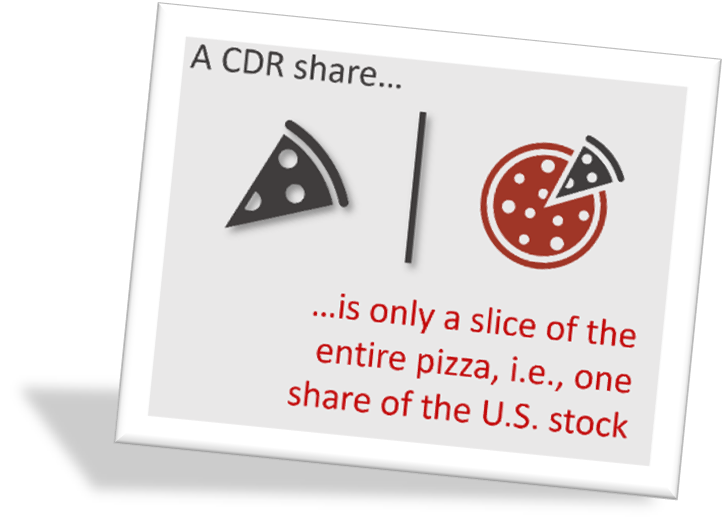
After all, a CDR is only a slice of the entire pizza.
Guideline #1: Know What the Currency Hedge Really Does (and Doesn’t)
The headline promise is simple: no currency conversion, no currency swings. CDRs are designed to reduce the impact of USD/CAD movements on your investment. That can be helpful if your main goal is stability in Canadian dollar terms. But hedging is a double-edged sword:
- If the Canadian dollar weakens, hedging can protect you.
- If the U.S. dollar strengthens, hedging can limit your gains versus owning the U.S. stock directly.
So before you buy a CDR “because currency is scary,” ask yourself the following:
- Am I investing for one year, or decades?
- Do I really need hedging, or do I just need a better process for handling the U.S. dollar?
Guideline #2: Treat the Fee like a Permanent Headwind
The part that bugs me the most: CDRs come with an embedded hedging cost. It’s not called a “management fee,” but the hedge includes a spread averaging ~0.60% per year for U.S. CDRs and ~0.80% for Global CDRs. That’s small in a single year. Over 10-20 years? It’s a meaningful drag.
A simple way to frame it: If you can buy the underlying stock with no annual fee, why volunteer to pay one—unless you’re getting something truly valuable in return?
Guideline #3: Use Limit Orders (Liquidity Matters)
CDRs are usually based on highly liquid underlying stocks—but the CDR itself often trades with less volume than the U.S. listing. That can mean a wider bid-ask spread, especially during volatile markets or outside peak trading hours.
If you use CDRs:
- Use limit orders (especially for larger buys/sells).
- Be cautious around thinly traded names.
- If you’re building a position over time, smaller increments can reduce spread impact.
Guideline #4: Dividends are “The Same,” but Don’t Misunderstand the Math
Yes—CDR holders receive dividends (paid in Canadian dollars). The key is to think in yield, not “dividend per share.”
Because you’re holding a fractional interest, you receive the equivalent dividend amount based on your investment size. The dividend mechanics are not magic—it’s still the same company paying the same dividend. Also worth noting:
- Withholding tax rules generally apply the same way as holding the U.S. stock (account type matters—RRSP vs. TFSA vs. taxable).
- Make sure the proper W-8BEN documentation is on file with your broker when applicable.
Guideline #5: If You’re Buying CDRs Because the Stock is “Too Expensive,” It's Time to Pause
This is where CDR marketing really works: “Costco is almost $1,000—buy the CDR for ~$40.” It feels easier. But it doesn’t solve the real problem, which is usually limited capital and a lack of diversification early on.
If you’re starting with $100/month, a better plan is often:
- Start with one or two broad-market ETFs for instant diversification.
- Build the habit of systematic investing (that’s the real superpower early on).
- As your portfolio grows, start adding individual stocks in U.S. dollars when it actually makes sense.
Guideline #6: If Your Only Reason is “I Don’t Want to Convert to U.S. Dollars,” Learn the Easy Workaround
Currency conversion fees from banks and brokers are real, but there’s also a well-known solution: Norbert’s Gambit. It’s not complicated, and it can save you meaningful money over time—especially as your account grows. If you’re willing to learn one process, you may not need to pay an ongoing hedge spread forever.
My Bottom Line
CDRs are not a trap. They’re not “bad.” For some investors, they’re a rather convenient tool. But they’re also not revolutionary.
If you’re paying an annual hedging cost, accepting wider spreads, and still ending up with a limited selection of stocks, you'll want to be sure you’re getting enough value for that convenience.
More By This Author:
When AI Stops Being “Tech” And Starts Being The Economy - Investment Themes For 20264 Tech Stocks Immune To The AI Bubble
How To Invest In 2026, Part 2



Comments
Log in or sign up to join the conversation.